Billionaire Called the Waitress “Too Dumb to Serve” — Then She Answered Him in 9 Languages

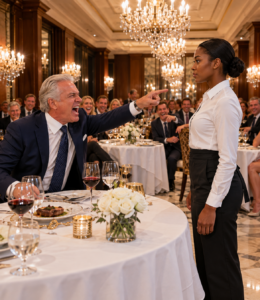
You’re too dumb to serve my table. Get this black girl out of here. >> Sir, I was assigned to >> Is your brain full of holes? >> Roland Prescott shouted in frustration. >> I said no dirty, stupid black people at my dinner. >> I can take your order whenever you’re ready, sir.
>> Get the hell out. International guests all around. What would you even understand? >> He snatched the menu and smashed it across her face. >> Out of my sight, dumb. >> It fell to the floor. Denise didn’t flinch. She’d heard worse. >> “A bunch of morons who think they’re so smart, but don’t know a damn thing.”
>> He kicked the menu pages toward her. A guest laughed. Nobody stopped him. Denise straightened up, calm. Roland Prescott had no idea that before long he would be begging this young woman for the sake of her talent. Have you ever watched someone prove their worth in nine different languages? because you
were about to drop a comment and hit like. And let me take you back to where it all started. Limme Manhattan served guests from 46 countries a year. Its staff spoke exactly one language. Tuesday night was a disaster. A German couple sent back their steak three times. The waiter kept nodding and
bringing the same cut, same temperature, same confusion. A Brazilian family left without ordering. The host stood at the podium smiling helplessly while their reservation walked out the door. Tips vanished. One-star reviews piled up like unpaid bills. Colton Mercer stood by the
bar, arms crossed. If they can’t speak English, seat them in the back. I’m not wasting floor staff on people who can’t read a menu. Nobody argued. Nobody ever did. Denise watched from section four, table six, a Japanese couple. The woman held the menu upside down.
Her husband pointed at random items, hoping something would land. Two waiters walked past them without slowing down. Jerome Caldwell caught Denise looking. He shook his head. Low voice. Don’t get involved. Colton’s watching. Denise picked up a stack of napkins, walked toward table six, pretended to
straighten the linens. She leaned close to the woman and whispered four words in Japanese. The woman’s chopsticks froze midair. She looked up at Denise like she’d heard a ghost speak her mother’s language.
Her husband set down his glass. His shoulders dropped for the first time all evening. Denise smiled, pulled back, kept walking. Nobody noticed. Nobody ever did.
Thursday afternoon, Roland Prescott arrived for a pre-dinner meeting. He stood in the center of the dining room like he owned every wall in it. He didn’t, but the staff treated him like he did. Saturday night, he announced eight delegations.
Germany, France, Saudi Arabia, China, Russia, Brazil, Italy, Japan, a $500 million joint venture. My name is on every page of that contract. He straightened his cuffs. I need this restaurant perfect. No mistakes, no embarrassments, no excuses. Then he
pointed at Denise without looking at her and keep her away from the main room. She barely speaks English. Denise stood still, Trey balanced on her palm. 3 years of this had taught her exactly how to disappear in plain sight. After Roland left, Jerome found her by the service elevator, leaned against the
wall, quiet. He doesn’t know you at all, does he? Denise untied her apron, retied it, tighter. Nobody here does. Friday evening, the Japanese couple came back. Mr. and Mrs. Tanaka walked through the front door at 7:15. Same table 6, same
confused look. But this time, Mrs. Tanaka’s face was different. She scanned the room. She wasn’t looking for a waiter. She was looking for someone specific. Denise saw them from the service station. Her stomach tightened. She glanced at the floor chart. Table six wasn’t hers tonight. Colton had
reassigned her to the back section after Roland’s order tables 12 through 18 near the kitchen door where the air smelled like grease and dish soap and the tips barely covered Subway Fair. She kept her head down, refilled water pitchers, folded napkins, kept working, but Mrs. Tanaka found her
anyway. She walked across the dining room, past three waiters, past the hostess stand, and stopped right in front of Denise. She said something in Japanese, fast, urgent. Her hands were shaking. Denise understood every word.
Mrs. Tanaka wasn’t looking for directions this time. She was lost, not in the restaurant, but in the city. Their hotel had moved their reservation to a different location. They had no place to sleep tonight. Their phone was dead.
They didn’t know a single person in all of Manhattan who spoke their language, and the front desk had smiled at them and shrugged twice. Denise looked around. Colton was at the bar checking receipts. Jerome was watching from across the room, his eyes saying the same thing as Tuesday. Don’t. She pulled
a pen from her apron, grabbed a napkin, and in clean, careful Japanese characters, she wrote the hotel’s new address, the nearest subway station, and a sentence at the bottom. Show this to any taxi driver. He will take you there.
Mr. Tanaka read it. His hands trembled. He bowed deep. The kind of bow you give someone who just saved your night. Mrs. Tanaka grabbed Denise’s hand, held it with both of hers, whispered. Anata Wateni Desu, “You are an angel.” Denise
pulled her hand back gently, smiled, walked away. Her chest burned, not from sadness, from holding something in for so long that even kindness felt like breaking a rule. A French Somalia had been watching from the wine al cove. He stepped into Denise’s path, held up a
bottle of Burgundy. The guest at table 9 wants to know if this is a Premier Crew or a Grand Crew. I told him Premiere, but he insists the label says otherwise. I don’t read the older vintage as well. Denise glanced at the bottle, answered in French, not textbook, not careful.
fluid. She corrected the vintage year, explained the difference between the two Appalachians, and added a regional idiom about Burgundy wine makers that only someone who’d studied the culture would know. The Somalier blinked twice. “Where did you learn that?” he asked. Denise didn’t answer. She picked up her tray
and kept moving. Jerome was waiting for her at the end of the hallway, arms folded. He blocked her path. Not angry, stunned. How many? How many what languages? Denise looked at him for a long time.
She could lie. She’d been lying for three years, smiling and nodding and pretending she didn’t understand when guests spoke German at the bar or when the Italian sue chef cursed in Neapolitan. Or when the Russian wine distributor made jokes about the staff that nobody else caught. Nine. She said, “Maybe 10 if you count the Haitian
creole my grandmother mixed with her French.” Jerome didn’t move. Your grandmother, Lorraine Shelton, she interpreted for the United Nations for 31 years, translated ceasefire documents, once talked a hostage negotiator through a 6-hour standoff in Arabic and Farsy at the same time.
Denise paused. She raised me on verbs instead of lullabibis. Jerome looked at her like he was seeing her for the first time, and maybe he was. Three years of working side by side, and he’d never once heard her speak anything but English. Not because she couldn’t, because no one had ever
made it safe enough to try. “And you’re here,” he said slowly, pouring wine for a man who calls you dumb. Denise reached behind her, retied the apron, that familiar knot. “I’m here because rent is due on the 15th, Jerome.” She walked
back to the floor, pushed through the swinging door, the notebook pressed against her hip through the apron pocket, heavy with her grandmother’s handwriting, heavy with everything she’d never been allowed to say out loud. Garrett Aldridge stood in the shadow of the private dining entrance. He hadn’t said a word all night, but he’d seen
every second of the last 10 minutes. The Japanese, the French, the Somalier’s face. The way Denise switched between languages like someone turning pages in a book she’d memorized long ago. He pulled out his phone, opened his notes app, typed one line, black waitress,
Japanese, French, Spanish, 10 minutes. Then he put the phone away and said nothing to anyone. Denise’s apartment was a studio in Washington Heights. One room, a twin bed pushed against the wall, a hot plate on the counter, and books stacked floor to
ceiling, spine to spine in six different languages. The place smelled like old paper and instant coffee. Rent was 1,400 a month. She was always exactly 3 days late. On the nightstand, next to a glass of water and a phone with a cracked screen, sat the notebook. Cracked brown leather, pages soft from decades of
turning. Every line filled with Lorraine Shelton’s handwriting, vocabulary lists in 14 languages, grammar rules in blue ink, tiny drawings of flags in the margins. Lorraine had been a force for 31 years. She interpreted for the United
Nations. She translated ceasefire agreements in rooms where the wrong word could start a war. She once guided a hostage negotiator through a 6-hour standoff, switching between Arabic and Farsy in real time.
Her voice the only thing keeping a man alive on the other end of a phone line. Heads of state knew her name. Ambassadors requested her by voice. She retired with no pension, no ceremony, no plaque on a wall. No one from the UN sent flowers. She died in a walkup
apartment in Harlem with a teapot on the stove and the notebook opened to a page of Portuguese conjugations. The obituary was four lines in a neighborhood paper no one read. Denise was 19. She kept the notebook, added her own pages, Russian vocabulary, Mandarin
tones, notes on formal Arabic greetings. She studied on the A train, practiced with cab drivers, bodega owners, the grandmother at the laundromat who only spoke Cantonese, and always smiled when Denise tried a new phrase. Lorraine used to say one thing more than anything else. She’d stand at the kitchen stove
stirring rice and beans, drilling 8-year-old Denise on Portuguese verb conjugations, and she’d say, “Words are bridges, baby. They can’t burn a bridge you built inside your head.” Denise had applied to 14 interpreter positions in 3 years. No degree, no certification,
résumés returned or ignored. Lame was supposed to be temporary, a six-month gig to cover rent while she figured things out. That was 3 years ago. Saturday morning, Philip Eckhart called in. I quit, he told Colton over the phone. I’m not spending another evening
being screamed at by that man. Find someone else. Colton stood in the empty dining room, phone pressed to his ear, face white. The German delegation was arriving in 3 hours. Ambassador Brower spoke limited English. His assistant spoke none. He called Roland. Roland’s voice came through the speaker like a
blade. Find me a German translator in 3 hours in Manhattan. Now, I don’t care how. Colton called three translation agencies, top tier, Manhattan-based. The requirement, someone fluent in German, available immediately, professional enough for a
high-level diplomatic dinner. All three said the same thing. Not possible, not on a Saturday afternoon, not in 3 hours, not for any price. Jerome found him at the bar 20 minutes later. Watched him spiral before speaking. Denise speaks
German. Colton looked up. The waitress. The waitress. Stop. Jerome didn’t stop. I heard her last night. Fluent, not tourist German. The real thing. Colton shook his head. She’s a buser now. Prescott demoted her yesterday. I’m not putting her in front
of an ambassador. Jerome leaned on the bar. Then don’t. But when Brower walks in and nobody can say good evening in his language, that’s on you. Colton said nothing. Jerome walked away. 2:55 p.m.
Ambassador Brower arrived early, gray suit, silver pin on his lapel. His assistant, Ela, spoke only German and carried a look of quiet impatience. The welcome cocktail was chaos. No one could explain the menu. No one could communicate the seating arrangement. No
one could tell Ela where the restroom was. She asked three staff members. All three smiled and pointed in different directions. Brower stood by the bar holding a glass of water he hadn’t touched. His patience was thinning. Colton hovered nearby, sweating through his shirt. Denise was
clearing glasses at the far end of the room. She wasn’t supposed to be on the floor, but two servers had called in sick and Colton needed bodies, so she was here, invisible, useful, and silent. She heard Elkie ask a fourth person for directions. The woman was nearly in tears. Denise sat down the tray, walked
over, calm. Guten Darf itch Enan Helen. Good evening. May I help you? Elkie froze, then exhaled like someone had just opened a window in a room with no air. Brower turned. His face shifted surprise first, then curiosity, then
something closer to respect. He asked Denise a question in German. She answered, he asked another, she answered that, too. A 5-minute conversation followed entirely in German. Denise explained the evening’s menu, the wine pairings, the seating protocol. Brower laughed twice. Ela took notes. When it
was over, Brower turned to Colton. His voice was polite but sharp. This young woman speaks better German than my last three translators. Why is she carrying plates? Colton opened his mouth, closed it, opened it again. She’s She’s a waitress, sir. Brower looked at
him the way a professor looks at a student who just failed an open book exam. Then you’re wasting her. Roland arrived 10 minutes later. He saw Brower chatting warmly with Denise near the window, laughing.
Denise’s hands moving as she described something. A vineyard maybe, or a childhood memory. Something real. Roland’s jaw tightened. His fingers curled around the stem of his wine glass, but he said nothing. He needed Brower happy. He needed this deal. So he
swallowed it, straightened his tie, and watched the woman he’d called too dumb to serve make his most important guest laugh. Saturday afternoon, the cocktail hour ended. Brower’s delegation moved to the private dining room for the pre-dinner briefing. Denise went back to clearing
glasses. Colton found her in the service hallway. He didn’t look grateful. He looked annoyed. Starting tomorrow, you’re off the floor entirely. Kitchen duty only. Mr. Prescott’s orders. Denise sat down her tray. I’ve been on the floor for 3 years. I haven’t done anything wrong. You haven’t done
anything right either. That’s the point. She knew the real reason. It wasn’t performance. It wasn’t complaints. It was the color of her skin standing too close to a man who believed people like her belonged behind a door, not in front of one. But saying it wouldn’t change
anything. It never did. She nodded, picked up the tray, walked away. Roland was waiting in the hallway outside the manager’s office. He didn’t look at Denise as she passed, but he spoke loud enough for her to hear quiet enough to deny it later.
I don’t care if she speaks 50 languages. She doesn’t belong in my dining room. My grandfather built hotels across this country, and not once, not once did he put a black face at the front desk. There’s a reason for that. Denise kept walking. Her shoes didn’t slow. Her breathing didn’t change, but her hands
her hands pressed into the tray so hard the metal edge left a white line across her palms. Jerome was outside by the dumpster smoking a cigarette he’d bummed from the sue chef. He saw her pushed through the back door. Saw her face. What happened?
Kitchen duty starting tomorrow. Jerome dropped the cigarette, grounded under his heel. You saved that woman’s life last Friday. Three languages in 10 minutes. I counted. And you’re mopping floors tomorrow.
I can’t afford to lose this job, Jerome. You can’t afford to keep it either. The words hung in the alley like smoke. Denise leaned against the brick wall, closed her eyes. She could hear the kitchen exhaust fan humming above her.
Could smell the grease and the rain on concrete. Jerome had been at Lameison for 15 years. He’d watched every black employee come and go. Promoted never tolerated sometimes. Invisible always.
He’d chosen silence to survive. And he hated himself for it every single day. He looked at Denise, wanted to say something that mattered, something that would fix it. But there was nothing to say. The system wasn’t broken. It was working exactly the way it was built to
work. Go home, he said quietly. Get some rest. Tomorrow’s going to be a long day. Denise walked to the subway. The A train was late. She stood on the platform shoulderto-shoulder with strangers and opened her phone. One new email. She tapped it open. An interpreter position
at a small agency in Queens. She’d applied three weeks ago. wrote a cover letter in four languages, attached samples of her translation work. The email was one line. We regret to inform you that without a certified degree in linguistics or translation
studies, we are unable to move forward with your application. Application number 15. Same answer, same wall. She closed the phone, slipped it into her pocket. The train arrived. She stepped on, found a seat by the window.
The notebook sat in her apron pocket. She didn’t open it. Didn’t need to. She could feel it there. The weight of 14 languages. The weight of Lorraine’s handwriting. The weight of everything she carried that no one in that restaurant would ever see. She rode home in silence. Sunday 4:00 in the
afternoon. Lameison was being transformed. White tablecloths replace the usual linen. Eight national flags stood in brass holders down the center of the long table. Candles, crystal, place cards in calligraphy.
The $500 million joint venture dinner was 6 hours of planning compressed into three. Colton moved through the room like a man diffusing a bomb. Every fork angle mattered. Every napkin fold had to be exact. Roland had made it clear this dinner would define the next decade of
Prescott International. At 5:15, Colton’s phone rang. Philip Echart, the translator, the one who quit yesterday, but Roland had called him back, tripled his fee, promised a car service and a suite at the Prescott Grand. Philip had agreed.
He was on his way. Was. There’s been an accident, Philip said. His voice was thin. FDR drive. I’m in an ambulance. Broken collarbone. I can’t come. I’m sorry. The line went dead. Colton stood in the middle of the dining room, phone
at his side, staring at nothing. He called Roland. Roland’s response was immediate and violent. Get me another translator now. Someone who speaks German, French, Arabic, Mandarin, Russian, and Portuguese in 90 minutes. Go. Colton called three
agencies, the best in Manhattan. Same answer from all three. Not possible. Not on a Sunday evening. Not with six languages. Not in 90 minutes. One agency laughed before hanging up. He tried five freelancers. Two didn’t answer. One
covered German and French, but no Arabic. Two were already booked. He left voicemails that sounded like prayers. 6:30, the delegations began arriving. Ambassador Hendrickk Brower came first.
Then Victoria Woo with her Mandarin speaking trade atache. Nikolai Vulov, Russian, quiet, suspicious of everything. The Brazilian delegation three deep. the Italians, the Japanese representative who hadn’t spoken a word at the cocktail hour. And then Khaled
al- Rasheed. He arrived with four aids, dark suit, silver cuff links, a man who carried silence like a weapon, and expected every room to adjust to him, not the other way around. His English was non-existent. His patience was shorter. Roland stood in the foyer
greeting delegates with a smile that looked bolted on. He tried speaking slowly, loudly, the international equivalent of shouting at someone who can’t hear you.” Brower frowned. Khaled glanced at his aids. Victoria Woo covered her mouth, impossible to tell if she was laughing or cringing. 6:45
Colton pulled Roland into the kitchen. The swinging door slapped shut behind them. Sir, we have no translator. None. Zero. Then we wing it. Sir Khaled al-Rashid doesn’t speak a word of English. His aids handle everything through Arabic. If we can’t communicate with him, this deal dies before the
appetizer. Roland stood in the center of the kitchen. Stainless steel on every side. The hum of refrigerators, the clatter of prep cooks who pretended not to listen. For the first time in his life, Roland Prescott had no answer. No money to throw, no name to drop, no
assistant to blame, just a room full of people he couldn’t talk to, and a half billion dollar contract sitting unsigned on a table he couldn’t reach. Denise was at the dish station 15 ft away, rubber gloves to her elbows, soap foam on her wrists. She heard every word. She didn’t
look up, didn’t react, just kept scrubbing. The plate in her hands was already clean. had been for a while. The notebook pressed against her hip through the wet apron. Still there, always there. She said nothing, rinsed the plate, set it on the rack, and waited.
6:50. The kitchen door swung open. Garrett Aldridge walked in. He never came on Sundays. Lay me ran fine without him most nights. Colton handled operations. The chef handled food. The floor handled itself. But tonight, a $500 million deal was happening under
his roof. His name was on every permit, every license, every square foot of this building. He needed to be here. He heard the argument before he saw it. Roland’s voice, sharp, desperate. Colton’s voice, thin, apologetic. [clears throat] Two men drowning in a problem neither
could solve. Garrett listened for 30 seconds. That was all he needed. He pulled out his phone, opened his notes app, scrolled to Friday night. One line typed at 11:14 p.m. Black waitress, Japanese, French, Spanish. 10 minutes.
He put the phone back in his pocket, turned to Colton. His voice was calm, the kind of calm that doesn’t ask permission. Get me the black waitress from Friday night, the one who handled the medical emergency. Now, Colton blinked. Sir, she’s she’s on dish duty tonight. Mr. Prescott reassigned her.
She’s not even supposed to be on the floor. I didn’t ask for her job title. I asked for her. Now Roland stepped forward. His face was red. You can’t be serious. She can barely Garrett cut him off.
Didn’t raise his voice. Didn’t need to. She spoke three languages in 10 minutes while your entire staff stood there useless. I was watching. He paused. Let it land. Get her. Silence. The kind that fills a room when everyone realizes who actually holds the power. The prep cook
stopped chopping. The sue chef set down his ladle. Even the exhaust fan seemed to go quiet. Roland wanted to argue. Every muscle in his jaw said so. But this was Garrett’s restaurant. Garrett’s name on the lease. Garrett’s liquor license on the wall. And Roland was out
of options. He had no translator, no backup plan, no way out except through the woman he’d spent a week humiliating. He said nothing, stepped back. Colton walked to the dish station. His shoes clicked on the wet tile. He found Denise at the industrial sink, elbows deep in
soapy water, scrubbing a sauté pan that didn’t need scrubbing. Shelton. She didn’t look up. The owner wants you. Main dining room now. Denise’s hands stopped. Water dripped from her fingertips into the steel basin. She looked up at Colton.
His face was tight, uncomfortable, like a man delivering news he didn’t understand and wasn’t sure he believed me. Colton swallowed you. Denise pulled off the rubber gloves, set them on the edge of the sink, wiped her hands on the apron. Slow, deliberate. She reached
into the pocket. The notebook was there, damp from the steam, but there it was always there. She untied the apron, folded it once, set it on the counter next to the gloves. Jerome appeared in the doorway. He’d heard everything from the service corridor. He didn’t speak, just reached
out and straightened the collar of her shirt. It had been folded under from the rubber gloves. A small gesture, the kind that says everything without a single word. The kind a father would make before sending his daughter onto a stage she’d earned but never been given.
Denise looked at him. Jerome nodded once. Go. She picked up the notebook, held it against her chest with both hands, took a breath, and walked toward the double doors of the main dining room. 30 people on the other side, eight languages, one chance. Her grandmother’s handwriting pressed warm against her
ribs. Denise stood outside the double doors of the main dining room. She could hear them on the other side, chairs scraping, glasses clinking. A dozen conversations and languages she recognized before the words even formed.
German near the head of the table, Mandarin on the left, Russian somewhere deep in the room, and Arabic. Khaled’s Arabic, sharp, impatient, already offended. She pulled the notebook from where she’d tucked it against her chest, opened it. The pages were soft, the edges brown with age. She turned to the
Arabic section, Lorraine’s handwriting, tight and precise. The first line on the page read, “Assalam alalaykum, peace be upon you.” And in the margin, in smaller letters, her grandmother had written, “Always lead with peace, baby.” Denise closed her eyes, breathed in, tried to hear
Lorraine’s voice, not the words she knew, the words, the voice. The way Lraine would say a phrase like she was handing someone a gift. Patient, warm, certain that language was never just about being understood. It was about making someone feel seen. She could smell the dish soap still on her skin.
Could feel the dampness in her shirt from the steam at the sink. 5 minutes ago, she’d been scrubbing pans. Now she was about to walk into a room of ambassadors delegates and a billionaire who hated her. Jerome appeared behind her. She hadn’t heard him coming. He didn’t say anything at first, just
looked at her standing there, 24 years old, wet apron folded over her arm, holding a dead woman’s notebook like it was a shield. He reached out, straightened the collar of her shirt. It had been folded under from the rubber gloves. a small thing, the kind of thing a father would do before sending his
daughter onto a stage. Denise looked at him. Her eyes were dry. Her hands were steady, but something in her face asked the question she wouldn’t say out loud. Jerome nodded once slow.
“Go.” Denise put the notebook in her back pocket, pushed the doors open, and stepped inside. The dining room was bright, warm. 30 faces turned toward her. Eight flags on the table. Crystal catching candle light. Roland Prescott sat at the head.
His face, the face of the man who’d called her too dumb to serve, who’d thrown a menu at her, who’d ordered her to the kitchen, went white when he saw her walk in. Garrett stood behind her, arms crossed, watching. At the far end of the table, Khaled al-Rashid was standing. His coat was on his arm. His
aids were already at the door. He was leaving. Denise walked toward him. Khaled al-Rashid was three steps from the door when Denise spoke. Assalamu alayikum. Say al-Rashid. He stopped. His right foot hovered above the marble floor. His aids froze behind him. The
entire room went quiet. The kind of quiet that happens when 30 people hold their breath at the same time. Khaled turned slowly. His eyes found the source of the voice. A young black woman in a wrinkled white shirt standing alone in the center of the dining room. No briefcase, no badge, no translator’s
lanyard, just a cracked leather notebook tucked into her back pocket and dish soap still under her fingernails. He stared at her. She held his gaze. Then she spoke again in Arabic, formal, respectful, unhurried. She told him there had been a misunderstanding, not an insult. She explained that the host
lacked the language to express proper respect, not the intention. She acknowledged his culture’s emphasis on hospitality and honor. And then she quoted a line from the Quran about patience and dialogue, not from memory, like a student reciting a text, but the way someone speaks when the words
actually live inside them. Khaled listened. His jaw loosened. His aids looked at each other. One of them took a half step back from the door. When she finished, Khaled was quiet for a long time. 10 seconds, 20. The room didn’t move. Then he took off his coat, folded
it once, handed it to his aid without looking. Walked back to the table, pulled out his chair, and sat down. One of his aids whispered something. Khalid raised a hand silence. His eyes stayed on Denise.
Not suspicion, something closer to recognition. The way you look at someone who just proved they understand something most people don’t even know exists. The exhale from the room was almost audible. But the problem wasn’t solved.
It had only been paused. Seven more delegations sat around that table and none of them could talk to each other. The evening’s contract, 200 pages of joint venture terms, revenue splits, intellectual property clauses, and regional compliance frameworks, was printed in English. Half the signitories
couldn’t read it. Garrett stepped forward from the corner. His voice was even, almost casual, like he was asking her to refill a water glass. Miss Shelton, the floor is yours. Denise looked around the table.
30 faces, eight flags. She nodded. She started with German. She turned to ambassador Brower. Hairboat shafter darfic dweezlich and puncta dare for einbar and suzam and ffassen. May I summarize the key points of the agreement? Brower leaned back in his chair, studied her, then nodded slowly.
Bida, please. Denise translated the first three clauses of the contract. Revenue allocation governance structure regional authority in precise formal German. No hesitation. No searching for words. Brower listened.
When she finished, he said one word. Goods psychit. Excellent. She moved to Mandarin. Victoria Wu tested her. She dropped a Chinese proverb into the conversation.
playing music to a cow. A phrase used to describe wasting effort on the ignorant. It was a trap, a way to see if Denise actually understood the culture or just the syllables. Denise smiled, answered with another proverb.
In any group of three, there is one who can teach me. Wu<unk>s eyebrows lifted. She turned to her attache and nodded. Russian next. Nikolai Vulov sat deep in his chair, arms folded, eyes narrow. He didn’t trust anyone in the room. He
asked a question in Russian, long technical about profit distribution in the Eastern European markets. The kind of question designed to expose a fraud. Denise translated it for the table, then turned back to Vulov and answered in Russian each financial term precise each
clause reference by number. Vulkov’s arms uncrossed. He reached for his vodka glass, took a sip, nodded once. That was his applause. French came next. Then Portuguese, the Brazilian delegation, three strong asked about tariff exemptions in South
American territories. Denise answered in Brazilian Portuguese, not European. The distinction mattered. They knew it. She knew it. Italian. The delegate from Milan had been silent all night watching. He asked one question about intellectual property
protections in the EU market. Denise answered in Italian, clean, Milan inflected. He raised his wine glass tour and didn’t put it down. Spanish. The Mexican delegation pushed harder a complex legal question about crossborder arbitration. Denise didn’t just
translate. She added cultural context that Philip Echart wouldn’t have known existed. The lead delegate wrote something on his napkin and slid it to his colleague. They both nodded and then Japanese. At the far end of the table, a representative who hadn’t spoken all evening, quiet, observing. Denise turned
to him last spoke softly in Japanese. Do you have any questions, sir? He looked up, surprise first, then something warmer. He asked his question. Denise translated it for the room. Nine languages, 1 hour and 40 minutes. One
waitress standing in the center of a room full of people who were worth more than she’d earn in 10 lifetimes. And not one of them could do what she was doing. The table fell into a rhythm. Denise stood at the center, turning from delegation to delegation, switching languages. is the way a musician changes keys without pause, without friction,
without ever losing the melody. Each time she spoke, the delegation leaned closer. Each time she translated, the gap between strangers got smaller. The contract pages turned clause by clause, country by country. Denise translated every term, clarified every question,
bridged every silence. When the last clause was read, each delegation picked up their pen one by one. Germany, China, Russia, France, Brazil, Italy, Mexico, Japan, Saudi Arabia. Signed, Denise
stood still. The pen clicks echoed across the silent room. Nine signatures, nine countries, $500 million. She didn’t smile, didn’t celebrate. She just watched the last pen touch paper and felt the notebook shift in her
back pocket. Lorraine’s weight, Lorraine’s work, still carrying her across rooms she was never supposed to enter. Roland Prescott sat at the head of the table. He hadn’t spoken in 100 minutes. His wine glass was full, untouched since the first pour. His
hands lay flat on the table, perfectly still. His face had no color left. He watched the woman he’d called too dumb to serve close the most important deal of his career, and he couldn’t say a word because the moment he opened his mouth, everyone in that room would
remember exactly what he’d said about her. So, he sat there silent. While the room moved around him like he wasn’t in it. The dinner ended at 9:42. The last glass was set down. The last handshake exchanged. Delegates stood, buttoned their jackets, gathered their portfolios.
The room should have felt lighter. The deal was done. But nobody moved toward Roland. Ambassador Brower was the first to stand formally. He lifted his glass not toward the head of the table, not toward the host. He turned to Denise.
She was still standing in the center of the room, hands at her sides, notebook pressing against her hip. He tapped the crystal with a butter knife. The room went quiet. “Ladies and gentlemen,” Brower said. His English was careful, deliberate. “Tonight’s agreement was made possible by one person. Not the
host, not the lawyers, not the translators we were promised.” He paused. a waitress who this morning was washing dishes in the back of this restaurant. He turned to Denise, his voice dropped, not softer, but more serious, more personal. Miss Shelton, I have worked with translators from
Geneva, from Brussels, from the floor of the United Nations General Assembly. You are the finest I have ever witnessed. Not because of your vocabulary, because of your instinct. You didn’t just translate our words, you translated what we meant. The applause started slowly,
then it wasn’t slow anymore. Not polite applause, not the kind you give because someone important is watching. Real the kind that comes from people who just watch something they didn’t think was possible. Khaled al- Rasheed stood. The room quieted again. He spoke in Arabic
and then stopped, looked at Denise, waited. She understood. He wanted her to translate it herself. She swallowed then spoke. He says, “In my culture, we have a saying, the bridge is greater than both banks.” Tonight,
she was the bridge. She translated the sentence, then stopped because she realized he was talking about her. Her throat tightened, her eyes went red, but she didn’t cry. Not here. Not yet.
Victoria Woo spoke next. She didn’t stand. Didn’t need to. Her voice carried the room on its own. Prescott International didn’t close this deal. She did. Every single one of us was ready to walk out of this room tonight.
The food was fine. The wine was fine. The contract was fine. But none of it mattered until someone in this room actually spoke to us. Not at us, to us. She looked at Roland. You should know the difference. Nikolai Vulov raised his glass, said nothing. His nod was enough.
The Brazilian delegation followed. Then the Italians, then the Japanese representative, the quiet one who bowed from his seat. A full bow, the kind that takes effort. The room was looking at Denise the way people look at the sun after a long winter. Not because she was
powerful, because she was proof that power had been in the wrong hands all along. Brower turned to Roland. His voice changed. The warmth was gone. What replaced it was the tone diplomats use when they’re about to end something. Mr.
Prescott, I will not sign a long-term partnership with a man who calls his most valuable asset too dumb to serve. The room didn’t gasp. It was worse than that. It went completely still.
We, the German, Saudi, and Chinese delegations, would like to offer Miss Shelton the position of director of multilingual relations for our new joint venture. effective immediately. Full authority over all cross-cultural communications.
Khaled spoke again. Denise translated before she could stop herself. She has my delegation’s full support. Three more delegations nodded. Russia, Brazil, Italy. Roland’s chair scraped the floor. He stood. His face was tight the color of
old paper. This is my deal. My name on every page. My hotel, my reputation, my This is my restaurant, Roland. Garrett’s voice came from the back of the room. He hadn’t moved all evening. Hadn’t spoken since giving Denise the floor. But now he stepped forward, hands in his
pockets. Calm the way a man is calm when he’s already made his decision. She saved your deal in your restaurant. After you threw a menu in her face and told your manager to put her in the kitchen, he stopped walking. Sit down.
Roland looked around the room. 30 faces. Not one of them was on his side. Not his manager, not his lawyer, not the delegates he’d spent months courting. He opened his mouth. Nothing came out. He sat down. His hands disappeared under the table. No one saw them shaking, but
everyone knew. The silence that followed was the loudest sound in the room. 30 people watching a billionaire realize that money doesn’t buy respect. It never did. He’d spent his entire life inheriting power from his grandfather, from his father, from a system that told him his name was enough. And in 100
minutes, a waitress with no degree and a dead grandmother’s notebook had made every person in that room forget he existed. Garrett turned to Denise. His voice was quiet now, almost gentle. Miss Shelton, the offer on the table is real.
But before you answer, is there anything you need? Denise stood in the middle of the room, 30 people watching, chandelier light catching the moisture in her eyes. Her hand found the notebook in her back pocket. She pressed her thumb against the leather against Lorraine’s handwriting against 14 languages written
by a woman who died in a walkup apartment with four lines in the obituary. She looked up. on one condition. The room waited. The position includes an annual scholarship named after my grandmother, Lorraine Shelton, for young people who speak more than one language but don’t have a degree to
prove it. The ones who learned at kitchen tables. The ones the system never saw. Brower looked at Khaled. Khaled looked at Woo. Woo nodded. Done. Brower said he didn’t hesitate. Didn’t look at a lawyer. didn’t check a budget.
Some things don’t need approval. They just need someone brave enough to ask. The Mexican delegate leaned forward. We’d like to contribute as well annually. The Italian delegate raised his hand. As would we. Denise looked around the table. Six countries offering
to fund a scholarship named after a woman none of them had ever met. A woman who translated ceasefires and died without a pension. A woman whose entire legacy fit inside a cracked leather notebook that smelled like dish soap and old ink. Denise exhaled.
For the first time all night, maybe for the first time in 3 years, she let her shoulders drop, not in defeat, in release. Jerome stood in the doorway of the kitchen. He’d been watching through the round window in the swinging door.
His hands were shaking. Not from nerves, from something he’d waited 15 years to see. A black woman standing in the center of a room full of power. Not serving it, holding it. He wiped his eyes with the back of his hand and smiled. The week after the dinner, three
of eight delegations withdrew from Prescott International. Brower’s office sent a formal letter, two paragraphs. The second one read, “We do not build partnerships with individuals who measure human worth by the color of skin. Our decision is final.” Khaled al-Rashed’s delegation
followed. Then Victoria Woos. The press picked it up within 48 hours. Headlines ran in four countries. Roland’s board of directors called an emergency meeting on a Wednesday morning. By Thursday afternoon, he was asked to resign as CEO. not fired, asked
the polite kind of ending that powerful men get when their name is still on the building, but their judgment is no longer trusted. Roland’s grandfather had built the first Prescott Hotel in 1962. His father expanded it to 11 cities.
Roland had inherited the empire and the belief that came with it that certain people were born to lead and certain people were born to serve. Three generations of certainty undone in one evening by a woman with a cracked leather notebook and nine languages they never bothered to learn. The video of that dinner, the one a guest recorded on
his phone, went viral in 6 days. 14 million views. The comment section was a flood. She’s my hero. This is what real power looks like. Somebody give this woman a TED talk. Denise didn’t watch it. She didn’t need to. She’d lived it.
She started her new position on a Monday. Director of multilingual relations, an office with a window, a salary she had to read twice because she thought there was a typo. Business cards with her name printed in gold. The first time her name had ever been printed on anything that wasn’t a rejection letter.
Her first act was filing the paperwork for the Lorraine Shelton International Language Scholarship. Funded by six countries, open to anyone who spoke more than one language but lacked formal credentials. No degree required, no certification, just proof that you’d built your bridges the hard way at kitchen tables, on subway platforms,
inromats, in the spaces the system never thought to look. Jerome was the first person she called after signing the paperwork. He picked up on the second ring. She didn’t say much, just it’s real, Jerome.
It’s happening. He was quiet for a long time. Then Lorraine would have loved this. Denise held the phone against her ear and closed her eyes. I know. The first class of recipients was announced 4 months later. 14 young people from nine countries.
The youngest was an 8-year-old girl from the Bronx who spoke English and Haitian Creole and was just starting to learn French from a library book she checked out every Tuesday. On the day of the ceremony, Denise gave a short speech. She didn’t talk about Roland, didn’t talk about the dinner, didn’t talk about
the deal. She talked about a kitchen in Harlem, about rice and beans on the stove, about a woman who drilled verb conjugations into an eight-year-old’s head while the radiator clanked and the street lights buzzed outside the window.
My grandmother believed that every language you learn is a door, Denise said. Not a door someone opens for you, a door you build yourself with your own hands, in your own time. And once you build it, nobody nobody can take it away from you. The room was quiet. Not the awkward kind. The kind that means people
are holding something in their chest and don’t want to let it go yet. After the ceremony, Denise found the 8-year-old girl sitting alone at a table in the back. She was writing in a notebook, a brand new one, the kind with a hard cover and blank pages. Denise sat down next to her. What are you writing? The
girl looked up, shy, “My first French word.” “Which one?” The girl turned the notebook around in careful oversized letters. She had written P O N T. Bridge. Denise looked at the word for a long time. Then she reached into her bag, pulled out Lorraine’s notebook, the
cracked brown leather, the soft pages, the tiny flag drawings in the margins. She set it on the table next to the girl’s brand new one. Side by side, old and new, full and empty. Two notebooks, two generations, one unbroken line.
You’re going to fill every page, Denise said. The girl smiled, picked up her pen, and kept writing. If you know someone who’s been told they’re not enough, not smart enough, not polished enough, not credentialed enough, share this story with them because the world is full of Denis’s
people who carry extraordinary things inside them that no one ever bothered to ask about. Leave a comment. What’s something you’re great at that nobody knows? Subscribe to Black Voice Uncut. And remember, the bridges you build inside your head are the ones nobody can burn.
#justice for Denise #lack excellence # hidden talent #9 languages #lackvoice uncut #underdog story # Lorraine Shelton # language is Power.