CEO Fired a Black Single Dad Over a 1-Minute Break—One Call He Made Left the Whole Board Speechless
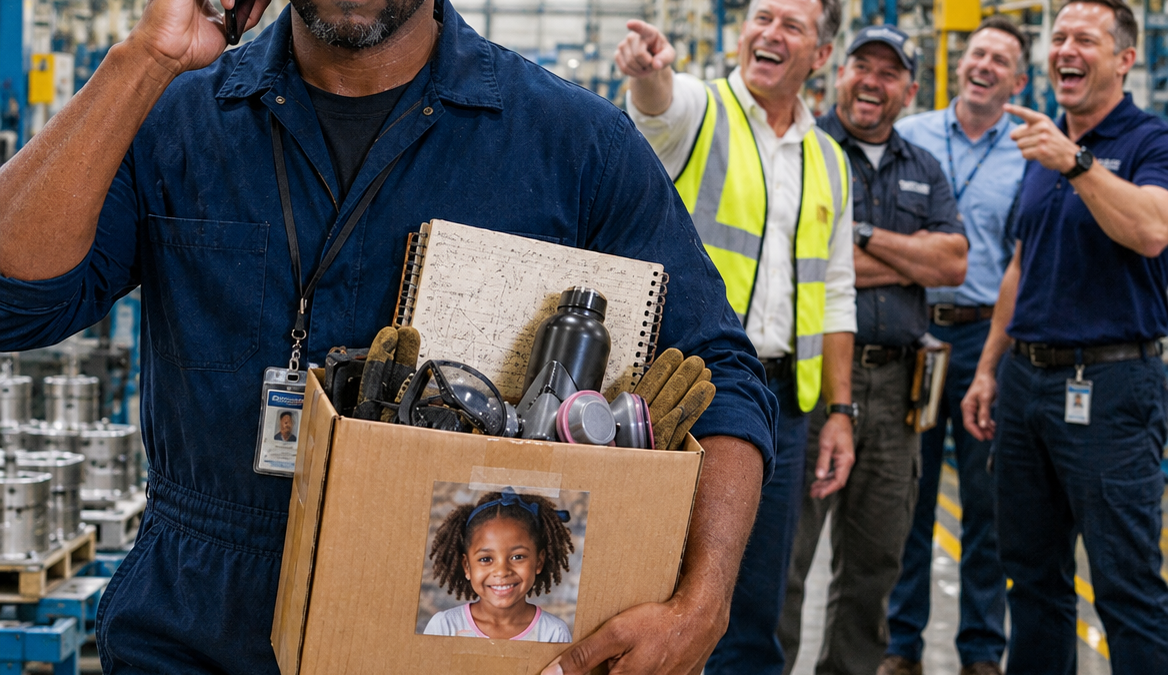
You dumb bastard. Too stupid to work, now standing here drinking water? >> I’m taking my 1-minute break, sir. >> 2 seconds over. You’re fired. Stupid piece of can’t even count to 60. >> Darnell’s hands were shaking from 11 hours in a respirator.
He kept them down. >> You fire me over 1 minute after 12 years? >> Black piece of like you was lucky I even let you clock in. Should have kicked you out the day I walked in. Badge, now. >> He didn’t move. He looked at the man’s face looking for something human.
He didn’t find it. Wilson’s hand closed around the lanyard and twisted. The cord bit into skin. The badge hit the concrete, his daughter’s photo still taped inside. 200 people watched.
Nobody said a word for him. He walked out to his truck and made one phone call. It put an entire board of directors in dead silence. Have you ever watched a powerful man destroy someone in front of 200 people and then lose everything because of one
phone call? Because you are about to so drop a comment, hit that like, and let me take you back to where this all started. 4:15 in the morning, Wichita, Kansas. The kind of dark where you can hear your own kitchen humming.
Darnell stood at the counter scraping the last bit of peanut butter from the jar with the back of a spoon. Two sandwiches. One for his daughter’s lunch box, one for himself. Zuri was still asleep down the hall.
8 years old. She wouldn’t hear him leave. She never did. He pulled a sticky note off the pad by the fridge and wrote the same six words he’d written 22 mornings straight. Grandma’s picking you up. Love, Dad.
He used to write funny little jokes. Now, it was just the same line. He didn’t have the energy for new ones. He stuck the note on her lunchbox, grabbed his keys, and walked out into the dark.
The parking lot at Ridgeline Aerostructures sat under sodium lights that turned everything orange. Darnell pulled into the same spot he’d parked in for 12 years. The asphalt smelled like old rain.
He swiped his badge at the door. The reader beeped once. He walked through a hallway lined with framed photos of Harold Brown, the man who built this plant from a single hanger 40 years ago. Harold shaking hands with governors, Harold on the floor with grease on his shirt smiling like he belonged there.
Harold had been dead for 6 years. The floor hit him the way it always did. The chemical bite of penetrant solution, sharp, sweet, the kind of smell that never washes out of your clothes. Ultraviolet lamps humming over the bays, casting everything in a low purple glow,
the rattle of air compressors, the hiss of pressure lines, and right in the middle of the floor, between bay 11 and bay 12, the whiteboard. Blue dry erase marker letters big enough to read from 30 ft. Standard break, 1 minute, all personnel.
Three guys from the night shift were standing by it when he walked in. One finishing coffee, one stretching his back, one just standing with his eyes closed breathing. Nobody wrote them up. Nobody pulled their logs. That’s how it worked for everybody.
Darnell was the only level three inspector on the morning shift, had been for 2 years since Bill Hendrix retired, and the company never replaced him. Level three meant he was the last signature. Every part that left this plant, every wing fitting, every spar joint had to pass through his hands before it could
ship. If he didn’t stamp it, it didn’t fly. The younger inspectors knew. They’d walk panels over to his bay before signing off just to have him take a look. He’d hold the part under the UV lamp, tilt it, run his fingers along the edge, and either nod or point at what they
missed. Most of the time he pointed. Two bays, one man, 12 years of the same routine. Gloves on, respirator tight, eyes on the part, sign the sheet, next one.
He’d written a memo five months ago warning that fatigued inspectors miss cracks. Sent it up the chain, CC’d the floor manager, nobody [clears throat] replied. The memo sat in the system somewhere collecting digital dust.
But it was in there, time-stamped three weeks before today. The CEO pulled him aside in the hallway. Got a new kid starting Monday, my wife’s nephew, name’s Wade. Show him the ropes. Wade Johnson, 26, 10 months in the industry, never worked in aerospace.
Couldn’t tell a crack indication from a scratch mark. Held the UV probe like he was afraid of it. Darnell taught him anyway, patiently. The way Bill Hendrix had taught him 12 years ago. He showed Wade how to read indications on a wing spar fitting, the hardest read on the floor.
He let Wade photocopy his personal notebook, 12 years of notes, hand-drawn diagrams, color-coded charts, everything he knew in one binder. Wade said, “Thank you.” Darnell said, “You’re welcome.”
That was three weeks ago. This morning Darnell clipped his badge to his lanyard, checked the photo of Zurie taped inside, and told himself the same thing he told himself every shift. Today, I’ll ask about the supervisor position.
I’ve earned it. The assignment board hung by the entrance to the floor, white magnetic strips on a green background, names on the left, bay numbers on the right. Darnell found his name before he found his coffee. Bay 11, Bay 12.
Both of them. Again. He looked at the rest of the board. Every other inspector had one day. One. That was standard. That was what the manual said. One inspector, one bay, one shift.
Wade Johnson’s name sat at the top of the board. One bay, Bay 9. And next to it in red marker, three letters that hadn’t been there yesterday. S U P.
Supervisor. Darnell read it twice. Then a third time. >> [clears throat] >> The letters didn’t change. Wade Johnson, 10 months on the floor, couldn’t read an indication without Darnell standing behind him.
Three weeks ago, the kid had held a UV probe upside down and didn’t notice until Darnell reached over and flipped it. Last Tuesday, he’d signed off on a bracket without checking the underside. Darnell caught it. Pulled it back, showed him what he missed.
Wade had just nodded and said, “Oh, yeah, thanks.” And now his name had S U P written next to it in red marker. Darnell stood there for a long time. Long enough for the night shift guys to file out past him.
Long enough for the overhead lights to finish warming up, flickering from dim yellow to full white. Long enough to read every name on that board, one by one and confirm what he already knew. Nobody else got two bays.
Nobody. Darnell didn’t go to his bay. He walked toward the front office. He didn’t rush. He didn’t raise his voice. He just walked, badge swinging against his chest, boots steady on the concrete.
He got six steps past the security checkpoint before Roy Taylor stopped him. Hold up. Swipe again. Darnell looked at the reader. The green light was still on from his first swipe. It cleared me already.
Swipe again. System’s been acting up. Darnell swiped. The reader beeped, green light, same as before. Roy stared at the screen for a few seconds, scrolled something, clicked something, then nodded slow like he was doing Darnell a favor by letting him into his own workplace.
Behind him, Wade Johnson walked through the same checkpoint without stopping. Badge on his hip, coffee in his hand, still wearing the new hire lanyard that hadn’t even faded yet. Roy didn’t look up, didn’t ask for a second swipe, didn’t say a word.
Darnell watched Wade pass. The kid didn’t even glance at the reader, just walked through like the door was always open for him. Then Darnell turned back to Roy. System’s not acting up, is it? Roy clicked his pen and wrote something on his clipboard. He didn’t answer. He
didn’t need to. They both knew. The floor was filling up. Morning shift. 160 people funneling through the bays, pulling on gloves, checking stations. The air compressors kicked on one by one, building to a steady hum that rattled the light fixtures.
The smell of penetrant thickened as the booths warmed up. That sharp chemical sweetness that stuck to the back of your throat and never really [clears throat] went away. Wilson was standing at the end of Bay 9 with his arms crossed. He had a way of standing on the floor that made it clear he didn’t belong there.
Clean shoes on stained concrete, no gloves, a reflective vest draped over one shoulder like a costume he’d put on for a photo. He saw Darnell coming. He didn’t move. He didn’t uncross his arms.
Mr. Wilson, I saw the board. And? Wade Johnson, shift supervisor. That’s right. Sir, I’ve been here 12 years. I’m the only level three on this shift.
Wilson tilted his head. The way you look at a dog that walked into the wrong yard. And? I trained him three weeks ago. He’s a level two. He couldn’t read an indication without me standing over his shoulder.
Wilson smiled. Not a real smile. The kind that shows teeth but nothing behind them. Then be proud of yourself, Armstrong. He stepped closer. Close enough that Darnell could smell his cologne. Something sharp and expensive that had no business on a factory floor.
You black guys are damn lucky I let you clock in here at all. He said it loud. Loud enough for Bay 9 to hear. Loud enough for the two inspectors at the next bench to stop working and look up. One of them set his probe down.
The other just froze gloves halfway on, staring at the floor. A black guy like you teaching? A white man leading. That’s how it works around here. Always has, always will.
The words hung in the chemical air like the smell of penetrant. Heavy, sharp, impossible to pretend you didn’t notice. Nobody moved. The UV lamps buzzed. Somewhere behind them, a pressure line hissed and clicked.
Darnell felt his jaw tighten. He felt the heat crawl up the back of his neck, spreading across his shoulders like a slow burn. But his hands stayed at his sides. His voice stayed low.
Lower than the compressors. Lower than the fluorescent lights buzzing above the office door. “I’m not asking for a favor, sir.” “I’m asking why the most qualified person on this shift wasn’t considered.”
Wilson’s smile disappeared like someone turned off a switch. “What did you just say to me?” “I said I’m the most qualified. Don’t you raise your voice at me.” Darnell hadn’t raised his voice. Everyone on that floor knew it.
The two inspectors at the next bench knew it. The night shift guys filing past the door knew it. The woman at bay 12 who’d stopped pretending to work knew it. But it didn’t matter what everyone knew. It mattered what Wilson said.
And Wilson said he was loud. Roy Taylor appeared behind Darnell like he’d been waiting for a signal. Clipboard in one hand, yellow highlighter tucked behind his ear. He didn’t look at Darnell’s face. He looked at the clipboard.
“I’m logging this.” Darnell turned around. “Logging what?” “Aggressive behavior toward a senior officer.” “I asked a question.” “I’m writing what I saw.” “You saw me ask a question.”
“Standing still, hands at my sides.” Roy clicked his pen twice. He wrote something on the form quickly like he’d already decided what it said before he walked over. Darnell couldn’t read the words, but he could see the box Roy checked at the top of the page.
Employee conduct violation. One box. One check mark. One click of a pen. His question about a promotion became a disciplinary entry. His complaint became his crime.
Darnell looked at the form. Then at Roy. Then at Wilson, who was already turning away, adjusting his vest, checking his watch because to Wilson, this conversation was already over. This man was already handled.
“You’re making a mistake.” Darnell said quietly, almost to himself. Wilson stopped. He didn’t turn all the way around, just tilted his head over his shoulder, the way you glance at a noise you’ve already decided doesn’t matter.
“No. I made a mistake 12 years ago. I’m fixing it now.” Then he walked away. His clean shoes clicked on the concrete. The sound got smaller and smaller until it disappeared into the hum of the compressors.
Marva Coleman sat at her bench in Bay 12. She had a clear line of sight to everything that just happened. She saw Wilson step into Darnell’s space. She heard every word, the lucky ones, the black guys, the always has, always will.
She watched Roy check the box without blinking. She didn’t say anything. She looked down at her work, picked up her probe, pressed the tip against the surface of a bracket, and stared at the indication until her eyes blurred. Her phone sat in her front pocket.
She didn’t reach for it, not yet. But she knew something else. Bay 12 had a ceiling-mounted camera, wide-angle, recording since 6:00 a.m. She’d walk past it every morning for 9 years. She knew exactly what it could see.
She filed that away, and she kept working. Behind Wilson’s head the whole time he was talking, the whole time he was saying those words, the whiteboard was right there, bolted to the wall. Blue marker, big letters, standard break, 1 minute, all personnel.
All personnel. Not all personnel except one. Not all personnel except the black ones. All personnel. The whiteboard didn’t care who Grant Wilson was. It said what it said.
By midmorning, Wilson had stopped using words. He didn’t need them anymore. He had the schedule. Roy Taylor walked up to Darnell’s bay at 9:15 with a stack of paperwork and a face that said, “Don’t ask.”
Lot 6200, rush, due by end of shift. I’ve already got two bays, Roy. Now you’ve got two bays and a rush lot. Who’s assisting? Nobody. We’re short-staffed.
They weren’t short-staffed. Darnell could see three inspectors standing at bay nine doing nothing, waiting for Wade to figure out how to assign them. Wade was flipping through a binder, Darnell’s binder, the one he’d photocopied, trying to find the procedure for a routine die check.
His finger was tracing the page line by line, the way a kid reads a textbook the night before an exam. Three people standing around, and Darnell got no one. He didn’t argue. He pulled on his gloves, tightened his respirator until the rubber bit into the bridge of his nose, and started working.
At 10:30, a group of clients walked through the front door, four men in suits. Wilson met them in the hallway with a handshake and a smile so wide you’d think he’d invented the airplane himself. He walked them onto the floor like a tour guide, pointing at equipment, rattling off numbers, making everything sound clean and efficient and
impressive. They stopped at Bay 11, Darnell’s Bay. Darnell was mid-inspection, UV probe in one hand, report sheet in the other. He was signing off on a fuselage bracket, the kind of work that required steady hands and total focus.
One wrong signature and a cracked part ends up on an aircraft carrying 200 passengers. Wilson walked right up to him, didn’t wait for him to finish, didn’t say excuse me. Just reached over and pulled the clipboard out of his hands. The pen clipped to the board clattered to the concrete.
Then he grabbed a rag from the cleaning bin and pressed it into Darnell’s chest. Not handed, pressed. Hard enough that Darnell had to take a half step back. Hard enough that the rag left a damp spot on his coveralls.
Make yourself useful where people can see you. The clients were standing 5 ft away. They saw it. One of them shifted his weight and looked at the ceiling. Another cleared his throat. The other two didn’t react at all, like watching a man get humiliated on a factory floor was just part of the tour.
Darnell looked down at the rag in his hands, a cleaning rag. He was a level three inspector, the last signature between a cracked part and a flying aircraft, and Wilson had just turned him into a janitor in front of four strangers.
He set the rag on the bench quietly. He bent down, picked up his pen, retrieved his clipboard. He went back to work. Wilson didn’t notice. He was already walking the clients toward Bay 9, where Wade was standing behind a clean bench with a fresh uniform and a smile that
hadn’t earned anything yet. Wilson’s hand was on Wade’s shoulder, like a father introducing his son. Lunch never happened. At 11:45, Roy pulled Darnell off his bay and sent him into the penetrant booth for the rush lot.
Full PPE, respirator sealed, face shield down. The booth was 8 ft by 6 ft, lit by a single UV strip that hummed at a frequency just high enough to give you a headache after 30 minutes.
Darnell worked in that booth for 3 hours straight. No water, no food, no break. The respirator pressed into the bridge of his nose until the skin underneath turned white, then red. Sweat ran down the inside of his gloves until his fingers pruned. His knees locked. His lower back seized twice.
He had to brace one hand against the booth wall just to stay upright. The penetrant smell was so thick he could taste it through the filter, metallic sweet. The kind of taste that sits on the back of your tongue for days.
Every breath felt like drinking chemicals. When he finally stepped out, the light hit him like a slap. His eyes couldn’t adjust. Everything was white and flat and too bright. The lunch hour was long gone. The break room was empty.
His sandwich sat in his locker untouched. The peanut butter he’d scraped from the bottom of the jar that morning still wrapped in the same plastic bag. While Darnell was sealed in that booth, Roy had been busy. Two write-up forms appeared in Darnell’s personnel file that afternoon.
Both backdated. One for failure to follow procedure on a lot he’d completed 2 weeks ago. A lot that had passed final inspection without a single flag. One for insubordination, dated the same morning but describing an incident that never happened.
A conversation that never took place. Words that were never said. Darnell didn’t know about them yet. He would. And while all of this was happening, while Darnell was drowning in two bays and a rush lot and three hours in a sealed booth with no break and no water,
Wade Johnson was outside. Leaning against the loading dock wall, cigarette in one hand, phone in the other. The afternoon sun warm on his face. Nine minutes.
Nobody pulled his badge log. Nobody wrote him up. Nobody walked over and pressed a rag into his chest. Nobody called him a name. Nine minutes for Wade. 62 seconds for Darnell.
Same plant, same whiteboard, same rules, different skin. Hour 11. Darnell’s hands were trembling. Not from nerves, from fatigue. 11 hours in a respirator will do that.
Your fingers stop listening to your brain. Your eyes start blurring at the edges. The UV light turns everything into a purple smear, and you have to blink hard just to see the part in front of you. That’s when lot 8814 came across his bench.
Wing spar fitting. The most critical joint on the aircraft. If this part fails, the wing folds. There’s no second chance. There’s no backup system. It holds or it doesn’t. Darnell placed the fitting under the UV lamp. He tilted it, rotated it, ran his fingertip along the edge, the way he’d
done 10,000 times before. And there it was, a hairline crack running diagonally across the load-bearing surface. Thin enough to miss if you were tired. Thin enough to miss if you were rushed. Thin enough to miss if you were anyone other than a man with 12 years and a notebook full of
hand-drawn diagrams. He set the fitting down. He did not stamp it. He picked up his pen, wrote reject across the inspection sheet in block letters, and signed his name underneath.
Wilson was there in 4 minutes, Roy right behind him. “What’s the hold up?” “Lot 8814, cracked. I rejected it.” “That lot ships Friday.” “Not with my name on it.” Wilson slammed his palm on the inspection bench. The sound cracked across the bay like a gunshot.
Darnell’s water bottle toppled off the edge and hit the concrete floor. Water splashed across his boots. “You people always find a goddamn reason to stop my line. Stamp it or get the hell out of my plant.” Darnell looked at the fitting under the purple light.
The crack was right there, visible, undeniable, a fact. “It’s cracked, sir.” “Stamp it.” “No.” Wilson stared at him. His jaw was working. His hands were flat on the bench, knuckles white.
For a second, it looked like he might flip the whole station. He didn’t. He straightened up, pulled his vest back over his shoulder, and walked away without another word. But Darnell had seen his eyes, and what was in them wasn’t rage.
It was calculation. >> [clears throat] >> 40 minutes later, Darnell’s legs were shaking. His mouth was chalk. He could feel his pulse in his fingertips, slow, heavy wrong. He stepped off the line, walked to the water fountain, 10 [clears throat] ft from his bay. He pressed the button. The water arced up, cold, thin. He drank for maybe 20
seconds, stood there for maybe 40 more, let his hands hang, let his shoulders drop, let himself breathe. 62 seconds. That’s all it was. When he turned around, Roy Taylor was standing behind him, clipboard in hand, a single sheet of paper, one line highlighted in
yellow, his badge log, only his, nobody else’s. Wilson was already walking toward him. Darnell knew it was coming before the man opened his mouth. Everything after that, you already heard. Security walked Darnell toward the exit, past the break room, past the locker bay, past the long hallway lined
with Harold Brown’s photographs, Harold shaking hands, Harold smiling, Harold on the floor. Darnell didn’t look at the photos. He looked straight ahead. But right before he reached the door, he glanced back, and there was Wade Johnson sitting at Darnell’s bench, his bench, the one he’d stood behind for 12 years.
Wade had the photocopied notebook open, Darnell’s notebook, flipping through pages, trying to find the procedure for reading a wing spar indication, the same indication Darnell had just rejected. Their eyes met, just for a second. Wade looked away first. His fingers froze on the page. He didn’t look up again.
Darnell turned around and walked out the door. He drove to Zuri’s school. For the first time in 22 days, he was there before the bell. He parked across the street and watched the doors. When she came out, she stopped on the steps. She saw his truck and didn’t move for 3 full seconds, like she didn’t believe it.
Then she ran. He held her for a long time in the empty parking lot. She smelled like crayons and cafeteria milk. He didn’t let go until his arms stopped shaking.
He sat in the truck. Zuri was in the back seat humming something from school. He looked at her in the rearview mirror. Then he picked up his phone. He didn’t call a friend. He didn’t call HR.
He dialed a number and waited for two rings. Adrian. It’s Darnell. I know. I’ve been waiting for this call for 3 years. Activate article four. A pause.
The kind of pause someone takes when they’ve rehearsed this moment a hundred times and now it’s actually here. You’re sure? I’m sure. Once I send the notice, Ridgeline loses certification on every part in that plant.
Nothing ships. Nothing flies. Not until a new license is negotiated and that negotiation goes through you. I understand. They fired you. Over 62 seconds of water. The sound of a keyboard. Fast.
Deliberate. Like someone loading a gun. Notice goes to the board, Ridgeline legal and the customer’s quality office within the hour. I’ll CC the FAA licensing division. Darnell, they’re going to find out who you are tonight.
That’s the idea. He hung up. In the back seat, Zuri was drawing on the back of a receipt with a crayon she’d found under the seat. She didn’t know what her father had just done. >> [clears throat] >> She just knew he picked her up on time.
6:30 that evening, Eleanor Brown’s phone rang. She listened for 90 seconds. She didn’t interrupt. When the call ended, she set the phone down on her kitchen table next to a framed photograph of her late husband standing on the Ridgeline floor with grease on his shirt.
Harold Brown had built that plant from a single hangar. He’d hired Darnell when the kid was 26 and fresh out of trade school. He’d watched him develop an inspection process so precise it became the industry standard for non-destructive testing on aircraft structures.
When Darnell wanted to patent it, to own it through his own company, not hand it over. Harold said yes. Not because it was good business, because it was right. They’d signed the agreement at this table. Kestrel Metallurgy LLC would license the Armstrong process to Ridgeline exclusively.
Article 4 gave the licensor the right to terminate at will, and as part of the deal, Darnell received 22% of Ridgeline’s equity. Nobody on the floor knew. Nobody in management knew. Not even the board, except Eleanor.
Harold had told his wife one thing about that deal. That man will own this place before it deserves him. Eleanor called the board secretary. Emergency session tonight, 8:00, no exceptions. The boardroom had a long oak table, 12 leather chairs, and a projection screen
nobody used, except for quarterly earnings. The coffee was old, the lights were too bright. At 8:05, seven board members were seated. Eleanor sat at the far end, hands folded, silent.
At 8:08, Adrian Wallace walked in. Nobody [clears throat] recognized her. She set a single folder on the table and sat down without introducing herself. At 8:12, Grant Wilson pushed through the door carrying his laptop and a flash drive.
He still had his reflective vest on. What’s this about? I’ve got numbers to present. Nobody answered. He looked around the table. He saw Adrian Wallace, whom he did not recognize. He saw Eleanor Brown, whom he’d never taken seriously.
And he saw the projection screen already on, already showing a document he had never seen before. A signature page, two names. Harold T. Brown, founder and CEO, Ridgeline Aerostructures.
Darnell T. Armstrong, managing member, Kestrel Metallurgy LLC. Wilson stared at the screen. The throughput deck he’d spent all week preparing was loaded on his laptop. He would never present it.
What the hell is this? Eleanor spoke for the first time. That is the licensing agreement for the Armstrong process. Every part in this plant is certified under it. Without it, nothing ships. Nothing flies. Nothing moves.
She paused. The air conditioning hummed through the vents. The man you fired this morning over 62 seconds at a water fountain owns it. He owns the process. He owns 22% of this company.
And as of 1 hour ago, he has terminated our license. Silence. Not the awkward kind. The kind that presses down on a room like a physical weight. Wilson’s mouth opened. Then closed.
His fingers were still on his keyboard, but the numbers on that screen would never mean anything again. Adrian opened her folder. A single sheet of paper, a badge swipe log. One line highlighted in yellow.
She slid it to the center of the table. This is the document your floor manager pulled today. One employee, one entry. You used this to fire the man who holds the license to your entire operation. She placed a second document beside it.
The Kestrel licensing agreement, Article 4 highlighted in blue. Two sheets of paper side by side, yellow and blue. One that Wilson created. One that was about to bury him.
>> [clears throat] >> The door opened. Darnell walked in. Still in his work boots. Still in his coveralls. A red line still visible across the the of his neck where the lanyard had cut into skin. He didn’t sit down. He stood at the end of the table and looked at Wilson.
You told me 62 seconds was all my job was worth. Let’s find out what it’s worth to yours. Wilson’s mouth moved. Darnell didn’t wait. I have one question, then I’m done. He looked around the table.
Who stamped lot 8814 after I refused? The room was already silent. But now it changed. Seven board members realizing this wasn’t just about a firing. Wilson’s face shifted. The arrogance drained out of it the way color leaves
skin. What replaced it wasn’t anger. Wasn’t defiance. It was fear. Wilson tried four things in 90 seconds. Each one smaller than the last. First, confusion.
This has been a misunderstanding. Nobody told me about any licensing agreement. It’s in the company charter, Eleanor said. Page 14. You signed it when you took the job. Wilson blinked.
His mouth stayed open, but nothing came out. He looked at Adrienne like she might help him. She didn’t. Second, justification. I was enforcing standards. The man walked off the line. I followed protocol.
Adrienne slid the badge swipe log back toward him. The yellow highlight caught the overhead light. You pulled one man’s log out of 160 employees on that shift. One. If this is protocol, show me the other 159.
Wilson didn’t answer that. His fingers tapped the edge of his laptop twice, then stopped. Third, deflection. Roy Taylor pulled the log. That was his call. I just acted on what was in front of me.
Roy Taylor reports to you, Eleanor said. She didn’t blink. He pulled the log you told him to pull. For the man you told him to pull it on. Fourth surrender. Wilson stood up and extended his hand across the table toward Darnell.
Palm open, fingers spread. The kind of handshake meant to make everything disappear. 12 years of work, one morning of humiliation. All of it gone in one grip. Darnell looked at the hand.
He looked at it for a long time. Long enough for Wilson’s arm to start trembling. Long enough for every board member to see it shake. Long enough for the silence to become its own kind of answer. He didn’t take it.
Wilson’s hand dropped to his side. And that was the moment everyone in the room knew it was over. Eleanor didn’t raise her voice. She didn’t need to. Grant Wilson is suspended without pay effective immediately. Legal is instructed to preserve all floor
footage, badge swipe data, personnel files, and internal communications from the past 12 months. Nothing gets deleted, nothing gets moved, nothing gets touched. She looked at Wilson. Security will escort you out through the main floor, same door.
The same door Darnell had walked through that morning. Past the same hallway. Past the same photographs of Harold Brown. Past the same floor where 200 people had watched a man get fired over 62 seconds of water.
The security guard who appeared in the doorway was the same one who’d walked Darnell out 12 hours earlier. Same uniform. Same badge. Same face. Wilson looked at him. Then at his laptop, still open, still showing throughput numbers that would never matter again.
He closed it slowly, tucked it under his arm, and walked. Their footsteps echoed down the hallway, past Harold Brown shaking hands with governors, past Harold Brown cutting ribbons, past Harold Brown standing on the floor with grease on his shirt and a smile on his face.
Wilson didn’t look at the photos. He looked straight ahead, the way Darnell had looked straight ahead that morning. Same hallway, same guard, same door, different man walking through it.
Roy Taylor didn’t wait to be called. He showed up at the boardroom door 20 minutes later. He was carrying his phone. His hand was shaking so badly he had to set it down with both hands. I have something.
He placed the phone on the table, screen up, a text message chain between him and Wilson, timestamped. Three messages, 6:14 a.m. Pull Armstrong’s badge log today, only his. 9:20 a.m.
Add two write-ups to his file. Backdate them. 3:08 p.m. 40 minutes before the firing. I need that log on my desk before end of shift. Roy stared at the edge of the table.
He didn’t look at anyone. I did what he told me. I shouldn’t have. Nobody thanked him. Nobody told him it was okay, because it wasn’t. He was placed on administrative leave before he reached the parking lot.
Marva Coleman was the last one through the door that night. She walked into the boardroom at 9:15, still in her coveralls, still smelling like penetrant. She was holding her personal phone. Bay 12 has a ceiling camera, but I also have this.
She pressed play. The video was shaky, shot from waist height, half hidden behind an inspection bench, but the audio was clean. Every word, every sound, the slap of the badge log hitting the bench.
Wilson’s voice, clear, loud, unmistakable. The lanyard snapping, the badge hitting concrete, the silence afterward. All of it. The board watched in silence.
2 minutes and 14 seconds. Nobody moved. Nobody looked away. When it ended, Eleanor reached over and turned the phone face down on the table. We’ll need a copy of that.
Marva nodded. She didn’t say anything else. She’d been silent all day. She’d watched Wilson humiliate Darnell and hadn’t said a word. She’d watched Roy check the box and hadn’t moved.
But she’d been watching. And she’d been recording. Sometimes silence isn’t cowardice. Sometimes it’s patience. The FAA opened an investigation within 72 hours. It started with one question.
The same question Darnell had asked in the board room. Who stamped lot 8814? The answer came fast. [clears throat] Wade Johnson. The man who’d been sitting at Darnell’s bench with Darnell’s notebook open in front of him, trying to figure out how to read the indication that Darnell had
spent 12 years learning to catch. Wade had stamped the fitting. The cracked fitting. The wing spar joint that holds, or doesn’t. The part that Darnell had written reject across in block letters and signed his name under.
Wade stamped it the same night Darnell was fired. The ink on the approval wasn’t even dry when the lot was loaded for shipping. But that wasn’t the worst part. The FAA investigator pulled Wade Johnson’s certification file.
Level three clearance, signed and approved. The signature at the bottom belonged to Grant Wilson. The hours logged, the document certifying an inspector has enough supervised experience to qualify, was signed by Roy Taylor.
The date on the form was 11 days before Darnell was fired. 11 days. Wilson had signed Wade’s level three certification 11 days before he had a reason to fire Darnell. Before the 62 seconds.
Before the water fountain. Before the badge log with one line highlighted in yellow. The seat had been sold before the excuse was invented. The replacement was certified before the original was removed.
62 seconds wasn’t the reason. It was the receipt. And the hours log was a lie. Wade did not have the accumulated hours required for level three. Not even close. 10 months on the job.
The minimum requirement was four years of documented supervised work. Four years. Roy Taylor had signed off on hours that never happened. Shifts that were never worked. Supervision that never took place.
That wasn’t a policy violation. That was federal fraud. Falsifying certification documents on flight critical aircraft components. The kind of crime that doesn’t end with a fine. The kind that ends with a federal case number and a pair of handcuffs.
The memo came back. Darnell’s memo. The one he’d written five months ago about fatigued inspectors missing cracks. The one he’d sent up the chain. >> [clears throat] >> The one nobody replied to.
The FAA investigator found it in the company’s own filing system. Time-stamped. On the record. Exactly where Darnell had put it. The company had received the warning. The company had ignored it.
And then the company had assigned the man who wrote the warning to two bays a rush lot and three hours in a sealed booth and fired him when he stepped away for 62 seconds of water. The company’s own system convicted the company.
The time-stamp didn’t lie. The filing path didn’t lie. The read receipt, which showed Roy Taylor had opened the memo and closed it four minutes later without forwarding it, didn’t lie either. The trial lasted nine days.
The prosecution called 14 witnesses. Floor inspectors, former employees, a woman from accounting who’d flagged pay discrepancies between black and white inspectors and been told to stop asking questions.
But the testimony that broke the courtroom came from Wade Johnson. Mr. Johnson, who taught you how to read a crack indication on a wing spar fitting? Wade was sitting in the witness box. His hands were flat on his knees.
He stared at the railing for six seconds before he answered. Darnell Armstrong. The man whose position you were given? Yes. The man who was fired so you could sit at his bench?
Yes. And on the night of his termination, you stamped the fitting he refused to approve, the cracked fitting, using a level three certification that you did not legitimately hold. Is that correct? Yes. Did you know the fitting was cracked?
Wade’s voice dropped. The court reporter leaned forward. She had to ask him to repeat it. I didn’t know how to tell. The courtroom didn’t react the way courtrooms do in movies. Nobody gasped. Nobody whispered.
The silence was worse. It was the silence of jurors, spectators, and reporters all understanding the same thing at the same time that a cracked part nearly made it onto a flying aircraft because the only man who could catch it had been fired for drinking water.
The EEOC filed its findings the same week. Four years of data. Write-ups over, time assignments, promotion records, disciplinary actions, all broken down by race. Black inspectors received written warnings at three times the rate of white inspectors for the same
infractions. Black employees were assigned overtime at nearly double the rate. In four years under Wilson, not a single black employee had been promoted to a supervisory position. Not one.
Darnell wasn’t singled out once. He was singled out on a schedule. Six current and former employees joined the complaint. Six people who had kept quiet for years because they needed the job, the insurance, the paycheck.
Six people who watched what happened to Darnell and decided that silence had cost enough. Marva’s video went public during the trial. A local station ran it first. By the next morning, it was national.
Two minutes and 14 seconds. Shaky footage. Shot from waist-height, but the audio was perfect. Wilson’s voice, the words, the lanyard snapping, the badge hitting concrete.
The 200 people standing still and saying nothing. The whiteboard photo traveled even further. Someone had taken a picture of it during the investigation. Blue dry erase marker, big letters, bolted to the wall between bay 11 and bay 12. Standard break, 1 minute, all
personnel. That image ended up on every news broadcast, every legal blog, every social media threat about the case. Five words on a whiteboard. The simplest piece of evidence in the entire trial.
And the most devastating. The sentencing came on a Tuesday. Grant Wilson. Nine years in federal prison. Restitution. >> [clears throat] >> Permanent debarment from federal contract work for life.
The judge noted that falsification of safety certifications on aircraft components represented a direct threat to public safety. And that the racial motivation behind the termination constituted an aggravating factor.
Roy Taylor. 30 months. Reduced for cooperation, the text messages, the testimony, the admission that he’d falsified Wade’s hours log on Wilson’s direct orders. Wade Johnson.
24 months. Reduced for cooperation. He’d testified against Wilson. He’d admitted to stamping the fitting. He’d sat in that witness box and said the name of the man who taught him everything he knew and the name of the man who told him to stamp a part he couldn’t read.
Ridgeline Aerostructures entered a consent decree. Back wages, compensatory damages, complete restructuring of hiring and promotion practices under federal oversight. No open ending. No time will tell. Just consequences.
Darnell Armstrong walked back into Ridgeline Aero Structures on a Tuesday morning. Same parking lot, same sodium lights, same cracked paint line. He swiped his badge at the door. The reader beeped once, green light.
Nobody asked him to swipe again. He walked through the hallway lined with Harold Brown’s photographs. Harold shaking hands, Harold on the floor with grease on his shirt. The photos were the same. The man walking past them was not.
He stepped onto the floor. The compressors were humming. The UV lamps were buzzing. The penetrant smell hit him the way it always did, sharp, sweet, permanent. But the whiteboard was different. The old one was gone. In its place, bolted to the same wall between Bay 11 and Bay 12, was a new rules, two rules printed,
laminated, not dry erase, not something that could be wiped away with a sleeve. Rule one, no individual badge log may be pulled unless a full shift report is generated for all personnel.
Rule two, no inspection sign-off permitted after the 12th consecutive hour of work, no exceptions. Darnell had written both of them. The shift was already working when he walked through, but when he passed Bay 9, the first inspector looked up.
Then the second. Then the third. One by one, they stopped working. Not because someone told them to, they just stopped. By the time he reached Bay 12, the whole floor was still. 160 people standing at their benches looking at the man who had walked out of
that door 3 months ago with a red line on his neck and his daughter’s photo on the concrete. Nobody clapped. Nobody cheered. They just stood there. And that was enough.
Darnell nodded once, then he kept walking. On Roy Taylor’s old desk sat a stack of yellow highlighted badge logs, one name per sheet, all pulled for the same reason. Darnell fed them into the shredder one by one.
The machine chewed through the paper with a sound like a zipper closing. When the last page was gone, he wiped the dust off his hands and walked to his bay. His bay. Still his. The compensation from the consent decree was substantial.
Darnell didn’t keep it. He transferred the full amount into a certification training program for floor-level technicians. The people who stood at those benches every day breathing penetrant, doing the work that keeps aircraft in the sky.
The people who never got the chance to sit for a level three exam because nobody told them they could. Now somebody was telling them. The first class enrolled eight technicians. Darnell taught the first session himself. Same notebook. Same hand-drawn diagrams.
12 years of knowledge passed down the way Bill Hendricks had passed it down to him. That afternoon he drove to Zuri’s school. >> He was there before the bell. She came out, saw his truck, and didn’t stop on the steps this time. She just ran.
He picked her up every day after that. Every single day. And the day she stopped being surprised by it, the day she walked straight to the truck without looking, without that little pause on the steps, that was the day he knew he’d won.
Not the trial, not the board room, not the licensing agreement. This. Eleanor Brown called him that evening. She said one thing. Harold always said you’d own this place before it deserved you.
This story is fiction, but the feeling is not. Being watched harder than everybody else for doing the exact same thing that is documented case after case year after year. A man takes the same break everybody takes and he is the only one who gets his log pulled.
That is not a story. That is a pattern. And patterns don’t break themselves. So if you were standing on that floor when Wilson ripped that badge off Darnell’s neck, what would you do? Would you say something?
Or would you go back to your bench? Drop your answer in the comments. If this story made you feel something, hit that like button, [clears throat] share it, subscribe if you haven’t. Because dignity is not a reward for productivity.
A man who takes the same minute everybody takes is not stealing anything. And the person holding the real power in a room is not always the one doing the shouting. Sometimes it’s the quiet one by the water fountain with shaking hands.
The one who doesn’t argue. The one who just makes one phone call. That’s the one you should have been paying attention to all along.