Cops Booked a Black General for Impersonation — Then a Military Convoy Surrounded the Precinct
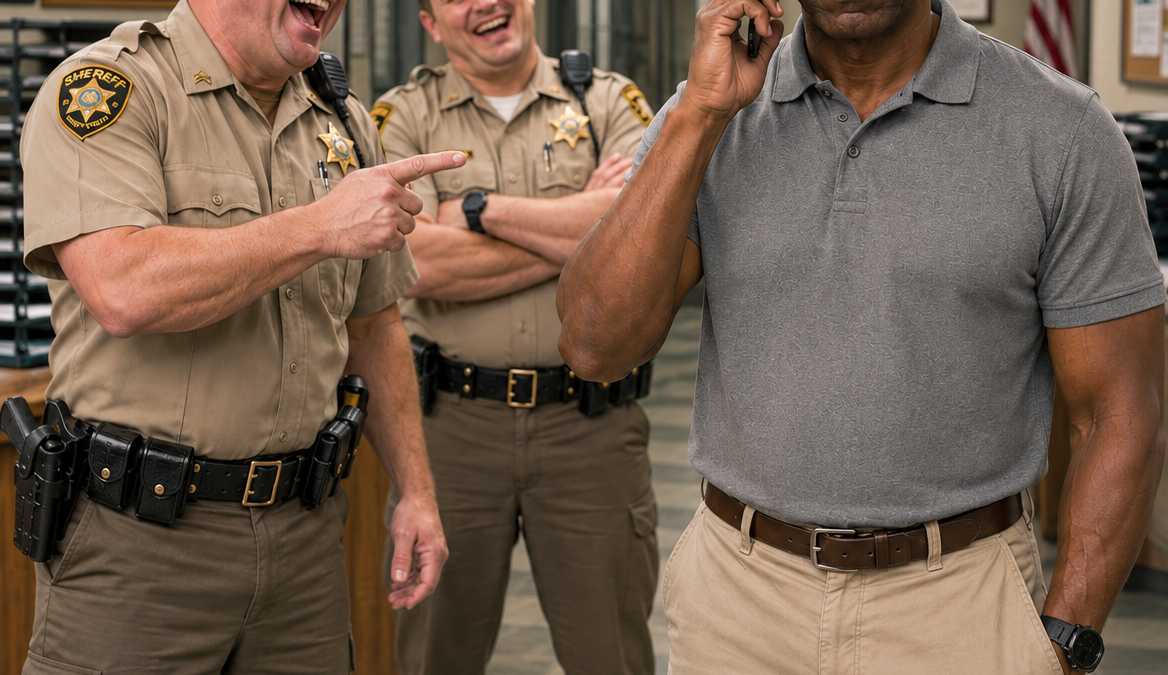
Sergeant Bryce Holden pressed Franklin Turner’s face against the mugshot camera. >> Impersonation of a military officer, that’s a serious offense. Stand straight, chin up, smile for me, General. >> He yanked Franklin back by the collar.
>> I’m telling the truth, you can verify it. And I’m the president. >> Hold still. >> Holden laughed right in his face. The flash went off. Franklin didn’t blink. Holden snatched the military ID off the counter, barely glanced at it, and tossed it in the trash.
>> Two stars, Halloween costume. Lock this fraud up. >> He grabbed Franklin by the arm and shoved him toward the holding cell. The cell gate clanged shut. Franklin sat on the metal bench, wrists raw, face stone. 40 miles east, a column of Humvees had just merged onto the highway. Sergeant
Holden’s worst day was 12 minutes away. Have you ever watched someone’s arrogance collapse in real time because you are about to drop a comment and hit like, and let me take you back to where it all started? 3 hours earlier, the morning had started the way most mornings did for Franklin Turner, quiet,
purposeful, alone. He stood in front of the bathroom mirror at the officers’ quarters in Fort Garrison, Virginia. 52 years old, close-cropped gray at the temples, a scar above his left eyebrow from a piece of shrapnel that had found him in Fallujah 16 years ago.
He didn’t look at it anymore. It was just part of his face now. His dress uniform hung on the closet door behind him. Two silver stars on each shoulder, a chest full of ribbons that told a story most people would never hear. Bronze Star, Legion of Merit, Purple Heart. Three decades of service pressed and pinned into wool and
metal. But today wasn’t a dress uniform day. Today was a drive-back day. Frank had spent the previous evening at the Pentagon for a classified briefing on force readiness. The kind of meeting where phones went into a locked box at the door and nobody left until the last slide deck was
shredded. He’d stayed overnight at a hotel near Arlington, slept 5 hours, and woke before dawn. Now he packed his dress uniform into a garment bag, zipped it flat, and laid it across the back seat of his car.
A navy blue Camry, 12 years old, 218,000 miles. It ran fine. It got him where he needed to go. He pulled on a gray polo shirt, khaki pants, and white sneakers. Nothing about him said military. Nothing about him said two-star general.
That was the point. Franklin Turner had never needed the world to know his rank. He wore it when duty required. The rest of the time, he was just a man driving home. By 8:00 in the morning, he was on Interstate 81 heading south through the Blue Ridge Mountains. Windows down, radio off. The kind of silence that
soldiers learn to love after years of noise. His aide-de-camp, Captain Elise Bradford, 29, had texted him twice already. The first message confirmed his 1:00 meeting with the base operations staff. The second reminded him that Lieutenant General Raymond Stokes, the base commander, wanted 15 minutes with
him before the afternoon session. Franklin had replied with a thumbs-up emoji and nothing else. Stokes was 58, a three-star general who had commanded everything from infantry battalions to joint task forces. He and Franklin had served together in two deployments. They weren’t friends in the casual sense. They were something
deeper. The kind of bond that forms when two men have pulled each other out of places most people pretend don’t exist. When Stokes gave an order about Franklin Turner’s safety, people moved. By 11:00 in the morning, Franklin crossed the state line into North Carolina.
The highway thinned from four lanes to two. Strip malls gave way to tobacco fields. Gas stations got farther apart. He was 45 minutes from Fort Garrison when his gas gauge dipped below a quarter tank.
He pulled off the highway into Barlow County, population 8,000, one main street, one courthouse, one police station with six officers and a sergeant who believed he was the law itself. That sergeant was Bryce Holden, 45 years old, crew cut, mirrored sunglasses, a
jaw that looked like it had been carved from the same granite as the Confederate monument outside the courthouse. He’d been with the Barlow County Sheriff’s Department for 22 years. In that time, he had accumulated 14 internal complaints, all from traffic stops, all involving black drivers, all
dismissed by a review board made up of men who had gone to high school with him. His deputy, Nathan Crowell, was 31. Crowell had joined the force 3 years ago after washing out of the state police academy. He was the kind of officer who laughed at whatever Holden laughed at and wrote whatever Holden told him to write.
He didn’t think for himself. He didn’t need to. Holden did all the thinking. At 11:15, Franklin pulled into a gas station on the edge of town. He filled his tank, bought a bottle of water, and pulled back onto the two-lane road that cut through Barlow County center.
He didn’t notice the patrol car parked behind the billboard at the county line. He didn’t see Holden lower his sunglasses and watch the navy blue Camry roll past. He didn’t hear the words Holden muttered to Crowell in the passenger seat. But the lights came on before Franklin had gone half a mile, red and blue spinning in the noon sun.
Franklin checked his speedometer. 53 in a 55 zone. He pulled over anyway. He’d done this before. Every black man in America has done this before. He put the car in park, turned off the engine, and placed both hands on the steering wheel and waited.
Holden took his time. He sat in the patrol car for a full 2 minutes, letting the heat build inside Franklin’s Camry. The engine was off, no air conditioning. The noon sun turned the windshield into a magnifying glass.
When Holden finally approached, he walked slow, boots crunching gravel, one hand on his belt. He stopped at the driver’s window and leaned down. His mirrored sunglasses reflected Franklin’s face back at him.
License and registration? Franklin reached for the glove compartment, slow, deliberate, the way his father had taught him when he was 16, the way every black father teaches his son. “I’m reaching for my documents.” Franklin said.
“I can see that.” Holden’s voice was bored, patient, the patience of a man who had done this a hundred times and enjoyed every one. Franklin handed over his driver’s license and registration. Then, without being asked, he pulled out his military identification card, a Department of Defense Common Access Card with his
photograph, his name, and his rank, Major General United States Army. Holden took all three. He didn’t look at them right away. He held them at his side and stared at Franklin for a long 5 seconds, letting the silence do its work.
Then he walked back to the patrol car and leaned against the hood, taking his time with each document. He looked at the license first, checked the photo, checked the address. Then the registration, then the military ID. He held the CAC card up, tilting it in the sunlight like he was checking a counterfeit bill.
“Major General Franklin Turner.” He read it out loud, flat, like he was reading a punch line. United States Army. Yes, sir. Holden looked at the card. Then he looked at Franklin. Polo shirt, khaki pants, sneakers, a 12-year-old Camry
with a cracked dashboard and a faded air freshener hanging from the mirror. You’re telling me you’re a two-star general? I am. Step out of the vehicle. Franklin’s hand stayed on the wheel for one more second. Then he opened the door and stepped onto the shoulder. The asphalt was hot enough to feel through
his sneakers. Cars passed on the other side of the road. A few slowed down to look. Holden circled him. Slow. Eyes moving up and down, taking inventory. Polo shirt, khaki pants, white sneakers with a grass stain on the left toe.
He stopped in front of Franklin and crossed his arms. A general in a polo shirt driving a 12-year-old Camry through Barlow County. He let out a long breath through his nose. That’s a new one.
I was at the Pentagon yesterday. I’m driving back to Fort Garrison. The Pentagon? Holden smiled. The kind of smile that wasn’t a smile at all. It was a verdict. Sure you were. And last week you were at the White House. And next week you’re having lunch with the Joint Chiefs.
You can call Fort Garrison. They’ll confirm my identity in two minutes. I’ll decide what I call and when I call it. Holden’s smile disappeared. Don’t tell me how to do my job. He held the military ID up between two fingers the way someone holds something dirty.
You know what impersonation of a military officer is? It’s a federal crime. Title 18, United States Code Section 709, up to three years. I’m not impersonating anyone. That’s what they all say. Holden tossed the ID onto the hood of his patrol car. It slid across the hot
metal and stopped at the edge. Crowell, come here. Nathan Crowell climbed out of the passenger side. He was shorter than Holden, softer around the middle. He adjusted his belt as he walked over, trying to look like he belonged.
Look at this. Holden pointed at the ID on the hood. Our friend here says he’s a major general. Crowell picked up the card, squinted at it, looked at Franklin, then at Holden. He didn’t say anything. He waited for Holden to tell him what to think.
What do you think, Crowell? Does he look like a general to you? Crowell shook his head. No, sir. No, he does not. Holden took the card back and slid it into his breast pocket. Turn around. Hands on the vehicle.
Franklin turned, placed his palms flat on the roof of the Camry. The metal was so hot it stung, but he didn’t flinch. He’d held his hands against worse things in worse places. Holden patted him down, slowly, thoroughly, running his hands along Franklin’s ribs, his waist, and his
ankles, finding nothing. He checked the pockets twice. He ran his thumb along the inside of Franklin’s belt. He squeezed the fabric of each pant leg from thigh to ankle, finding nothing. But the search wasn’t about finding anything. It was about making a point.
Spread your feet wider. Franklin did. Wider. He did. Holden stepped back. He unclipped his radio from his shoulder and keyed the mic. Dispatch, this is Holden. I’ve got a subject on Route 9 claiming to be a military general. Yeah, you heard me, a general.
He released the key and waited. Static crackled. A woman’s voice came back, confused. Copy, sergeant. You want us to run the name? Run it. Franklin James Turner. And pull up the federal database for stolen military credentials.
He clipped the radio back and looked at Franklin. We’ll see. A minivan passed. The driver stared. A woman in the passenger seat held up her phone. Franklin saw the screen flash in the sunlight. Someone was recording. Holden didn’t notice or didn’t care.
Pop the trunk, Holden said. There’s nothing in the trunk except my uniform bag. Pop it. Franklin reached through the open door and pulled the trunk release. The lid rose with a soft click. Holden walked to the back of the car.
Crowell followed. Franklin stayed where he was. Hands on the roof, feet spread, sun on his neck, he heard the zipper long and slow, then silence. Then Holden’s voice, different now, not angry, amused.
Well, well, well. Holden lifted the garment bag out of the trunk and unzipped it fully. Inside was Franklin’s dress uniform, dark blue jacket, two silver stars on each shoulder strap, a chest of ribbons so dense they overlapped at the edges, campaign medals, service medals, a Purple Heart.
Holden held the jacket up with one hand, arm extended like he was displaying a costume at a yard sale. Look at this, Crowell. We got the whole setup. Stars, ribbons, the works. He shook the jacket. The medals clinked together.
Where’d you buy this? Army surplus? One of those costume websites? That’s my service uniform. It has my name sewn into the collar. Holden didn’t check the collar. He didn’t look at the name tape. He folded the jacket over his arm and walked back to the patrol car.
We’re going to take a ride, General. He said the word like it tasted bad. You and your little costume are coming back to the station. We’ll sort this out there. I have a 1:00 meeting at Garrison. People are expecting me. “People are expecting you.” Holden opened the rear door of the patrol car.
“Sure they are. Get in.” Franklin looked at the backseat, the cage partition, the hard plastic bench where suspects sat. He’d ridden in vehicles with armor plating in combat zones. He’d been inside helicopters taking fire.
None of that had prepared him for this. A county road, a polo shirt. A man who had already decided he was guilty ordering him into the back of a squad car. He got in. Crowe went back to Franklin’s Camry and drove it behind the patrol car. Holden pulled onto the road. No siren. No rush.
Just the crunch of tires on asphalt and the low hum of the air conditioning that Franklin couldn’t feel from the backseat. They drove through town in silence past the gas station, past the courthouse, past the diner where a few people stood outside smoking and watched the patrol car go by.
Nobody waved. Nobody looked surprised. In Barlow County, a black man in the back of a squad car was not unusual. The station was a one-story brick building with a flat roof and an American flag out front.
Six parking spots, two patrol cars, a front desk behind bulletproof glass. The fluorescent lights inside were bright and white, the kind that made everything look overexposed. Holden parked in the back lot and came around to open the door.
“Welcome to the Barlow County Sheriff Station.” He grabbed Franklin’s arm and pulled him out. “Watch your step, General.” The station smelled like burnt coffee and floor wax. Four desks in the main room. Two officers sitting behind computers. A dispatcher behind a glass window.
All of them looked up when Holden walked Franklin through the front door. Holden had cuffed Franklin in the parking lot. Standard steel handcuffs ratcheted two clicks tighter than necessary. Franklin had said nothing when the metal bit into his wrists. He had been restrained before. Survival training, combat exercises, drills designed to
teach resilience. This wasn’t a drill, but the principle held. Silence, stillness, control. Holden didn’t lower his voice. He wanted everyone to hear. “Got a live one, boys. Pulled him over on Route 9. Had a military ID on him saying he’s a two-star general.”
He paused for effect. “A two-star general.” “In a Camry.” One of the officers, a heavy man with a red face, laughed. The other just stared. “Where’s the evidence?” the dispatcher asked through the glass.
Holden turned to Crowell, who had just walked in carrying the garment bag. “Show them.” Crowell unzipped the bag right there in the middle of the room. He pulled out the dress jacket and held it up. The stars caught the fluorescent light.
The ribbons gleamed. The Purple Heart hung heavy on the left breast. The heavy officer stood up from his desk and walked closer. He reached out and touched one of the campaign ribbons. “These look real.”
Holden cut him off. “They look expensive. There’s a difference.” He took the jacket from Crowell and carried it to the coat rack by the front door. He hung it there right next to the officers’ rain jackets and a faded Barlow County windbreaker.
A three-decade military career pinned between polyester. “Two stars.” Holden flicked one of the silver stars with his finger. It rang like a tiny bell. “I could buy these on Amazon for 12 bucks.
He turned back to Franklin who stood in the center of the room, hands cuffed in front of him, back straight, eyes forward. The posture of a man who had stood at attention 10,000 times. Sit down, Holden said. He pointed to a metal chair bolted to the floor near the booking desk.
Franklin sat. The chair was cold. The fluorescent light above him hummed at a frequency that drilled into the base of his skull. He counted the ceiling tiles, 12 across, eight deep. He had counted ceiling tiles in worse rooms than this.
Holden leaned against the desk and crossed his arms. Here’s what’s going to happen. I’m going to process you for impersonation of a United States military officer. That’s a federal offense. You understand that? I understand you’re making a mistake.
The only mistake here is whatever website sold you that uniform. Holden pulled out a booking form and slapped it on the desk. He uncapped a pen and held it like a weapon. Full name? Franklin James Turner.
Date of birth? Franklin gave it. Address? Officer’s Quarters, Fort Garrison, Virginia. Holden looked up. Officer’s Quarters. He said it slow, tasting each syllable.
You don’t quit, do you? He wrote something on the form. Franklin couldn’t see what, but Holden’s pen moved too fast for the words Franklin had given. Occupation? Holden looked up, pen hovering, a smirk already forming. And please don’t say general.
Major General, United States Army. Holden wrote something else. Franklin couldn’t see what, but the smirk told him it wasn’t what he’d said. Height? 6’1”. Weight?
205. Distinguishing marks? Franklin paused. Scar above the left eyebrow, shrapnel wound. Holden glanced up. Shrapnel, right. He wrote scar left eyebrow and nothing else.
Crowell, fingerprints. Crowell brought over the ink pad and the fingerprint card. He pulled a chair next to Franklin and sat down. He took Franklin’s right hand first, pressed each finger into the ink one at a time, rolled the print onto the card with the careful attention of a man trained to follow instructions and nothing else.
Thumb, index, middle, ring, pinky. Then the left hand, same process, same silence. Franklin watched his own fingerprints appear on the card, 10 black ovals, the same fingers that had signed deployment orders, shaken the hands of three presidents, and held his daughter the
day she was born. Now pressed into ink on a county booking card between the prints of drunk drivers and shoplifters. Crowell didn’t make eye contact. He didn’t speak. When the last print was done, he slid the card across the desk to Holden without a word.
When the fingerprints were done, Holden pointed at the camera mounted on a stand near the wall. Mug shot time. That was when it happened, the moment from the beginning of this story. Holden pressing Franklin’s face against the camera, the flash, the laughter, the military ID tossed in the trash.
After the photo, Holden grabbed the booking form and read the charge out loud. His voice carried through the entire station. He wanted the dispatcher to hear. He wanted the officers to hear. He wanted the walls to remember it.
Franklin James Turner, arrested at 11:42 a.m. on Route 9, Barlow County. charge impersonation of a United States military officer in violation of Title 18, United States Code Section 709.
He signed the form with a flourish, like he was autographing something he was proud of. “Get him a cell.” Kroll led Franklin down a short hallway. Three holding cells, all empty. The hallway smelled like bleach and old metal. Kroll opened the first cell and stepped aside.
Franklin walked in without being pushed. The door shut behind him. The lock turned with a heavy clank that echoed off the concrete walls. The cell was 6 ft by 8. A metal bench bolted to the wall. A steel toilet with no seat. A single fluorescent tube on the ceiling that buzzed like a dying
insect. The light was harsh and constant. No window, no clock. Time didn’t exist in here. Franklin sat on the bench. He rested his hands on his knees. His wrists were red from the cuffs. His fingertips were black with ink. A smudge of it had transferred to his khaki pants. He
didn’t wipe it off. Through the bars, he could hear Holden’s voice in the main room, louder now, performing. “Call the Barlow Courier. Ask for Danny. Tell him we got a story. Some guy tried to pass himself off as a two-star general. Had the whole getup, stars, medals, everything.”
A pause. Then, a laugh. “Yeah, I know. Tell Danny to bring a photographer. This one’s going on the front page.” Franklin closed his eyes. Not because he was tired. Not because he was afraid.
He closed them because he knew what was happening 40 miles north, and he knew what was coming. At Fort Garrison, Captain Elise Bradford had sent her third text to Franklin at 12:15. No response. She called his phone, straight to voicemail.
She called again, same result. She called a third time, pacing the hallway outside the operations center, her boots clicking a nervous rhythm on the polished floor. Voicemail again. By 12:20 she was standing in the doorway of Lieutenant General Raymond Stokes office.
She knocked twice on the open door, even though she could see him at his desk. Sir, General Turner isn’t answering his phone. He should have been here 20 minutes ago. His 1:00 is with the full operations staff. They’re already assembling.
Stokes looked up from his desk. He was a big man, 6’3, wide shoulders, the kind of presence that made a room feel smaller when he entered it. Three silver stars on each shoulder. A face that had seen everything and was surprised by nothing.
He set down his pen. How many times did you call? Three, sir. All straight to voicemail. That’s not like him. Stokes leaned back in his chair. Franklin Turner was the most punctual officer he had ever served with.
In 30 years, the man had never been late to a meeting, not once. Not in garrison, not in a combat zone, not anywhere. Pull his vehicle tracker. Bradford moved to the operations terminal. Every senior officer’s vehicle was equipped with a GPS locator, standard protocol for anyone with a
security clearance above top secret. She typed in the credentials and waited. The system took eight seconds to load. It felt like eight minutes. The screen loaded. A map appeared. A blue dot stationary, not on the highway, not at a gas station, not at a rest stop.
Sir, her voice changed. His vehicle is at the Barlow County Sheriff’s Station. It hasn’t moved in 35 minutes. Stokes stood up. He didn’t ask questions. He didn’t theorize. He picked up the phone on his desk and dialed the military police company commander.
“This is Lieutenant General Stokes. I need a convoy to the Barlow County Sheriff’s Station. Four vehicles, full escort. You have 5 minutes.” He hung up, picked up his cover, walked to the door. “Bradford, you’re with me.”
At 12:41 the Barlow County Sheriff’s Station was having its best day in years. Danny Meeks from the Barlow Courier had arrived with a camera around his neck and a notepad in his back pocket. Holden was leaning against the booking desk, arms crossed, telling the story for the third time. Each retelling got bigger. Each version made him sound
smarter. “I knew something was off the second I saw him,” Holden said. “You develop a sixth sense for these things after 22 years.” Crowell nodded along. The two other officers had pulled their chairs closer to listen. The dispatcher had opened her window to hear better. The dress uniform still hung on the coat rack by the front
door, stars catching the light every time someone walked past. Danny Meeks was writing it all down. He’d already taken photos of the uniform. He was planning to take a photo of Holden pointing at it for the front page. Then the rumble started.
Low at first, like distant thunder on a clear day. The coffee in Holden’s mug vibrated. The surface trembled in tiny concentric circles. Crowell walked to the window. He pulled the blinds apart with two fingers.
“Sergeant?” Holden didn’t move. “What?” “You need to see this.” Holden pushed off the desk and walked to the window. What he saw made the color drain from his face like water from a cracked glass.
Four Humvees, military olive drab, each one the size of a small building. They were pulling into the parking lot in formation, two abreast, engines growling. Behind them, two military police vehicles with MP stenciled on the doors in white block letters.
Soldiers in full combat gear dismounted from the rear vehicles and took positions around the perimeter of the building. Not aggressive, just present. Covering every exit. The front door of the station opened.
Not fast, not slow, just the way a door opens when the person behind it knows they own whatever room they’re about to enter. Lieutenant General Raymond Stokes stepped inside. Full dress uniform, three silver stars on each shoulder, service ribbons from collar to waist. A
command presence so heavy it bent the air around him. Behind him stood Captain Elise Bradford holding a leather portfolio. Behind her, two military police officers with sidearms. The station went silent.
The kind of silence that happens when every person in a room realizes at the same time that they have made a terrible mistake. Stokes didn’t look at Holden first. He looked at the coat rack. At the dress uniform hanging there between rain jackets. At the two silver stars. At the purple heart.
Then he looked at Holden. And Holden saw something in those eyes that he had never seen directed at him before. Not anger. Something worse. The absolute unshakable certainty of a man who holds power that cannot be questioned, challenged, or negotiated with.
Who is in charge of this station? Holden’s mouth opened. Nothing came out for 2 seconds. Then, “I am. Sergeant Bryce Holden.” “Sergeant Holden, I am Lieutenant General Raymond Stokes, commanding officer of Fort Garrison.”
He let that settle. Every word landed like a stone dropped into still water. “The man you are holding in cells is Major General Franklin Turner. He is a two-star general in the United States Army. He has served this country for 30 years. He holds a security clearance
above top secret. He was at a classified Pentagon briefing yesterday, and he was due at my base 90 minutes ago. Holden’s face went white, then gray. His mouth moved, but produced no sound.
Stokes stepped forward, one step. That was all it took. Where is he? Holden pointed down the hallway. His hand was shaking. Stokes turned to the military police. Release General Turner, now.
The two MPs walked down the hallway. Their boots echoed on the linoleum. Holden pressed himself against the wall to let them pass. Crowell had backed into a corner near the filing cabinet. The two other officers hadn’t moved from their chairs. Danny Meeks had stopped writing. His pen hung motionless over the notepad.
The sound of the cell door opening carried through the station. Metal on metal, then footsteps. Two sets of boots and one pair of sneakers. Franklin Turner walked into the main room. His wrists were still red. His fingertips still black with ink. His polo shirt was wrinkled where Holden had grabbed him by the collar. But his back was straight.
His chin was level, and his eyes were clear. Stokes looked at him, a long look. The kind of look that passes between two men who have been through things together that don’t fit into words. General Turner. General Stokes. Are you injured? No, sir.
Stokes nodded. Then he turned to the coat rack. He lifted the dress uniform off the hook with both hands, carefully, the way you handle something that has earned its weight. He carried it to Franklin and held it out. Franklin took it. He folded it over his arm. His fingers brushed the two silver stars on the shoulder, checking that
they were still there. They were. Then Stokes turned back to Holden. The temperature in the room dropped 10°. Sergeant, I want every piece of documentation you created today. Every form, every photograph, every fingerprint card on this desk. Now.
Danny Meeks raised his camera. The shutter clicked, but the photo he took wasn’t the one Holden had planned. It was a photo of a three-star general standing in a county sheriff’s station, a two-star general beside him, and a sergeant whose career was ending in real time.
Holden moved like a man underwater. He walked to the booking desk, opened the drawer, and pulled out the folder he had created less than an hour ago. Franklin’s mug shot, Franklin’s fingerprint card, the booking form with Holden’s signature at the bottom, the one he had signed with a flourish like he was proud of it.
He placed the folder on the desk in front of Stokes. Stokes opened it. He looked at the mug shot. A two-star general of the United States Army staring into a county sheriff’s camera, a number card held below his chin. He looked at the fingerprint card. Black ink pressed into 10 boxes. The hands of
a man who had commanded thousands of soldiers treated like a common criminals. Stokes closed the folder. He turned to Captain Bradford. Document everything. Photographs of this station, the holding cell, the coat rack where the uniform was hung, the evidence bin where the military ID was discarded, everything.
Bradford moved immediately. Camera in hand, methodical, professional. She photographed the cell, the metal bench, the steel toilet, the fluorescent light still buzzing overhead. She photographed the coat rack, the empty hook where the uniform had hung between rain jackets.
She retrieved the military ID from the trash bin using a latex glove and sealed it in an evidence bag. Stokes turned back to Holden. Your badge, your weapon on the desk. Holden’s hand went to his hip.
Instinct, resistance, but it lasted less than a second. He unclipped his badge and placed it on the desk, then his service weapon. The metal clunked against the wood. Crowell, same.
Crowell looked at Holden waiting for permission. Holden said nothing. Crowell unclipped his badge and weapon and placed them next to Holden’s. Neither of you will leave this building until the military police have completed their preliminary interviews. You will answer every question you are asked. You will not contact an attorney until the
interview is complete. You will not delete any files, messages, or recordings. Am I clear? Yes, sir, Crowell whispered. Holden said nothing. Sergeant, am I clear? Yes. Yes, what?
Holden swallowed. The word came out like it was being pulled from his throat with pliers. Yes, sir. Stokes looked at Danny Meeks, who was still standing by the wall with his camera and his notepad. Are you press? Danny Meeks, Barlow Courier. Mr. Meeks, Sergeant Holden invited you here to photograph what he believed was the arrest of a fraud. What
you have instead is the wrongful arrest of a decorated United States General. I’d suggest you report the actual story. Danny Meeks looked at Holden, then at Franklin, then at the three silver stars on Stokes’ shoulders. He flipped to a new page in his notepad and started writing. Stokes walked Franklin to the door. Outside, the sun
was still high. The Humvees sat in the parking lot engines idling. Soldiers stood at their positions. The American flag on the station’s flagpole snapped in the breeze. The same flag that hung in every room where Franklin had been promoted, every base where he had served.
Franklin stopped in the doorway. He looked back at the station one last time, at the fluorescent lights, at the booking desk, at Holden standing behind it, smaller now. Diminished. Like the room had grown around him.
Franklin said nothing. He didn’t need to. Bradford brought his car around from the back lot, the navy blue Camry, 12 years old, 218,000 miles. It looked exactly the same as it had that morning. Nothing about it had changed. Everything else had.
Franklin placed the garment bag in the back seat, straightened the jacket inside, checked the stars one more time. Then he got behind the wheel. Stokes leaned into the window. I’ll have the JAG office open a formal investigation by end of day. Federal charges. This won’t be handled locally.
Understood. Franklin? Stokes paused. I’m sorry this happened. Franklin looked at him. It’s not the first time, Raymond. It’s just the first time someone with stars on his shoulder saw it happen.
Stokes held his gaze for a moment. Then he stepped back and saluted, a full salute, right hand to the brow, held for 3 seconds. Franklin returned it. Then he started the engine and pulled out of the parking lot, past the Humvees, past the soldiers, past the flag.
The last thing Holden saw through the station window was the Camry turning onto Route 9, heading south toward Fort Garrison. The same road where he had pulled Franklin over 2 hours ago. The same road, a different world. The story broke before sunset. Danny Meeks filed his article at 4:32 that
afternoon. The headline read, “Barlow County Sergeant Arrests Decorated Army General, Charges Him With Impersonation.” The Barlow Courier had a circulation of 3,000. By 9:00 p.m. the article had been picked up by the Associated Press. By midnight, it was on every major news network in the country.
The security camera footage from the station made it worse. There was no audio, but the images told the story with surgical clarity. Holden pulling the dress uniform from the garment bag, holding it up for the room. Hanging it on the coat rack between rain jackets, flicking the silver star with his finger. The mug shot, Franklin’s
face straight on, number card beneath his chin. The fingerprinting, Holden leaning over the booking form, writing with exaggerated strokes. And the moment Stokes walked through the door, the exact frame where Holden’s face changed from confidence to collapse, that frame became a photograph that went everywhere. Newspapers,
websites, cable news chirons, social media posts with millions of shares. Someone set it side by side with Franklin’s official Army portrait. Same man, same face. One in a polo shirt behind bars, the other in full dress uniform with 30 years of service ribbons. The contrast was devastating.
Within 48 hours, three separate investigations were opened. Each one aimed at a different layer of what had happened in that one-story brick building. Together, they formed a net that Bryce Holden would never escape. The first came from the Department of Defense Inspector General’s office.
Military police from Fort Garrison had already secured the physical evidence. The booking form, the fingerprint card, the mug shot, the military ID retrieved from the trash. Bradford’s photographs documented the chain of custody from the moment Stokes entered the station. The IG investigation focused on whether
Franklin’s civil rights had been violated under federal civil rights statutes. Two investigators arrived at Barlow County the following morning. They spent 6 hours in the station cataloging every piece of paper Holden had touched.
The second investigation came from the FBI. Wrongful arrest of a federal official, deprivation of civil rights under color of law. The agents arrived in Barlow County 3 days after the incident, driving black SUVs that looked like they had been shipped from a different universe.
They interviewed Holden Crowell, the two other officers who had been in the station, the dispatcher, and Danny Meeks. They pulled every traffic stop report Holden had filed in the past 5 years. They found a pattern so clear it could have been drawn with a ruler.
63% of Holden’s traffic stops involved black drivers in a county where black residents made up 11% of the population. The third investigation came from the state attorney general’s office. 14 prior complaints against Holden, all dismissed by a local review board.
The attorney general called the review board’s record a monument to institutional negligence and opened a broader inquiry into the Barlow County Sheriff’s Department. Holden was suspended without pay on day two. His badge and weapon, the one Stokes had ordered onto the desk, were locked in an evidence locker.
By day five, he had been formally terminated. The termination letter cited gross misconduct, abuse of authority, and conduct unbecoming an officer of the law. His pension, 22 years of accumulated retirement benefits, was frozen pending the outcome of federal proceedings.
22 years of service, gone in 5 days, faster than the ink had dried on Franklin’s fingerprint card. Crowell was terminated on the same day. His defense, repeated to anyone who would listen, was that he had only followed orders.
The FBI agents wrote that down. It did not help him. It had not helped anyone who had used that defense in the history of American law enforcement, and it did not help Nathan Crowell. The Barlow County Sheriff, a man named Glenn Avery, who had overseen the department for 16 years, resigned on day eight.
His resignation letter was one sentence long. “I accept full responsibility for the failures of leadership that allowed this incident to occur.” He did not elaborate. He did not need to. Six weeks later, a federal grand jury in the Eastern District of North Carolina handed down indictments.
Bryce Holden was charged with deprivation of rights under color of law, wrongful arrest, destruction of government property. The military ID he had tossed in the trash was federal property. Each charge carried a maximum sentence of 10 years.
His attorney entered a plea of not guilty. The trial was scheduled for the following spring. Nathan Crowell was charged as an accessory. His attorney negotiated a cooperation agreement. Crowell would testify against Holden in exchange for a reduced sentence.
The agreement required him to provide a full accounting of every traffic stop he had participated in during his three years on the force. The list was long. The trial lasted nine days. The prosecution’s case was built on three pillars, the security camera footage, the booking
documents signed in Holden’s own hand, and the testimony of seven black residents of Barlow County. One by one, they took the stand. A school teacher pulled over for driving too slowly. A minister stopped for a broken taillight that wasn’t broken.
A college student detained for 45 minutes because her car looked like one reported stolen. No car had been reported stolen. Each witness told a different story. Each story sounded exactly the same.
Holden’s defense argued that he had acted in good faith that a man in civilian clothes presenting a general’s military ID constituted reasonable suspicion. The jury didn’t buy it. The deliberation took 4 hours.
Guilty on all counts. The word came down three times, once for each charge, and each time the courtroom held its breath a little longer. The judge sentenced Holden to 6 years in federal prison.
Lifetime ban from law enforcement. Restitution for the destruction of federal property. As the sentence was read, the camera caught Holden’s face. Jaw tight. Eyes fixed on the table.
Hands clasped so hard his knuckles had gone white. He did not look at the gallery. Franklin Turner sat in the second row. Dress uniform. Two stars on his shoulders. Purple Heart on his chest.
The same face Holden had pressed against a mugshot camera 4 months earlier. Crowell received 18 months suspended sentence. 5 years probation. He would never work in law enforcement again.
The Barlow County Sheriff’s Department underwent a complete restructuring. A federal consent decree mandated body cameras, dashboard cameras, mandatory bias training, and an independent civilian review board. The Confederate monument outside the courthouse, the one carved from the same granite as Holden’s jaw, was removed 3
months later. Not by court order, by a unanimous vote of the county commission. It was the first unanimous vote in the commission’s history. On a Tuesday morning, 6 months after the trial, Franklin Turner stood in a conference room at the Pentagon.
The room was windowless, lit by recessed panels that cast a warm, even light. An American flag stood in one corner, a Department of Defense flag in the other. 12 chairs around a mahogany table, all occupied by senior officers and civilian officials.
The Secretary of Defense stood at the head of the table. He read from a prepared statement, but he paused three times to look directly at Franklin. The statement commended Major General Turner for his extraordinary composure and dignity in the face of unlawful treatment.
It cited his three decades of service. It listed his deployments, his decorations, his contributions to national defense. Then the secretary paused. He set the statement down. “General Turner,” he said, “what happened to you in Barlow County happens to men and women across this
country every day. Most of them don’t have a convoy coming. Most of them don’t have a three-star general who knows where they are. Most of them sit in that cell and wait, and the camera footage never gets seen, and the story never gets told.
You know that better than anyone in this room.” Franklin nodded. “What sets you apart isn’t your rank. It’s the fact that you sat in that cell for an hour with two stars on your shoulder and didn’t use them as a weapon. You let the system work, and when it failed you, you trusted that the people around you would make it
right.” The room was quiet. “On behalf of the Department of Defense, it is my privilege to present you with the Distinguished Service Medal for your conduct on and off the field of duty.” The medal was pinned to his chest.
Applause filled the room. Franklin shook the secretary’s hand. He shook Stokes’s hand. He shook Bradford’s hand. He didn’t make a speech. He wasn’t that kind of man. After the ceremony, Franklin walked to his car, the navy blue Camry, same one.
He sat behind the wheel for a moment before starting the engine. His phone buzzed, a text from his daughter. She was 23 now, finishing law school at Howard University. The text said, “Saw the ceremony on the news. I’m proud of you, Dad.”
He typed back, “I’m proud of you, too.” He drove out of the Pentagon parking lot and onto the highway. The road stretched south in front of him, open, familiar, the same road he had driven a hundred times before, but something had changed.
Not in the road, not in the car, in the conversation. The Barlow County case became a landmark. It was cited in congressional hearings on police reform. It was included in training curricula for law enforcement academies across the country.
The mug shot of a two-star general, the one Holden had taken with such satisfaction, was projected on screens in classrooms. Young recruits learning what not to do. What happens when you see a uniform and decide the man inside it doesn’t match?
The security camera footage was shown in its entirety at a Senate Judiciary Committee hearing. 14 senators watched in silence as Holden hung the dress uniform on a coat rack and flicked the silver star with his finger. When the footage ended, the committee chairman removed his glasses and said,
“This is what happens when authority operates without accountability.” Franklin Turner never spoke publicly about what happened in Barlow County. He didn’t write an op-ed. He didn’t go on cable news. He didn’t start a foundation or a speaking tour.
He went back to Fort Garrison. He went back to work. He continued doing what he had done for 30 years, serving a country that didn’t always see him clearly, serving it anyway. Because that’s what generals do.
Not the stars, not the ribbons, not the convoys, the service, day after day, even when nobody’s watching, especially when nobody’s watching. And if you ever judge someone by the car they drive, the clothes they wear, or the color of their skin, remember Franklin Turner.
Remember the two stars in the trash can. Remember the convoy on the highway. And remember that the people you underestimate are often the ones with the most power. They just don’t need to show it. If this story moved you, drop a comment below. Share it with someone who needs to hear it. And if you haven’t already, subscribe and hit the notification bell.
Because we’ve got more stories like this coming. Stories about people who were knocked down, counted out, and written off. And what happened when the world found out who they really were.