Cops Yelled a Black Man to “Get Out of My Park” — Then Trembled When He Learned Who He Was
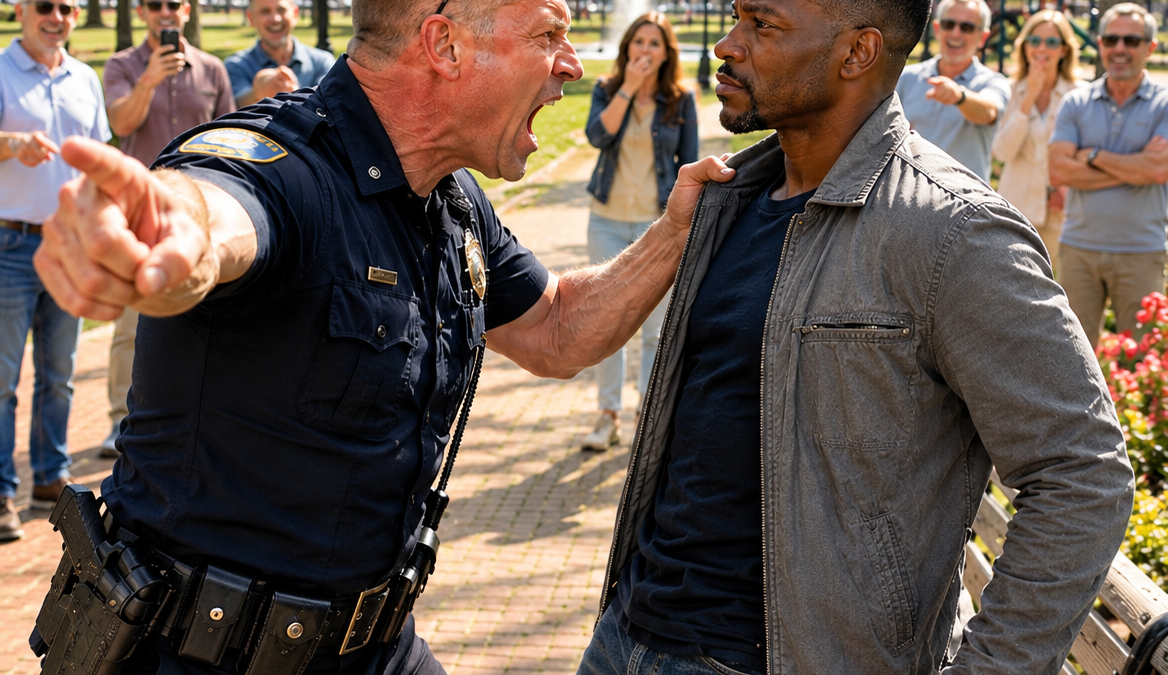
GET OUT OF MY PARK. >> THE words hit before the man even looked up. >> You not YOU HEAR ME? GET OUT. THIS AIN’T YOUR NEIGHBORHOOD. This ain’t your world.
>> The man folded his hands. >> I’m just sitting, officer. >> Sitting? >> The cop kicked the bench leg. >> You people don’t sit. You lurk. USE A PUBLIC PARK. STINK UP EVERYTHING YOU TOUCH. >> Grabbed the man’s collar, yanked him up.
>> Not for you. Not here. >> Shoved him forward. >> I can smell where you came from. Move your black ass before I drag you out like the trash you are. >> Man steadied himself, looked the cop dead in the eyes, said nothing.
Just a calm, quiet, half-smile. That smile was about to cost this officer everything. His badge, his freedom, and the nine-year career he’d built one lie at a time.
Have you ever felt that deep satisfaction watching a man in uniform lose everything? His badge, his career, his freedom, because he picked the wrong person to disrespect? Because you are about to.
So, drop a comment, hit that like, and let me take you back to where it all began. Lincoln Park sat at the edge of the Eastwood neighborhood in a mid-sized city in Ohio. Three years ago, it had been a different place entirely.
Cracked concrete pads led nowhere. Swing sets stood rusted and chainless. Benches rotted under layers of pigeon waste and peeling paint. Graffiti covered the restroom walls.
Needles turned up in the sandbox after dark. It was the kind of park mothers warned their children about. The kind of place the city forgot on purpose. Not anymore. The renovation took 18 months.
Workers resodded 3 acres of dead lawn. Electricians installed amber LED path lights that glowed after sunset. New brick walkways curved through rows of freshly planted oaks.
A children’s playground gleamed with slides, climbing walls, and rubber matted surfaces. Benches lined every path, solid white oak, polished smooth with bronze armrests that caught the morning light.
A fountain gurgled near the east entrance, and near the center of the park, a bronze plaque stood on a stone pedestal draped in red cloth. Whatever name it carried would be revealed tomorrow at the official rededication ceremony.
The local paper ran the story 3 weeks earlier. Anonymous donor saves Lincoln Park from developers. The television stations covered it twice. The mayor posed for photographs at the construction site and called it a victory for the community.
Everyone in Eastwood knew that someone had spent a fortune to save this park from the wrecking ball. No one knew who. Terrence Owens walked through the east entrance just after 7:00 on a Sunday morning. He carried a paper cup of coffee from the gas station two blocks over.
Black, no sugar. Nothing about him drew attention. He moved through the park quietly, like a man revisiting a place that lived more in memory than in the present. He made his way to a bench near the playground.
Not just any bench. Third from the big oak on the north side. He sat down, set his coffee beside him, and ran his fingers along the armrest. The wood was new, smooth, but the spot was the same.
32 years ago his mother used to bring him here every afternoon after school. Eloise Owens worked two jobs, nights in the hospital laundry, mornings at a diner on 4th Street. But between 3:00 and 5:00 every single day, she belonged to him.
They would walk to this bench, sit side by side, and she would ask the same question. “What did you learn today, baby?” He would tell her everything, and she would listen like he was the only voice in the world.
Eloise died 5 years ago. Pancreatic cancer, diagnosed in March, gone by September. She never saw what her son became. She never knew about Owens Capital, the technology investment fund Terrence built from a studio apartment and a
second-hand laptop into a $3.2 billion empire. She never read the Forbes profile. She never watched the Bloomberg interview. She never sat in the room when senators and Fortune 500 CEOs shook his hand and called him, “Sir.”
She never knew he bought this park. 3 years ago, the city council voted five to two to sell the land to Whitmore Properties. 14 acres of public space gone, replaced by luxury condominiums, a parking structure, and a coffee franchise on the corner.
Terrence read about it in the Tribune from his corner office 40 floors above downtown Chicago. He set the paper down, picked up his phone, and called the mayor’s office directly. “How much for the land?”
“28 million.” He wired it that afternoon. Then he wrote a second check, 12 million for the full renovation. New paths, new playground, a community center on the west side. 312 custom-built benches.
And one condition written into the deed in permanent ink. This land could never be sold, developed, or converted for any purpose other than public use. It would remain a park forever.
Tomorrow, the city would unveil the plaque with his name. The mayor would speak. The press would line the walkways. Terrence had agreed to attend. Reluctantly. But today, he just wanted to sit.
The morning air carried the smell of fresh-cut grass and damp earth. A robin landed beside his coffee cup, considered it briefly, and flew off. Somewhere across the park, a sprinkler hissed through its slow arc.
Sunlight filtered through the oak canopy and landed warm on his hands. Terrence closed his eyes. He could almost feel his mother’s fingers wrapped around his. Small. Warm.
Rough from years of bleach and dishwater. “I kept it, Mama.” He whispered. “I kept your park.” He had no way of knowing that in less than 20 minutes, a police officer would walk up to this bench, grab him by the collar, and try to throw him out of his
own park. The 911 call came in at 7:23. A woman named Karen Gladwell, 44, recently moved into one of the new townhouses across the street, had been watching from her kitchen window while her coffee brewed.
She saw a black man sitting alone on a park bench. No dog, no children, no book, no jogging clothes, just sitting. She picked up her phone.
Hi, yes, I’d like to report a suspicious individual at Lincoln Park. Black male, maybe late 30s, sitting alone near the playground. He’s been there about 20 minutes. I haven’t seen him before.
He doesn’t look like he I mean, I just don’t feel comfortable. Could someone check it out? The dispatcher asked if the man was doing anything threatening or illegal. No, not exactly.
But, you never know. He just doesn’t fit. Officer Brett Sullivan was three blocks away when the call crackled through his radio. Suspicious person, Lincoln Park, black male, gray jacket.
He swung the cruiser around without hesitation. Sullivan had been on the force for nine years, the last four, Eastwood Precinct. He patrolled this neighborhood like it was his property. Every block, every alley, every park bench.
He kept a mental catalog of faces that belonged. The additions were rare. The deletions were permanent. He pulled the cruiser into the gravel parking lot at 7:31, killed the engine, adjusted his sunglasses in the rearview mirror,
cracked his knuckles, stepped out. His boots crunched across the gravel with deliberate, measured weight. He didn’t hurry. Officers like Sullivan never hurried toward a target they had already categorized.
He crossed the lot, stepped onto the brick path, and headed north. Terrence heard the footsteps before he saw the uniform. Heavy soles on new brick. Measured. Unhurried.
The sound of a man who believed he owned every square foot he walked on. Terrence opened his eyes. Sullivan stopped 4 feet from the bench. Legs apart. Left hand on his utility belt.
Right hand hovering [clears throat] near his holstered weapon. He didn’t sit. He didn’t crouch to make eye contact. He stood over Terrence and looked down at him like a building inspector examining a code violation.
What are you doing here? No good morning. No introduction. No badge number. Terrence looked up. Enjoying the park. Enjoying the park.
Sullivan repeated the words slowly, giving each one a sarcastic edge, like he was translating something ridiculous. You got ID on you? Am I required to show identification for sitting on a public bench?
Sullivan’s jaw muscle jumped. He tilted his head to the right, a habit he had when someone tested his authority. I ask the questions. You give the answers. That’s how this works.
ID. Now. Terrence reached into his jacket pocket. Slowly. Hands visible at every stage. The motion every black man in America learns before he learns to drive.
Slow hands. Open palms. No sudden movements. He pulled out a worn leather wallet. Slid his driver’s license free, and held it out. Sullivan snatched it, studied the photograph, studied Terrence, studied the photograph again, like
something didn’t add up. Terrence Owens, Chicago, Illinois. He held the license between two fingers at arm’s length. Long drive just to sit on a bench.
I grew up three blocks from here. Sure you did. Sullivan slipped the license into his own chest pocket, did not hand it back. So, Mr. Owens from Chicago, what brings you to my park at 7:00 in the morning?
Your park? My park. My beat. My jurisdiction. I patrol this neighborhood 365 days a year. I decide who sits where.
And right now, he pointed a finger at Terrence’s chest, I’m deciding about you. Terrence watched him. His hands rested on his thighs, fingers loosely interlocked. The same posture he held in boardrooms when a man across the table was making a mistake he didn’t understand yet.
Calm. Patient. Still. Sullivan keyed his shoulder radio. Dispatch, run a name for me. Terrence Owens. He read off the license number and date of birth from memory.
Chicago address. I want warrants, priors, everything you’ve got. The radio hissed. 30 seconds passed. A minute. 613, your subject comes back clean. No warrants, no priors, no flags.
Sullivan stared at the radio like it had betrayed him. He looked at Terrence. Looked at the bench. Looked at the empty park around them. A clean record didn’t fit the story in his head.
Stand up. He said. Terrence stood. Slowly. He rose to his full height and met Sullivan’s eyes. Level. Unblinking. Turn around. Hands flat on the bench.
On what grounds are you searching me? On the grounds that I told you to. Sullivan stepped forward until less than a foot separated them. You want to do this the easy way or the hard way? Your choice.
But one of them ends with you on the ground. Terrence held the stare for three full seconds. Then he turned. Placed his palms flat on the warm oak. Sullivan’s hands moved over his jacket.
Down his sides. Across his waist. Into every pocket. He extracted a smartphone. A set of car keys on a plain black fob. A pack of spearmint gum. And $14 in loose bills.
He set each item on the bench spaced apart like numbered exhibits at a crime scene. He picked up the keys. Turned them over. What do you drive? That’s not relevant to anything.
I’ll decide what’s relevant. He squeezed the fob studying it. Fancy key for a man dressed like you. Doesn’t match. He dropped the keys on the bench and began a slow circle.
Behind Terrence. To his left. Back to the front. A predator testing boundaries. Here’s what I see. 7:00 a.m. Sunday.
Park’s empty. And you’re parked on a bench, alone, doing nothing, dressed like you just rolled out of wherever you slept last night. He paused. So, either you’re lost or you’re up to something.
And you don’t strike me as lost. I told you I grew up here. And I told you I don’t care. Across the park, the encounter had started drawing eyes.
A woman pushing a double stroller noticed Sullivan’s posture. She gripped the handlebar tighter and turned her children in the other direction. An elderly man near the fountain folded his newspaper, stood without a word, and walked away.
Two joggers slowed, exchanged a glance, and kept running. A teenager walking a golden retriever stopped near the parking lot, pulled out his phone, and started recording from 30 yards away.
Sullivan didn’t notice or didn’t care. He keyed his shoulder radio again. Dispatch, Sullivan, badge 613. I’ve got a male subject detained at Lincoln Park, north side playground area.
Requesting backup. The radio crackled. Copy 613, unit en route, ETA 4 minutes. The word detained settled into the morning air like a stone dropped into still water.
Terrence stared at the bench beneath his palms. White oak, tight grain, quarter sawn. He had chosen this wood himself, sat in his Chicago office with a supplier’s catalog spread across the conference table, comparing samples.
Quartered sawn white oak. Water-resistant finish. Marine-grade stainless hardware. 312 benches, custom-built. Shipped 1,200 mi to a park he hadn’t visited in 20 years.
>> He signed the purchase order with a pen that cost more than Sullivan’s monthly salary. And now, he was being frisked on top of one of them. “You know what I think?” Sullivan said, stopping behind him.
“I think you’re casing this park. Brand new playground equipment, new light fixtures still in boxes, construction tools lying around. He rested his hand on his belt. I’ve seen it a hundred times.
Guys like you show up in the daytime, scope everything out, then come back at 2:00 a.m. with a pickup truck and a crowbar.” >> Terrence’s fingers pressed into the oak. A vein rose along the back of his right hand.
His knuckles whitened. But when he spoke, his voice came out level and low, like a man who had been in this exact position before, and knew precisely where this road ended.
“Guys like me.” >> Sullivan leaned close, close enough that Terrence felt the heat of his breath on the back of his neck, close enough to smell the stale coffee and wintergreen chew.
“Yeah.” A beat of silence. “Guys like you.” A long silence settled over the bench. Sullivan straightened up, hooked his thumbs into his belt loops, looked around the park like he was
surveying his kingdom. Tell you what though, he said, almost conversationally, like they were friends now. I’ll give you one chance. You get up, walk out of this park right now, and I’ll forget this whole thing.
No report, no record. You just disappear back to whatever hole you crawled out of in Chicago, and we pretend this never happened. Terrence turned his head slightly, just enough to see Sullivan’s face over his shoulder.
And if I don’t? Sullivan smiled. The kind of smile that had no warmth in it, just teeth. Then we’re going to find out how your day really ends.
Terrence turned back, placed his hands flat on the bench again. I’m not leaving. Sullivan’s smile vanished. Wrong answer. The backup unit pulled into the gravel lot 4 minutes later.
Officer Danny Pierce stepped out of the second cruiser. He was older than Sullivan by nearly a decade, 12 years on the force, quieter. The kind of cop who kept his hands in his pockets and his opinions to himself.
He walked toward the bench with none of Sullivan’s swagger, just a man reporting to a call he hadn’t asked for. He saw the scene immediately. A black man standing with his hands flat on a park bench, Sullivan circling behind him, one hand on his belt,
chest puffed. The items laid out on the bench like evidence. And across the park, a growing cluster of bystanders with phones raised. Pierce had seen this before.
He knew what it looked like. He knew what it was. He approached Sullivan and spoke low. What do we have? Suspicious individual sitting alone near the playground at 7:00 a.m.
No explanation. Record came back clean, but I’m not buying it. He’s evasive, won’t give straight answers. Pierce glanced at Terrence. The man hadn’t moved, hadn’t spoken.
His palms were still flat on the bench, his back straight, his breathing even. He didn’t look evasive. He looked like a man exercising an extraordinary amount of self-control.
Brad, Pierce said quietly, maybe we should cut him loose. He hasn’t done anything. Sullivan turned to Pierce with a look that could melt asphalt. I’ve got this.
Just back me up. Pierce took a step back, said nothing. That silence would haunt him for the rest of his career. Sullivan turned back to Terrence. All right, Mr. Chicago, here’s what’s going to happen.
I’m going to cuff you for my safety while I figure out what you’re really doing here. You can cooperate or you can resist. But I promise you, resisting is not going to go well for you. I haven’t committed any crime, officer.
I’ll be the judge of that. Sullivan pulled the handcuffs from his belt. The metal clicked and rattled, a sound Terrence had heard before in news clips and documentaries, in the stories his uncles told around the kitchen table.
But never against his own wrists. Until now. Hands behind your back. Terrence moved slowly. He brought his arms behind him. >> [clears throat] >> Sullivan grabbed his left wrist first, clamped the cuff tight.
Too tight. Then the right. The metal bit into his skin. Cold, sharp. Terrence felt the ratchet click three times. Each click a notch tighter than necessary.
There. That wasn’t so hard, was it? Sullivan’s voice carried the satisfaction of a man who had proven a point. Terrence stood still. Hands cuffed behind his back. Standing in a park he owned. On a path he had paid for.
Beside a bench he had chosen. Breathing air that smelled like the grass he had replanted. The crowd had grown. 15 people now. Then 20. Phones pointed at them from every angle.
A woman in a jogging outfit had stopped dead on the path, recording vertically. A man walking two dogs stood frozen near the fountain. The teenager with the golden retriever had moved closer. 20 yards now.
His phone held steady. His mouth slightly open. Turn around and face me. Sullivan ordered. Terrence turned. The handcuffs clinked behind him. Sullivan looked at him with the expression of a man who had caught exactly what he expected to catch.
He planted his feet, crossed his arms, and leaned his head forward. Now, you’re going to tell me exactly what you’re doing in my park. And if I think you’re lying even once, we’re going to take a ride downtown.
Understand? I came to sit on a bench. Sullivan stepped forward and jabbed a finger into Terrence’s chest, hard enough to push him back a half step. Nobody drives from Chicago to sit on a bench in a park at 7:00 in the morning.
You’re lying. You’ve been lying since I got here. I’m not lying. Then explain yourself. What’s your connection to this park? What are you after?
Terrence looked at Sullivan, at the finger still hovering near his chest, at the badge on his shirt, at the handcuffs biting his wrists. He took a breath.
My connection to this park is deeper than you could possibly imagine. Sullivan’s lip curled. Oh, is that right? Deeper than I could imagine. Try me.
I don’t think you’d believe me if I told you. Sounds like something a liar would say. Sullivan turned to Pierce. You hearing this? This guy thinks he’s special. Pierce said nothing.
His eyes were on the growing crowd. His hand was near his radio. His face carried the tight expression of a man who knew this was heading somewhere bad and didn’t have the courage to stop it.
Sullivan grabbed Terrence by the shoulder and shoved him forward. Walk. Terrence stumbled. His shoe caught the edge of a brick and he went down hard. Both knees hit the pathway.
The impact sent a jolt through his body. His chin snapped forward. His cuffed hands twisted behind him, wrenching his shoulders. He landed on the bricks. The same bricks his money had laid.
The crowd gasped. Someone screamed. He didn’t do anything. A woman covered her mouth. The teenager moved closer. His phone shook in his hand, but the camera never stopped rolling.
Sullivan stood over Terrence. Get up. Terrence didn’t move immediately. He stayed on his knees, breathing. The morning sun was warm on the back of his neck. He could feel the grooves of the brick under his kneecaps.
He looked down. Embedded in the pathway, 1 inch from his right knee, was a small bronze marker. He had approved the design himself. It read donated by the Owens Foundation.
His name under his knees. In the park this officer called mine. I said, “Get up.” Sullivan reached down, grabbed the back of Terrence’s jacket, and hauled him to his feet.
Terrence’s shoulder popped. He winced, but made no sound. Sullivan dragged him toward the cruiser, one hand gripping his arm above the elbow, the other on his collar. Terrence’s feet scraped the bricks.
The coffee cup he had left on the bench tipped over. Black coffee ran down the oak slats and dripped onto the ground. The crowd was 30 people now, phones everywhere. Two women were crying.
An older black man stood near the playground, fists clenched at his sides, tears streaming down his face. He looked like he wanted to step in. He didn’t. He knew better.
They all knew better. “Please.” one woman called out. “He’s not resisting. You don’t have to do this.” Sullivan wheeled around. “Back off, all of you. This is police business.
You want to end up in cuffs, too? Then keep talking.” The crowd went silent, but the phones stayed up. Sullivan marched Terrence to the cruiser parked in the gravel lot. He opened the back door and placed his hand on top of Terrence’s head.
The standard transport hold, but he pressed down harder than standard. Much harder. “Get in.” Terrence ducked, sat on the plastic seat.
The handcuffs dug into his lower back. The seat smelled like disinfectant and old sweat. The partition screen was scratched with graffiti from a dozen previous occupants.
Sullivan slammed the door shut. Through the window, Terrence could see the park, his park. The oak tree, the bench, the fountain, the red cloth over the bronze plaque fluttering in the breeze, hiding his
name from the world for one more day. He closed his eyes, breathed. Then he spoke quietly through the partition.
Officer Sullivan. Sullivan was leaning against the front fender of the cruiser writing notes on a pad. He had already decided the narrative. Suspicious individual. Uncooperative.
Detained for safety. It would look clean on paper. It always did. He didn’t look up. What? I’d like you to make one phone call before we go anywhere. Yeah.
To who? Your lawyer. To your chief. Chief James Harrison. Tell him you have Terrence Owens in custody at Lincoln Park. Sullivan snorted. Didn’t look up from his notepad.
Chief Harrison doesn’t take personal calls from park benchers. He’ll take this one. Sure, he will. Sullivan kept writing. He dotted a period so hard the pen nearly punched through the paper.
Pierce, standing by the second cruiser, heard the exchange. He heard the name Terrence Owens. Something about it snagged in his memory. A news article? A conversation at the precinct? A briefing he half-listened to about the park renovation ceremony.
His stomach dropped 6 in. He walked to Sullivan. Brett? Maybe you should make that call. Sullivan looked up, annoyed. Why? Just make the call.
I’m not calling the chief on a Sunday morning because some vagrant told me to. He slapped the notepad shut. At that moment, neither of them noticed the black SUV pulling into the far end of the parking lot.
The engine was quiet. The windows were tinted. The driver’s side door opened and a man in a charcoal suit stepped out. He was already on the phone and his jaw was set in a way that meant someone’s morning was about to get very, very bad.
Police Chief James Harrison had not planned to be at Lincoln Park this morning. Victoria Ashford, Terrence Owens’ chief of staff, had called him 11 minutes ago. Her voice was flat and controlled, the way it got when something had gone badly wrong.
Chief Harrison, Mr. Owens is being detained by one of your officers at Lincoln Park right now, in handcuffs. He was in his car before she finished the sentence. Now he stood at the edge of the parking lot.
A cruiser with its back door shut, a black man sitting inside, wrists cuffed, head bowed. An officer leaning against the hood. A crowd of 30 people with phones raised like torches.
Harrison’s chest tightened. >> [clears throat] >> He recognized the man in the back seat. Two weeks ago, they had discussed tomorrow’s ceremony over dinner. The man had written an $8 million check to the police department’s community fund.
That man was now in handcuffs in his own park. [clears throat] Harrison walked across the gravel. His badge caught the sunlight. Sullivan saw the chief approaching and straightened.
He hadn’t expected brass on a Sunday morning. He tucked his notepad away and stood at attention, or something close to it. Chief Harrison, didn’t expect to see you here. I’ve got a situation under control. Male subject, suspicious behavior, refused to
cooperate. Open that door. Sullivan blinked. Sir? Open that door. Now. Sullivan hesitated. Then he moved to the rear door of the cruiser and pulled it open.
Terrence looked up. His wrists were red where the cuffs had bitten in. His jacket was dusty from the fall. His knees had two dark smudges from the bricks. But his eyes were the same.
Calm. Still. That same half smile at the corner of his mouth. Mr. Owens? Harrison’s voice cracked on the second syllable. He reached into the car with both hands.
I am so deeply sorry. He fumbled for his universal key. His hands were shaking. It took him two tries to get it into the cuff lock. The metal fell away from Terrence’s wrists and clattered against the plastic seat.
Sullivan stood 3 ft away. His brain was processing the words in slow motion. Mr. Owens? The chief’s voice breaking. The chief reaching into the car himself.
The chief apologizing. Sir? Sullivan started. I don’t understand. This man was Harrison turned on him. The chief’s face had gone from pale to dark red.
A vein pulsed at his temple. Do you have any idea who you just put in handcuffs? Sullivan opened his mouth. Nothing came out. Harrison pointed to the center of the park.
To the stone pedestal. To the red cloth fluttering in the breeze over the bronze plaque. You see that sign? Tomorrow morning at 10:00 a.m. in front of 200 guests, the mayor, the city council, and every television camera in
this state, that cloth comes down. And the name underneath it is Owens. Terrence Owens. Harrison’s voice rose with every word.
This man bought this park. Every bench your suspect was sitting on, he paid for it. Every brick you shoved him onto, he paid for it. Every light, every path, every blade of grass you call your park, he paid for
it. With his money, out of his pocket. 28 million for the land. 12 million for the renovation. 8 million for your department’s community fund.
Sullivan’s face drained white, then gray. His hands began to tremble. First the fingers, then the wrists, then the arms. Terrence stepped out of the cruiser, straightened his jacket, rolled his wrists,
looked across the park at the bench, the oak tree, the plaque hidden under red cloth. He turned to Sullivan. The officer’s mouth was moving, but no words came out.
His hands hung at his sides, twitching. He looked like a man watching his house burn from across the street. Terrence studied him. There was no anger in his face, no triumph, something closer to sadness,
the kind that comes from seeing something you expected, but hoped you wouldn’t. It was never your park, officer. His voice was quiet, even, but it was always everyone’s park.
That’s why I bought it. Sullivan’s knees buckled slightly. He caught himself on the cruiser door. Pierce, standing 10 ft away, had gone completely still. His face was the color of old paper.
The crowd had heard everything, every word. 30 phones had captured it all. The chiefs, shaking hands, the name, the number, the truth. And somewhere in the silence that followed, the red cloths on the plaque stirred
once in the morning breeze, as if the park itself had exhaled. The teenager lowered his phone. His hands were shaking. He looked at the screen. 42 minutes of footage. Every word, every shove,
every click of the handcuffs. He didn’t know it yet, but that video would be viewed by more people in the next 72 hours than the population of the entire state.
The woman with the stroller was crying. The old man near the playground unclenched his fists for the first time in 20 minutes. A jogger who had stopped to watch pulled off her headband and pressed it to her eyes.
Nobody moved. Nobody spoke. They just stood there in Terrence Owens Park and witnessed the exact moment the ground shifted beneath a man who thought he owned it all.
The next 60 seconds moved fast. Harrison turned to Sullivan. His voice dropped low, not for privacy, but because the words that followed didn’t need volume. They carried their own weight.
Badge. Gun. Now. Sullivan’s fingers moved to his chest. They fumbled with the pin on his badge, the same badge he had polished every morning for 9 years, the same one he tapped when he told people, “I’m the law around here.”
It took him three tries to unclip it. His hands wouldn’t stop shaking. He placed the badge in Harrison’s open palm. The metal was still warm from his body. Weapon. Sullivan unholstered his service pistol, ejected the magazine, cleared
the chamber, handed it over grip first, barrel pointed at the ground. The motions were mechanical, muscle memory, performing a ritual his conscious mind hadn’t caught up to yet.
Harrison set the badge and weapon on the hood of the cruiser. He didn’t look at them. He looked at Sullivan. “You are suspended without pay effective immediately. You will be escorted home. You will surrender your department vehicle, your access credentials, and your duty uniform by end of day.
Internal Affairs will contact you within 48 hours. The District Attorney’s office will receive my report by tonight. He paused. Do you understand? Sullivan nodded.
A small, broken movement. Like a machine running out of power. Do you understand? Harrison repeated, harder. Yes, sir. Go wait by Officer Pierce’s vehicle.
Don’t speak to anyone. Don’t speak to the press. Don’t speak to the crowd. You’re done. Sullivan turned and walked toward Pierce’s cruiser. His boots, the same boots that had crunched across the gravel with such authority 20 minutes ago, now scraped the ground in a shuffle.
His arms hung limp. His head was down. The spot on his chest where the badge had been was a darker shade of fabric. A clean rectangle surrounded by sun-faded navy. He looked like a man who had been unplugged.
The crowd watched him go. Nobody cheered. Nobody shouted. The silence was heavier than any insult. Harrison turned to Terrence. Mr. Owens, I cannot begin to express
Terrence raised a hand. Not now, Chief. Not here. Harrison nodded. He understood. There would be time for formal apologies, press statements, investigations, but not in this parking lot.
Not in front of cameras. Victoria Ashford arrived on foot from the far end of the lot, moving quickly in low heels. She carried a phone in each hand and a leather portfolio under her arm.
She looked at Terrence’s wrists. The red marks from the cuffs were already darkening toward purple, and her jaw tightened. Sir, your legal team is on line one. Channel 4 is already running a breaking alert.
Someone in that crowd streamed the entire thing live. Terrence took one of the phones, held it for a moment without answering. His eyes drifted past Victoria, past the cruiser, past Harrison, to the bench.
Third from the oak. His coffee was still there, tipped on its side, the last of it dripping down the slats. He brought the phone to his ear. Gerald? Yes. I’m fine.
No. I need you to listen. I want a full civil rights complaint filed before noon. Federal, not state. I want the body cam footage subpoenaed before they have a chance to lose it.
And I want the name of the woman who called 911. He paused. Yes. All of it. Today. He hung up and turned back to the park.
The crowd had begun to murmur. Word was spreading. Phones buzzed with shared videos. Someone had already posted the live stream with the caption, “Cop tells billionaire to get out of his own park.”
Pierce approached Terrence slowly. He stopped 5 ft away. His hands were in his pockets, his shoulders were drawn in. He looked like a man walking into a confession booth. Mr. Owens.
His voice was hoarse. I was there the entire I saw what was happening. I knew it was wrong. He swallowed. And I didn’t stop it. I didn’t say a word.
Terrence looked at him, studied him. Pierce’s eyes were wet. His chin trembled. “You’re right,” Terrence said. “You didn’t.” Pierce nodded. He didn’t try to explain.
He didn’t make excuses. He just stood there, absorbing the weight of what he had allowed to happen. “I should have stepped in,” Pierce whispered. “Yes,” Terrence said quietly.
“You should have.” He turned and walked back toward the bench, his bench, his park. He picked up the fallen coffee cup, set it upright on the armrest, and looked at the red cloth rippling over the bronze plaque.
Tomorrow, every person in this city would know his name. But not the way he had planned. The body cam footage hit the internet before noon. Sullivan’s camera had captured everything.
The approach, the first words, “What are you doing here?” The ID check, the search, the shove, the fall, both knees hitting the bricks, the handcuffs ratcheting shut, and the audio, crisp, damning,
undeniable. “Get out of my park. I can smell where you came from. Guys like you.” A local journalist named Denise Crawford was the first to post it. She had been in the crowd, filming on her phone, and cross-referenced it with the official body cam release that
Harrison’s office pushed out at 11:45. Her thread went up at 12:03. By 1:00 p.m. it had 6 million views. By 3:00 p.m. CNN had it.
MSNBC ran a special segment. Fox News covered it from a different angle, but covered it nonetheless. The Associated Press sent a wire bulletin. The New York Times published a digital piece before dinner.
The headline was the same everywhere with minor variations. Cop tells billionaire park owner to get out of my park. The photograph that defined the story was pulled from the teenager’s video.
It showed Terrence on his knees, hands cuffed behind his back, head bowed, and just below his right knee, clearly visible on the brick, the bronze marker donated by the Owens Foundation. That image was shared 44 million times in the first week.
It appeared on protest signs. It was painted on murals. A political cartoonist turned it into a single panel that ran in the Washington Post. A man kneeling on his own name while a badge stood over him.
The mayor called a press conference at 4:00 p.m. Sunday. She stood behind a podium at City Hall with Harrison to her left and the city attorney to her right. Her statement was brief. Her voice shook.
What happened this morning at Lincoln Park is unacceptable. It is a failure of training, a failure of judgment, and a failure of the values this city claims to stand for. I have asked the chief of police to launch a full internal affairs investigation, and I have personally requested that the
Department of Justice Civil Rights Division review this case independently. Officer Sullivan has been suspended without pay. Additional disciplinary actions will follow. She took no questions.
By Monday morning, the District Attorney’s Office had filed formal charges against Brett Sullivan. The list was precise and damning. Fourth-degree assault, unlawful detention, deprivation of civil rights under color of law, conduct unbecoming.
Each charge carried its own weight. Together, they carried the potential for 12 years in federal prison. Sullivan’s attorney released a one-paragraph statement calling the encounter a misunderstanding and asking the public to withhold judgment.
The public did not comply. The woman who made the 911 call, Karen Gladwell, was identified by Tuesday. Her voice was unmistakable on the dispatch recording, which was released under a public records request.
The internet found her name, her address, her employer, her social media accounts. Her company received 14,000 emails in 2 days. She was terminated on Wednesday.
She deleted every social media profile by Thursday. By the weekend, a for sale sign stood in front of her townhouse, the same window she had watched Terrence from 6 days earlier.
Pierce faced his own reckoning. Internal Affairs placed him on administrative leave within 24 hours. The charge, failure to intervene. He had stood 4 feet away while his fellow officer illegally detained, searched, and assaulted a man who had
committed no crime and said nothing. His silence was not neutral. It was complicity. Pierce didn’t fight it. He submitted a written statement three pages single-spaced handwritten in which he admitted everything.
I knew Officer Sullivan was wrong. I knew the man on the bench had done nothing. I chose silence because it was easier. That choice makes me responsible for what happened next.
He was demoted from officer to desk duty and suspended for 6 months without pay. The trial came 5 weeks later. Sullivan’s attorney tried to argue reasonable suspicion. The judge dismissed it in three sentences.
There was no reasonable suspicion. There was no probable cause. There was no crime. There was only a black man sitting on a bench in a public park and an officer who decided that was enough.
The prosecution played the body cam footage in full. 8 minutes and 43 seconds. The courtroom was silent except for the audio. Sullivan’s voice filled the room. Every insult, every command, every sneer
preserved in digital clarity. When the footage ended, the prosecutor asked one question. Officer Sullivan, whose park was it? Sullivan something.
Sullivan shook his head. He pled guilty to three of four charges as part of a deal. The judge accepted the plea and handed down the sentence. 4 years in federal prison, 5 years of supervised probation following release, permanent ban from employment in any law
enforcement agency in the United States, and a personal restraining order. He was never to contact Terrence Owens directly or indirectly for the rest of his life. As the sentence was read, Sullivan stood with his hands clasped in front of him.
The same hands that had grabbed, shoved, and cuffed. They were shaking again. They hadn’t stopped shaking since that Sunday morning. The city council convened an emergency session the following week.
They passed what the local papers called the Owens reform package, a set of sweeping policy changes drafted in direct response to the incident. Mandatory activation of body cameras for all patrol officers with automatic termination for non-compliance.
Quarterly bias training, not optional, not online, but in person, led by outside civil rights organizations. A new civilian oversight board with subpoena power. An independent complaint process for residents.
And a complete overhaul of stop and search protocols, requiring documented probable cause before any physical contact. The package passed unanimously. Not because every council member believed in it, but because every council member had seen the video.
And every one of them knew that the man who bought their park was watching. Three weeks after the vote, Harrison held a department-wide assembly. Every officer in the precinct sat in the auditorium.
On the screen behind him, he played the body cam footage one more time. All 8 minutes and 43 seconds of it. When it ended, he let the silence stretch for 10 full seconds.
Then he said five words. This will never happen again. No one in that room doubted him. Because the empty chair in the third row, Sullivan’s chair, said everything his words didn’t.
Across town in a federal holding facility, Sullivan sat on a concrete bunk and stared at a wall. He had lost his badge, his gun, his career, his pension, his reputation, and his freedom.
All because he looked at a man sitting on a bench and decided, in the space of a heartbeat, that he didn’t belong. The cruelest part was this. He never did find out what kind of car Terrence drove.
It was a black Mercedes S-Class parked two blocks away. It cost more than Sullivan’s house. The rededication ceremony took place on a Tuesday, two days later than originally planned.
The delay was deliberate. Terrence wanted the world watching, and by Tuesday, the world was. The city had expected 200 guests. Over 3,000 showed up. They came from across the state and beyond. Families with children, college students with handmade
signs, elderly couples who had lived in Eastwood their entire lives. A group of retired officers in civilian clothes stood near the back, hats in their hands. Television cameras lined the main path.
Satellite trucks filled the parking lot. Two national news anchors broadcast live from the fountain. The red cloth still covered the bronze plaque. Terrence stood at the podium. He wore a dark suit.
First time in the story that anyone saw him dressed for the role the world now knew he held. But his hands rested on the podium edges the same way they had rested on the bench. Steady. Unhurried. Rooted.
He didn’t mention Sullivan by name. Not once. He talked about his mother. Eloise Owens was a laundry worker and a waitress. She raised me three blocks from where you’re standing. Every day after school she brought me to this park.
We sat on a bench. That bench right there. Third from the oak. And she asked me one question. The same question every day. “What did you learn today, baby?” He paused. The crowd was silent.
3,000 people and the only sound was the fountain. She taught me that a park is not a piece of land. A park is a promise. A promise that there is a place in this world where everyone belongs. Where no one can tell you to leave.
Where the ground under your feet doesn’t care what you look like, where you come from, or how much money you have in your wallet. His voice caught on the next line. He gripped the podium. I bought this park because the city was going to break that promise.
14 acres of public space sold to the highest bidder. Condos where the swing set stood. A parking garage where my mother and I used to sit and watch the sunset. He steadied himself.
$28 million. That’s what it cost to keep a promise my mother made to a 7-year-old boy. That every park belongs to everyone. He looked out at the crowd, at the cameras, at the phones, at the faces
young, old, black, white, brown, all watching him. What happened here last Sunday should never have happened. A man sat on a bench and another man in uniform decided he didn’t belong.
That man was me. But it could have been your father, your son, your neighbor. He paused. The only difference between my story and a thousand others is that I had the resources to fight back.
Most people don’t. He reached into his jacket pocket and pulled out a folded piece of paper. Today I’m announcing the creation of the Owens Justice Initiative. A $20 fund.
Its mission is simple. Body cameras for every department that can’t afford them. Free legal representation for victims of unlawful stops and searches. And scholarships, full ride every year for young people of color who want to go
to law school. Because the next person who sits on a bench and gets told to leave should have a lawyer on speed dial. The crowd erupted. 3,000 voices, applause that rolled across the park like thunder.
When it died down, Terrence nodded to the mayor. She stepped forward, took hold of the red cloth, and pulled. The bronze letters caught the morning sun. >> [clears throat] >> Owen’s Community Park, in memory of Eloise Owens.
Every park belongs to everyone. Terrence stood still for a long moment. He looked at the plaque, at his mother’s name in bronze, at the bench, his bench, her bench, everyone’s bench, sitting quietly under the oak tree,
exactly where it had always been. After the handshakes, after the cameras packed up and the crowds thinned, Terrence walked back to the bench. He sat down, set a fresh cup of coffee beside him, and looked out at the park, at children playing on the new equipment, at joggers
on the paths, at an old couple feeding pigeons near the fountain. No one told him to leave. He pulled out his phone and took a photograph of the bench armrest. Just the wood.
Just the grain. He typed a single line beneath it. For Mama, I kept your park. What would you have done if you were sitting on that bench? Would you have stayed as calm as Terrence?
Or would you have spoken up? Drop your answer in the comments. And if this story reminded you that dignity is not something anyone can take from you, share it with someone who needs to hear that today.
Like, subscribe, and remember, every park belongs to everyone.