Department Head Fired Black Doctor for Treating a Homeless Man — Not Knowing She Owned the Hospital
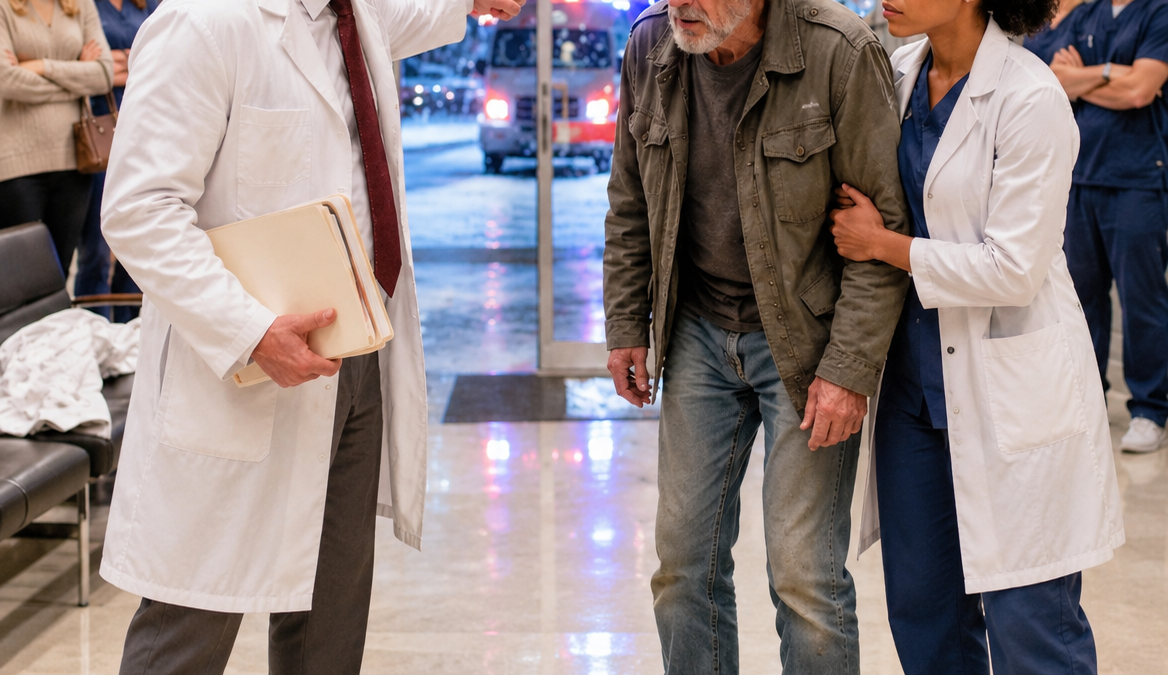
Step away from him now. He’s septic, Dr. Moore. His pressure is dropping. That’s a bed for paying patients, not garage off a bus bench. The waiting room went silent. Sleet ticked against the glass.
I’ve already started antibiotics. Her voice stayed level. On whose money? God, the smell. He wanted the room to hear it. 10 minutes, please. No badge, coat. You’re done. Red climbed his neck.
You’re firing me for treating a patient. For forgetting what you are. Faith’s hands shook. She pressed them flat so nobody would see. Wheel him to the curb yourself. He’ll die out there.
Then he dies where he belongs. Yes, Dr. Moore. Nobody moved. She folded the code and set it on the counter. 10 hours later, Moore walked into a meeting he thought was about his promotion and found out whose hospital he’d thrown her out of.
Have you ever watched someone powerful get everything they deserve right in front of the people they humiliated? Because you are about to so drop a comment telling me what you’d have done in that hallway. Hit that like button and let me take you back to the very beginning. 6 hours earlier, the night shift at Kingsbridge Memorial started
the way it always did. Sleep came down sideways in the ambulance bay. The automatic doors kept jerking open for nobody, letting in cold air that smelled like wet wool and diesel. Faith Anderson clocked in at 6. She walked the hallway before she touched a single chart. Bay 4
had a loose IV line taped by someone in a hurry. She stripped the tape, re-anchored it, and told the patient it would stop pulling now. Then she stopped at the janitor’s cart. How’s Ruby doing in algebra? Passing, he said. Barely.
Tell her I said barely still counts. On her way back, she bought two turkey sandwiches with her own card. One she ate standing up. The other she left at the intake desk with a sticky note that said, “For whoever needs it.
By 8, it was gone. Nobody ever told her who took it, and she never asked. Walter Boyd came in at 9:00 the way he always came in last. He waited outside until the chairs emptied so he wouldn’t take a seat from anybody. Faith found him by the wall, holding his left boot
in both hands. “Evening, Sergeant,” she said. “Ma’am.” He tried to stand. She waved him back down. Sorry to be a bother. He’d been coming to this ER for 3 years. The staff called him the bench guy because of where he slept two blocks down under the bus shelter with the
broken heater. Faith called him sergeant because he’d earned it in a desert in 1991 and because it cost her nothing. The boot came off. The sock did not. It had fused to the skin along the top of his foot. She smelled it before the numbers told her anything sweet, sour,
wrong. His temperature was 102. His heart rate was fast and getting faster. How long has it been like this? He thought about it. Since Christmas, maybe. Faith ordered blood cultures, fluids, and IV antibiotics.
Colleen Brady read the screen over her shoulder and made a face. You know, he’s uninsured, right? I know. He’s got a fever of 102. Brady pointed her pen at the laminated card taped to the triage counter. Resource stewardship protocol. Uninsured non-emergent patients get referred out.

Referred out, Brady said means back on the sidewalk. That’s Moore’s baby. Dr. Gerald Moore came in at 10:00 dry back from a conference in Florida. He looked at the board then at Faith.
Anderson, you’re saying seph triacone again. It’s Sephri AX1. Noted. You’re very articulate at handoff, by the way. People noticed that. He said it like a gift.
She said thank you because the alternative took energy she needed for the floor. 20 minutes later, a toddler came in barking for air. Moore had the airway open before Faith reached the doorway. He was fast, calm, and completely right. That was the thing about him nobody wanted to say out loud.
He was good at this. He just decided every shift who counted as a person. At 11, Faith stepped into the stairwell to take a call. Not yet, Margaret, she said. Give me a little more time. She hung up before anyone came through the door. Back at the desk, an email sat
unopened at the top of her inbox. The sender line read, “Bumont Health Holdings.” She closed the laptop when Brady walked over with a chart. Out in the far lot, a black sedan sat idling with its lights off. Nobody in that building knew what was in that email. Not Brady, who had
trained half the nurses on that floor. Not Moore, who signed her writeups. Faith had 11 months at Kingsbridge and a reason for every one of them. Tonight, the reason was lying in bay 4 with a fever. Walter’s blood pressure dropped at 11:40, 90 over 50, then 88.
Faith pushed fluids and moved him to a monitored bay. She wrote the note carefully, timestamping every order she gave. Some habit in her insisted on it. Even then, when she looked up at the tracking board, the line next to Boyd, Walter had changed. There were new initials on it. GM and one word in
capital letters, discharge. The antibiotic never came up from pharmacy. Faith checked the screen twice. The blood cultures were gone. The fluids were gone. Next to each canceled line sat the same three letters, GM.
11:44 p.m. She found him in the doctor’s lounge with his feet on a chair and the TV on mute. The room smelled like a coffee pot left on too long and the microwave was beeping at nobody. You canled my orders.
I corrected them. He didn’t look up. There’s a difference. He’s septic. Cultures and antibiotics aren’t optional. Do you know what a septic admission costs this hospital when nobody pays? Moore held up his cup like it was evidence. $14,000.
That’s a nurse’s overtime for a month. That’s not a medical decision. Everything in this building is a medical decision, Anderson. Including whether there’s a building next year. He smiled at her the way people smile at children who interrupt. You’ve been here what, 11 months? Sit with that number a while.
I’ve sat with a lot of numbers. His lactate is four. His lactate is four because he drinks. That’s not how lactate works. Something moved behind his eyes. Then, not doubt, irritation, the kind that files itself away for later. He set the
cup down and stood, and the chair scraped hard against the floor. Let me explain how the department runs, he said. We are not a shelter with an X-ray machine. Every bed that man occupies is a bed a paying family can’t have. You don’t get to spend the hospital’s money because you feel something.
He has a fever of 102 and his pressure is falling. Then give him a taxi voucher and a follow-up card. To what address? Moore laughed once. See, that’s the part you’re not built for, the hard part. Faith kept her voice level. She’d learned a long time ago
that volume was the first thing people used against her. Federal law requires a screening exam and stabilization, she said. regardless of ability to pay. That’s Mala. It’s not my opinion. I’ve been chief here 12 years. I know what Mala says. Then you know I can’t
discharge him. I know that I decide what stabilized means in my department. He walked around her toward the door close enough that she had to turn to keep facing him. He’s ambulatory. He’s alert. He’s dirty, which is not a diagnosis.
He’s stable. He was ambulatory. He can’t put weight on that foot. You people always do this, Moore said. The lounge went very quiet. The microwave kept beeping. [clears throat] Say the rest of that sentence, Faith said. You take a policy conversation and
turn it into something it isn’t. Red had crept up his neck and into his ears. That’s exactly what I mean. Every time in the doorway, a secondyear resident named Norah Whitfield had stopped with two coffees in her hands. She had come in for the sugar packets. She did not
move, and she did not breathe, and both of them watched her decide not to be there. “What?” Moore said pleasantly. “You need something?” “No, sir.” “Good.” He walked out. Faith stood in the smell of burnt coffee for three seconds, then
followed him because the man in bay four did not have time for her to be angry in private. Moore didn’t stop at the desk. He went straight down the main corridor where the doors to the waiting room stay propped open on busy nights and where 60 people were sitting on plastic chairs listening to sleep hit the glass.
Walter had heard the raised voices. He was already trying to stand. That was the part that would replay in Faith’s head for months, not the shouting. Walter Boyd, hand braced on the wall, sock stuck to his foot, apologizing.
I don’t want to cause trouble, ma’am. I can wait outside. I’m fine outside. Sit down, Sergeant. I really am fine, Sergeant. Sit down. She got him back into the chair and knelt to check his pulse. It was thin and running fast under her fingers, the rhythm of a body
starting to lose. Moore’s voice came from behind her, pitched for the whole room. Is this what we’re doing now? 60 people waiting and my attending is on the floor with a vagrant. Faith didn’t turn around. His lactate is four.
He’s dying while you talk. He’s homeless. There’s a difference between sick and homeless. And if you can’t see it, you shouldn’t be practicing. A mother in the second row put her hands over her son’s ears. An old man looked at the ceiling. Nobody said a word, and
the not saying filled the hallway like water. Do you know what you are? Moore said. You’re a diversity hire with a clipboard problem. Somebody upstairs needed a photo for a brochure, and here we are.
behind him near the vending machines. Whitfield’s phone came up to hip level. Her hand was shaking so badly she had to brace her wrist against her thigh. She kept it there anyway. Faith finished the pulse count. All of it. Then she stood up. I’m requesting a
second opinion from the on call hospitalist, she said. That’s my right under the medical staff bylaws. Request denied. That’s not a thing you can deny. Watch me. He went to the nearest workstation and started typing while she stood there. He was not fast
at it. He hunted for the keys with two fingers, and every pec was audible in that hallway, and somehow that made it worse. Then he opened Walter’s chart and changed the triage level from a two to a five. Non-emergent.
Two keystrokes. In the system, a dying man became a man with a sore foot, and every alarm the software would have raised went quiet. There, he said, “Now he’s a five. Now he’s somebody else’s problem.” That’s falsifying an assessment. That’s
clinical judgment. Mine outranks yours. At 11:50 p.m., an email went to human resources. Subject line: misuse of hospital resources/insubordination. F. Anderson. He read it aloud as he wrote it like a man dictating a shopping list. Refused to comply with
departmental resource protocol, he said, confrontational in front of patients and families. Repeated pattern. There’s no pattern. There is now. He hit send. That’s how patterns start. Then he pointed at the discharge chairs by the sliding doors, the row where people wait
for rides, where the cold rolls in every time the sensor trips. Boyd goes there now. Colleen Brady had been listening from the nurse’s station with a chart in her hand. She put it down. No. Moore turned.
Excuse me. I’m not wheeling a septic patient into a draft doctor. You want him there? You push the chair. You’re refusing a direct assignment. I’m refusing to help you kill someone slowly. Brady’s chin came up. Write me up. I’ve got 22 years and a union rep who’s bored.
You’re off this assignment. Go to fasttrack now. Brady looked at Faith. Faith gave her the smallest shake of the head. Don’t. Not for me. Not tonight. and Brady went walking slow enough to make it clear it was a choice. An older woman in the waiting room stood up like she meant to
say something. She looked at the white coat and she sat back down. That happens more than anyone admits. Authority doesn’t have to threaten a room. It just has to be wearing the right thing. A transport tech moved Walter to the discharge chairs. The doors opened for
an ambulance crew and stayed open 30 seconds. Sleet blew across the tile in a thin gray sheet, and Walter started to shiver in a way that had nothing to do with cold. Riggers, the body’s alarm bell.
Faith crouched in front of him. How you doing, Sergeant? Cold, ma’am? His teeth were chattering. Sorry. I know you got busy. You’re not sorry. There’s nothing to be sorry for. He’s not wrong, you know. Walter tried to smile about what I
am. He’s wrong about everything, she said. Stay right there. Don’t move. She stood and looked down the corridor. Moore was already back at the workstation, back turned, moving on to the next thing. The way you do when a problem is solved. In her head, Faith
ran the math one more time. The pharmacy line was closed to her. The orders were cancelled. The medical staff office wouldn’t open until Monday, and Walter Boyd did not have until Monday. He had hours, and she knew almost exactly how many. So, she walked into the supply
room, pulled the antibiotic and a bag of saline off the shelf, and scanned her badge to log them out under her own name. She understood exactly what that would look like on a report. She did it anyway. Faith hung the antibiotic herself at 12:12 a.m. She did it in the discharge
chairs, kneeling on tile, taping the line to Walter’s arm with her own hands because no nurse on that floor was allowed to help her. She ran the saline wide open. She wrote every step in the chart with the time attached down to the minute. The way you write when you already know somebody is going to read
it later. You don’t have to do this, ma’am. Hold still. I mean it. You got a job. I’ve had this foot a while. He was shaking hard now, the cup of water in his other hand jumping against his knee. It ain’t worth your job. Sergeant, if you
apologize to me one more time tonight, I’m going to be genuinely offended. He laughed. It turned into a cough that folded him in half. She got the antibiotic in over 18 minutes. Somewhere in that window, three floors up, a 58-year-old chief of emergency medicine
opened the Pixus dispensing log and started scrolling. He found the entry at 12:40 a.m. Anderson F. Two units pulled after her orders had been cancelled. There was also a morphine draw from earlier in the shift, wasted with a witness documented properly by a nurse
who’d since gone home. He put those two facts next to each other and made a decision that had nothing to do with either one. By 1:00, the word was moving through the night shift the way words do at 1:00.
Diversion. Nobody said it loud. A tech stopped talking when Faith walked past the bedroom. Two nurses looked at their screens instead of at her. A woman she’d worked beside for 11 months went quiet at the coffee machine, and the quiet had a shape to it.
Faith felt it land. She had felt it before in other buildings, in other cities. It’s not the accusation that gets you. It’s watching people you like decide in real time that it’s probably safer to believe it. Moore called security. At 1:15, Dwayne Kesler came
down from the loading dock with his radio hissing on his shoulder. He’d worked nights at Kingsbridge for six years. He knew Faith by name because she was one of maybe four physicians in the building who used his doc. He said, I need you to come to the staff locker room. Why? He says I got to open your
locker. Is HR here? No. Is my union rep here? Is there a witness from the medical staff office? Kesler’s jaw worked. No, ma’am. Then policy says you can’t. I know what policy says. He wouldn’t look at her. He
says if I don’t, I’m fired tonight. I got a kid at Central Piedmont. Tuition’s due in March. Faith looked at him for a long moment. Then open it, she said. But you write down every word he tells you and the time he tells you in your shift log tonight.
Doc, Dwayne, write it down. He wrote it down. The locker room smelled like wet coats and floor cleaner. Moore stood by the sinks with his arms folded while Kesler cut the lock. Eight or nine people found reasons to be in that corridor. That was the point of doing it
there. Her bag went onto the bench and Moore told them to empty it. A hairbrush, a protein bar, a wallet, a tampon that rolled across the bench, hit the tile and kept rolling. a folded index card with a child’s handwriting on it. Ruby’s
algebra grade taped inside the flap and her father’s stethoscope, the tubing gone soft with age, taped where it had cracked. It came out of the side pocket and hit the concrete with a small flat sound that carried down the whole corridor. Nobody breathed. Faith looked
at it on the floor and did not move to pick it up because she was not going to bend down in front of him. Kesler picked it up. He set it on the bench carefully with two hands. Nothing, he said. Nothing yet, Moore said. He turned to Faith. You’ll do an
observed screen now. Then we’ll see. On what grounds? Reasonable suspicion? It’s in the handbook. Reasonable suspicion requires documented behavioral indicators signed by two supervisors. Then I’ll find a second signature. He smiled with his mouth. There are 11
physicians in this building who’d sign anything I put in front of them and you know it. That’s not a threat. That’s arithmetic. Faith walked to the lab herself and gave the sample because refusing would have been the story. She stood in a bathroom at 1:40 in the morning with a stranger’s eyes on her and thought about her father
who died in an emergency room in Ohio while a resident wrote likely drug-seeking in his chart and who was at the time bleeding into his own belly from a torn spleen. The screen came back negative in the morning. By then, it wouldn’t matter. At 1:55 a.m., her badge
stopped working. She learned it at the door of the bedroom with a bag of fluids in her hand and a patient waiting. Red light. Red light again. She tried the doctor’s lounge. Red light. Somewhere in an office, someone had typed her name into a field and pressed a button. And 11 months of her life stopped opening
doors. She was standing in the corridor with the dead badge in her hand when Moore came around the corner with a clipboard and an audience of half the night shift. Anderson, you’re terminated. Effective immediately for cause. You can’t terminate a medical staff member. That’s
a peer review process. I can suspend you tonight and let peer review catch up. Badge coat and out. There’s a patient in Bay 6 waiting on There’s a patient in Bay 6 waiting on a doctor. You are not one as of 2 minutes ago. Colleen Brady
stepped out from behind the desk. This is insane. She said she hung an antibiotic. That’s the crime. She hung an antibiotic on a septic vet you dumped by the door. Brady, go home. I’ve got 4 hours left on shift. You’ve got zero hours left ever. Get out of my
department. And that was that. 22 years gone in a sentence in a hallway with the vending machine humming. Faith took off the coat. She folded it. sleeves in once across and set it on the counter. Then she picked up her father’s stethoscope from the bench where Kesler had left it and put it in her pocket.
What she did not do was tell him. The sentence was right there, one breath away. I own this hospital. She could have said it and watched the floor open under him. She didn’t say it. Not because she was noble. Because a fired doctor is a witness and an owner who
fires him in a hallway at 2:00 a.m. is just a rich woman having a tantrum. She wanted this done in a way he could never come back from. She was almost at the exit when she saw him do it. Moore sat down at the workstation nearest the discharge chairs. He opened Walter Boyd’s chart. He entered a note. Patient
refusing admission and further care. Advised of risks left against medical advice. Then he pulled the AMA form up on the screen and in the signature field with two fingers and no hesitation at all, he typed the name Walter Boyd.
Walter was 15 ft away, chin on his chest, too far gone to know his own name was being used. He’s not refusing, Faith said. He can’t refuse. He’s not oriented. He signed. He didn’t sign anything. He’s septic and hypotensive and you know it. Then I
guess it’s lucky I’m the one who documents it. Moore clicked save and stood up brushing his hands off. Get him to the curb. Somebody call a taxi voucher. And Anderson, if you’re still on this property in 5 minutes, it’s trespassing.
12 ft behind him, wedged between the vending machine and the wall, Norah Whitfield had her phone up. She had been recording for 4 minutes and 11 seconds. Her hand was steady now. Somewhere in the middle of it, the fear had turned into something else. That clip would end
up mattering more than anything else that happened in this hospital. A prosecutor would say so out loud in a courtroom 11 months later. Tonight, it was only a scared second year behind a vending machine, praying the screen wouldn’t dim.
She stopped recording, slid the phone into her scrub pocket, and went to check on the man in bay 6. Nobody else did. Faith walked out into the parking lot at 2:04 a.m. The sle had turned to something halfway between rain and ice, and it stung. She sat in her car and did
not cry. She pulled out her phone and called a number that only two people in Charlotte had. Margaret Linquist picked up on the first ring, wide awake, the way lawyers are. Faith, call the board, Faith said.
Tonight, all of them, 9:00 a.m., what happened? Faith watched the automatic doors slide open across the lot, and a transport tech wheel a chair out into the weather with a man slumped in it. He just gave me everything I needed, she said. call them.
Faith did not drive home. She got as far as the exit of the lot, sat with the engine running for 11 minutes, and turned around. The transport chair was empty by the curb, tipped on its side, wheels still turning in the wind. She found him under the ambulance canopy, 20 ft from the doors, slumped sideways
against the wall. His skin was cold. His breathing was shallow and fast. When she pressed on his fingernail, the color took 4 seconds to come back. Sergeant. Nothing. Walter.
Nothing. Her badge didn’t work, so she banged on the glass with the flat of her hand until it shook in the frame. Kesler came out first. Whitfield came out second, still in her scrub jacket. And she did not ask a single question. She just dropped to her knees on the wet concrete on the other side of him.
They coded Walter Boyd outside his own emergency room in the rain at 3:15 in the morning. Faith ran it. Kesler did compressions because he’d learned it in a church basement class. Whitfield got the airway. A medic crew coming off a call jumped in with a monitor. Faith
worked on him until her arms shook and somewhere in the middle of it, she started saying his rank out loud over and over like it was a rope she was throwing him. 90 seconds in, they got a rhythm back. He went up to the ICU under a different attending’s name because Faith Anderson no longer had privileges in that building. Gerald Moore arrived
on the executive floor at 9, holding a coffee and expecting to be congratulated. He’d sent his incident summary up at 4 in the morning. Difficult physician resource abuse handled decisively. He had written the phrase handled decisively twice.
He didn’t recognize the woman at the far end of the room taking notes on a small machine. He didn’t ask why the general counsel was there. He didn’t ask why the door closed behind him and stayed closed.
Harold, he said to the chairman, “Long night. You’ll want the short version. Sit down, Gerald.” He sat. He put his coffee on the table. Then he looked at the head of the table and stopped. Faith Anderson was sitting there, not in scrubs, not standing in a doorway
waiting to be dismissed, sitting at the head of the table with a folder in front of her. And nobody in that room thought it was strange. What is this? She’s not staff. I terminated her last night. You terminated an attending physician without peer review? Margaret Linquist
said, “We’ll come back to that.” Harold Prescott took his time. Old men on boards always do. “Dr. Moore, I don’t believe you’ve been properly introduced to Dr. Anderson,” he said. “She is the sole trustee of the Calvin Anderson Family Trust. The trust holds 63% of
Bumont Health Holdings.” Moore laughed, one short sound out before he could stop it. Bowmont owns this hospital, Prescott said, which means in every practical sense, so does she. She has since her father died, and she has been on your schedule for 11 months.
The lid came off Moore’s coffee cup in his hand. He didn’t seem to notice it running over his fingers and onto the table. That’s no, that’s not possible. She’s an attending. She takes call. She works nights.
She chose nights. Prescott said she wanted to see this place at 3:00 in the morning. That’s when hospitals tell the truth. Faith opened the folder. I had two questions when I took this job, she said. One, is it one man or is it the policy? Two, how far does that man go
when he believes nobody above him is watching? You answered both in 9 hours. Moore’s voice came out thin. You let me. You stood there and let me say those things. You said them, Faith said. I just didn’t interrupt.
She turned her laptop around. The video ran on the wall screen. 4 minutes and 11 seconds timestamped. The hallway, the waiting room, 60 people, diversity hire with a clipboard problem. Then he dies where he belongs.
Nobody spoke while it played. The stenographers’s machine ticked. Then Faith laid one printed page on the table and slid it down toward him. This is the against medical advice form for Walter Boyd, she said. Timestamp 158 a.m.
Signature field Walter Boyd. Entered from workstation 14, logged in under your credentials. At 158 a.m., Mr. Dr. Boyd had a systolic pressure of 80 and a lactate of five. He could not have told you what year it was. She let that sit for a moment. So,
here’s my one question, Dr. Moore. Which line of the resource stewardship protocol authorized you to sign a patient’s name? Moore looked at the page. He looked at the chairman, then at the lawyer, then back at the page.
I want to talk to my attorney, he said. That, Margaret Linquist said, is the first correct clinical decision you’ve made since midnight. Faith closed the folder and stood. She had been awake for 26 hours, and she was not tired. One more thing, Margaret
pulled every referred out chart overnight. 3 years of them. She looked at him then, and for the first time since she’d met him, he was the one who couldn’t hold eye contact. We should talk about those, too.
Moore did not leave the room right away. That’s the part people always get wrong about this kind of man. They imagine him storming out. What he actually did was start negotiating in the doorway with his coffee still spreading across the table behind him. [clears throat] That video is edited. He said, “Whoever
gave you that, cut it. You cut out the 90 minutes before it where she was already refusing direct instruction. It’s 4 minutes and 11 seconds continuous. Margaret Linquist said, “Our forensic vendor has the original file and the phone’s metadata. Nothing was
cut. Then it’s out of context. What’s the context for signing his name?” Moore turned to the chairman instead. Men like him always look for the oldest man in the room. Harold, you know me. 12 years. I brought doortodoor
time under 30 minutes in this department. You gave me a plaque for it. We did. Prescott said finance has been on my neck about payer mix since the merger talks every quarter. You want me to hold the line and then hang me for holding it? We asked you to manage a
budget, Prescott said. Nobody asked you to put a man on a curb. Moore’s hands had started to move without him. He pressed them flat on the back of a chair. The residents pushed the AMA form, he said. Whitfield was the one who wanted him out. She hates the homeless
population. Everyone knows that. She said things. Dr. Whitfield gave us the recording. Faith said. He stopped. Something behind his face gave way. Look. He turned to Faith directly for the first time. Doctor. Dr. Anderson.
This is a misunderstanding about tone. I have a nephew who’s black, my sister’s boy. I coached his baseball team for 2 years. Nobody answered him. That was worse than an answer.
I’d like to shake your hand, he said, and started around the table. Sit down, Gerald, Prescott said. Or stand still. Either one. Lindquist read it out, and she read it flat, which is the only way that kind of thing should ever be read. Clinical privileges
summarily suspended, effective immediately under the medical staff bylaws. Termination for cause pending peerreview hearings scheduled in 14 days. Mandatory self-report to the North Carolina Medical Board within 48 hours.
Building access revoked and a preservation notice. Every email note and login under his credentials frozen as of 8 that morning. On the wall screen, an IT tech somewhere in the basement clicked a button [clears throat] and Gerald Moore’s badge number went red. He watched it happen.
That was the moment his shoulders came down. Dwayne Kesler was waiting in the corridor with an empty file box. He’d been on shift for 14 hours. Nobody had asked him to stay. He’d stayed anyway because Linquist had called him at 6:00 in the morning to ask about his shift log, and he had read it to her over the
phone, every line exactly as he’d written it at 1:15 a.m. Moore looked at the box, then at the man holding it. Dwayne, sir, you and I have worked together six years.
Yes, sir, we have. Kesler carried the box down to the lot. He held the door. He did not say another word, and his face gave away nothing at all, and that silence followed Gerald Moore out of the building he’d run for 12 years.
By noon, Faith was back in the emergency department. She pulled the laminated card off the triage counter herself. The adhesive gave with a small tearing sound, and the tile underneath it was two shades lighter than the rest. The resource stewardship protocol is void, she told the room. Effective now. Screen
everybody. Stabilize everybody. If anyone tells you the money says otherwise, you send them to me. Somebody in the back started clapping, then stopped, embarrassed. A charge nurse burst into tears. Colleen Brady was reinstated that afternoon with backay and a written apology signed by the board. She read it
twice and said the apology was nice, but the backay was nicer. The hospital self-reported the mala violation to federal regulators before the day ended. Linquist argued for waiting. Faith didn’t. We report it now while it’s ugly, she said. If we tidy it up first,
we’re him. At 400 p.m., Walter Boyd woke up in the ICU with a tube in his arm and a heated blanket over him. He looked at the ceiling for a while. Then he looked at Faith. Ma’am, I can’t pay for any of this. I know. Then who is? Faith pulled the
chair closer and sat down. The man who signed your discharge papers, she said. Eventually, the file Margaret Linquist found was 2 years old and 11 pages long. Rosalie Pike, 62 years old, a retired school cafeteria manager with no insurance and
a daughter in another state. She came into Kingsbridge Memorial on a Tuesday night with tearing pain between her shoulder blades and a blood pressure that read differently in each arm. That difference is a red flag every emergency physician learns in training. It means the wall of the aorta may be splitting.
She was seen for 19 minutes. Her chart said anxiety. She was given a taxi voucher and a follow-up card for a clinic that had closed the year before. She died on her kitchen floor 11 hours later, still holding the card. The chart was clean. That was what bothered
Linquist. It was too clean for a 19-minute visit. So, the hospital pulled the audit trail, which is the part of a medical record that nobody outside the building ever thinks about. Every keystroke in an electronic chart leaves a timestamp, and timestamps do not care who you are. Rosalie Pike’s chart had
been edited 9 hours after she died. From workstation 11 under the credentials of Gerald Moore, the original assessment had said, “Pain radiating to the back. Consider dissection.” Somebody had replaced it with anxiety, likely situational.
Once federal investigators had that, they had a reason to look at everything. The audit took 4 months. 19 uninsured patients referred out of that emergency department over 22 months. All of them meeting criteria that should have kept them in a bed. 14
of the 19 were people of color. Six charts had been altered after the fact. Claire Donnelly of the Charlotte paper got the video first from a source she never named. She sat on it for three weeks while she called every nurse who’d left that department in 2 years. The
first four wouldn’t talk. The fifth did, then called back an hour later to say she’d give her name, too. That’s how it goes. Nobody speaks first. Everybody speaks fifth. The story ran on a Sunday. The video was embedded in the third paragraph. By Monday, it had been viewed 9 million
times, and by Wednesday, Rosalie Pike’s daughter was on a national morning show holding up the follow-up card her mother had died holding. The federal indictment came down in the spring. Healthc care fraud, obstruction, falsification of records. The state added involuntary manslaughter for
Rosalie Pike. Assistant United States Attorney Diane Kowalsski tried the case the way you build a wall, one brick at a time, and she never once raised her voice. Dwayne Kesler testified for 40 minutes. He read from his shift log, the one he’d written at 1:15 in the morning because a doctor
on her way to being fired told him to. Chief ordered locker opened. No HR present, no union rep. I asked twice. He said, “If I refused, I was terminated tonight.” The defense asked why he’d written it down. Kesler said, “Because it felt wrong, sir, and I wanted somebody to be able to check.” Norah
Whitfield testified for 2 hours. She was asked why a resident would risk her entire career filming her department chief. She said the honest answer was that she was ashamed she hadn’t spoken, so recording was the least she could do.
Colleen Brady testified about the laminated card on the triage counter and about the phrase referred out and about what everybody on that floor knew it meant. Faith testified for a day and a half the standard of care for sepsis, then the night itself, hour by hour, order by
canceled order. Walter Boyd testified last. He wore a borrowed navy suit. He’d cut his hair for it. He answered every question with sir or ma’am. And when Kowalsski asked him what he remembered about the doors, he said he remembered the cold coming
across the floor in a line and thinking he should move his feet and not being able to. The defense had one real argument. Physician discretion. Emergency departments triage. Resources are finite. Doctors make judgment calls that look bad in hindsight. And if every
bad call becomes a crime, no one will practice medicine. It might have worked. Juries are cautious about second-guessing doctors. Then Kowalsski put the AMA form on the screen next to the vital signs recorded 4 minutes earlier and asked one question.
Whose hand typed that name? There is no version of medicine in which you sign a patient’s name for him. Not triage, not discretion, not resources. You didn’t need to be a doctor to understand it.
The jury was out for two days. Guilty on all federal counts, guilty on the state charge. The sentence came down in October, 12 years. The judge said the aggravating factor was not the cruelty, which was considerable, but the paperwork that a man had used, the medical record itself, the thing
patients cannot see and must trust as a tool to hide what he’d done. The North Carolina Medical Board revoked his license permanently. He was excluded from all federal health programs for life, which means he will never work in an American hospital again in any capacity.
The Pike estate received $2.4 million, most of it from the hospital settlement, which Faith did not fight and did not appeal. On the courthouse steps, Moore’s attorney read a statement about a lifetime of service and a moment of poor judgment.
Rosalie Pike’s daughter walked past it without slowing down, and the cameras followed her instead, which told you everything about how much that statement was worth. Faith gave one interview to Donnelly and only after the sentencing.
Donnelly asked the obvious question. Why not say it that night? Two words and none of it happens. Because then it would have been about me, Faith said. A rich woman gets insulted, a man gets fired, everyone goes home. Rosalie Pike stays in a
filing cabinet. You let yourself be humiliated in front of 60 people. I let him show me who he was in front of 60 witnesses. Faith said those are different sentences. There was one more consequence and it never made the news. The 11 physicians
Moore had said would sign anything he put in front of them. Linquist checked. Four of them had. All four resigned quietly over the following year. Not one of them was charged. Not one of them ever explained.
That part matters. A man like Gerald Moore doesn’t run a department for 12 years alone. He runs it because a dozen people decide every day that it isn’t their fight. 6 months after the sentencing, there is a new card taped to the triage counter at King’sbridge Memorial. Same spot,
same patch of tile, two shades lighter than the rest. It says, “No one is screened by their wallet.” underneath in smaller letters. The Rosalie Pike Standard. It isn’t only a sign. Faith made sure of that because signs are cheap. Every night shift now has a
social worker on the floor, not on call from home. The charity care fund got a real budget line instead of a footnote. And the chart system flags any record edited more than an hour after a patient leaves. That flag goes to the board, not to the department chief. That last one
exists because of a woman none of these people ever met. Colleen Brady runs the department as nurse manager. She still says referred out like a curse word, mostly to remind new hires what it used to mean.
Norah Whitfield is chief resident. She teaches the second years a class nobody assigned her about what to do when the person doing harm outranks you. Walter Boyd has an apartment on the east side with a radiator that clanks. His VA benefits took nine months and four appeals to restore. And Faith’s office
made every one of those calls. He works the intake desk 3 days a week as a veteran peer liaison, a job that didn’t exist before him. The board created it and he interviewed for it like anybody else. When the weather turns, he’s the one who takes blankets
out to the bus shelter two blocks down. He knows exactly which shelter. He knows which end of the bench stays dry. In January, a kid, maybe 22, came through the doors soaked and shaking and wouldn’t sit down. I can’t pay, he said.
Walter pulled a chair over. Nobody asked you to sit. You work here? Yeah. Walter put a blanket around him. I used to sit right where you’re standing, son. Sit down.
Faith Anderson made her ownership public the week after the verdict in a two paragraph statement because reporters were going to find it anyway, and she wanted it in her own words. She kept working nights. People assumed that would change. It didn’t. She still walks the hallway before she touches a chart.
She still buys the second sandwich. Ruby passed algebra, then passed geometry, and there’s a photo of her on the fridge in the breakroom. Rosalie Pike’s daughter came to the hospital once in the spring to see the card on the counter. She stood there a long time. Then she asked if she could
touch it, which nobody had expected, and she pressed her palm flat against her mother’s name for maybe 5 seconds. Then she said thank you and left and has not been back. It would be a lie to tell you this fixed everything. One hospital in one city
changed because one person happened to own it and happened to be standing in the right hallway at the wrong time. That’s not a system. That’s luck wearing a nice coat. What isn’t luck is what the other people did with 10 seconds each. A resident held up a phone. A security
guard wrote a line in a log. A nurse said no out loud and lost her job for it and got it back. None of them knew who Faith was. That’s the part worth sitting with. Gerald Moore is in a federal facility in Butner. He’ll be 70 when he’s released and he will never hold a
license again. So the question was never whether this happens. It’s what we do when we’re standing in the hallway watching it. you were in that waiting room. 60 people were. Be honest with yourself for a second. Would you have filmed it, said something out loud, or looked at your shoes and waited for it
to end? Tell me in the comments. I read them. And if Walter’s part got you, like this video and send it to somebody who works nights. They’ll understand it faster than anyone. Subscribe because the next story is one somebody almost buried in paperwork,