Harvard Prof Bets Black Janitor Can’t Solve His Board — He Laughed… Wept When She Wrote the Answer
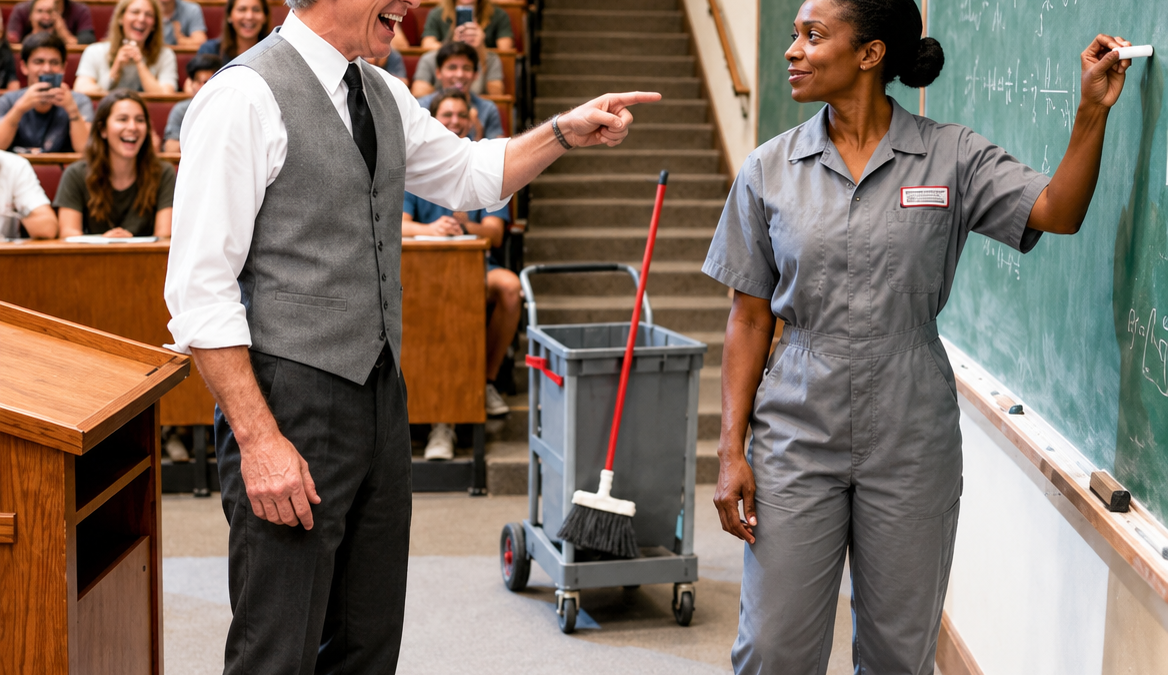
Get away from my board. The smell of bleach is ruining my chalk. >> I’m sorry, sir. I was just >> Just? Just what? Looking? Numbers don’t speak your language. They never will.
>> Yes, sir. >> Look at you. The uniform. The hands. You think advanced math is for janitors? >> I’m sorry, sir. >> A student raised a phone. 200 faces froze.
Whitfield laughed. Loud. Cruel. He turned to the class. >> $10,000. If she solves it, I pay. If she fails, she resigns tonight.
Deal, janitor? >> Celeste’s fingers closed around something small in her pocket. A pencil. Her mother’s pencil. In 2 hours, a Harvard mathematician would be on his knees crying into his own equation. To understand what was about to happen in Hall 507,
you have to back up 7 years. Roxbury. A folding chair at a funeral. Celeste Holloway buried her mother at 19. Miriam Holloway taught algebra and geometry at Roxbury High for 26 years.
Her students called her Miss H. She believed every kid was a mathematician. They just had different starting lines. When Miriam died, Celeste was halfway through her freshman year at a state school.
A month later, a letter from MIT arrived. Full scholarship. Mathematics department. Acceptance for the following fall. She didn’t go.
She had applied a year before on a dare from her mother. She had won. Then, 3 weeks before moving day, a second letter came. One paragraph. Cold.
“Concerns have arisen regarding the integrity of certain submitted materials. Your offer is hereby withdrawn.” She hadn’t cheated. She had never cheated. She drove 3 hours to MIT’s admissions office.
The receptionist did not let her past the lobby. She sat until closing. A security guard escorted her out. “These things happen,” he said, almost kindly.
She walked back to her car. She did not cry. She buried the letters with her mother and moved to Cambridge anyway. Not as a student, as a custodian. For 7 years, Celeste cleaned the Harvard Science Center, floor five, hall 507,
11:00 at night to 7:00 in the morning. She mopped between desks she had once dreamed of sitting at. She kept a notebook in her uniform pocket. Each Monday, after the last students left, Professor Edmund Whitfield’s chalkboard still held what graduate students had begun to call the wall,
a problem so dense, so obscure, that for four straight semesters, no one in his class had cracked it. Whitfield himself was a legend. 30 years at Harvard, two Cole prizes, a reputation for elegance, cruelty,
and a peculiar habit. He refused to let cleaning staff into his office without a witness present. Two years earlier, a custodian named Helen had been fired after Whitfield reported a missing pen.
The pen turned up the next afternoon in his own desk drawer. Helen was not rehired. The department issued no apology. In her notebook, Celeste began solving the wall. The first time it took her 3 weeks.
The second time, 10 [clears throat] days. By the spring of 2024, she could read his board on a Monday night and write the answer before sunrise. Once she had solved the wall by 2:00 in the morning, then on the next page, she had written a
second solution using a method she had never seen in any book. She did not know it had a name. She did not know she had just rediscovered, alone, a technique that had earned a Fields medal.
She closed the notebook quickly. She never told a soul. She never wrote in the margin of his chalkboard. She erased her own notes from the corner of the slate every morning before she left. The notebook stayed in her pocket.
The chalkboard stayed his. Until a Tuesday in October. That night, Brandon Whitcomb, Whitfield’s senior TA, a doctoral candidate who liked his coffee black and his classroom wider, stayed late grading.
He turned out the seminar lights, walked to his car, came back 15 minutes later for his laptop bag. He pushed open the door to Hall 507 and stopped. There she was.
Mop forgotten beside the doorway, standing in front of the chalkboard, reading, her lips moving silently, tracking each symbol like a violinist sight-reading a score. He watched for a full minute.
Then he backed out, closed the door without a sound, and texted Whitfield. He stood in the empty hallway. His fingers shook slightly. He couldn’t say why.
You need to see this. The janitor’s been studying your board. Whitfield read the message at 6:00 the next morning. He set the phone down, picked it back up, read it again. He didn’t laugh.
He smiled. In three decades at Harvard, no student had ever beaten him. Not in a seminar, not in a department debate, not among the 20 Putnam fellows he had personally trained. He was Edmund Whitfield.
The wall was his. The idea that a janitor, that this janitor was reading it like literature, did not unsettle him. >> [clears throat] >> It offered him an opportunity. He finished his coffee.
He reached for his coat. He had a class to teach in 2 hours, and he had a plan for the cleaning lady who dared to look. The classroom was already half full by 8:40 a.m. Hall 507.
Tiered seats, three projection screens, a long chalkboard the color of seal skin running the full width of the front wall. By 8:55, every seat was taken.
Standing room behind the back rail. 40-some auditors crowded in for what was supposed to be a one-time guest seminar from Edmund Whitfield, fresh off a new paper that had made the front page of the Notices. In the very last row, near the door, sat Dean Eleanor Sterling, 68,
retired from the chair last spring. She still came by to audit. She still kept her keys. Nobody, including Whitfield, noticed her there. At 9:00 sharp, Whitfield walked in.
Charcoal suit, pocket square. He set his briefcase on the desk and turned to the chalkboard without speaking. He wrote for 3 minutes. Steady, white, beautiful chalk. The wall, week 12.
A variational problem with three boundary conditions, written in notation so compressed that two students in the front row physically leaned forward to track it. He stepped back, tapped the chalk twice against his palm.
Discuss. Murmurs. A few notebooks opened. Nobody spoke. That was when the door behind the back rail eased open, a cleaning cart, stacked towels, a bottle of disinfectant clipped to the handle.
Behind it, Celeste Holloway in a gray uniform, eyes down, intending to slip behind the last row and replace the wastebasket liner. She froze when she saw the board. Just for 4 seconds.
She did not mean to stop. Her body did it for her. Whitfield saw the movement at the back of the room. He turned. He squinted. He smiled. “Madam.” His voice carried.
Every head in the room turned. “Do you have a contribution to advanced harmonic analysis?” A ripple of laughter. Celeste’s eyes stayed on the floor. No, sir. I’m sorry, sir.
You stopped. I’ll keep moving, sir. No. He set the chalk down, stepped around the desk, began walking up the center aisle toward her. Stay. Educate us.
Tell the class what symbol caught your eye. She did not lift her face. A student near the front raised a phone. Then another. Brandon Whitcomb in the second row met Whitfield’s eye and nodded, almost imperceptibly.
He hit record. Whitfield reached the back of the room. He was a foot taller than Celeste. He did not stand close enough to be threatening, but close enough to humiliate. Get away from my board. The smell of bleach is ruining my chalk.
The laughter doubled. Sir, I was only >> Just? Just what? Looking? Numbers don’t speak your language. They never will. Celeste lifted her chin 1 in. That was all.
Whitfield saw it. And something in him locked. He turned to the class. Voice loud, theatrical, the voice of a man who had been waiting for an audience. Friends, we have a guest mathematician with us today.
Let us make a bet. $10,000 cash. If our colleague here can solve what is on that board within 2 hours, I will personally write her a check on the spot. If she cannot, she signs a letter resigning her position with Harvard Building Services
tonight. The room hushed. Deal, janitor? In the back row, Dean Sterling slowly closed her notebook. She did not stand. Not yet. Celeste set down the towels.
She stepped around the cart. She walked to the front of the room, all 200 faces tracking her, and stopped 6 ft from Whitfield. I’ll take that bet, Professor. The whole room held its breath.
None of them knew what was about to break. Celeste took the chalk from him. >> [clears throat] >> Their fingers did not touch. She walked to the board, stood directly in front of it. For 11 seconds, she did nothing.
The room watched her shoulders, the slope of her neck inside the gray collar, the small tremor in her hand. Then she did something nobody expected. She did not begin solving.
She raised the chalk to the fourth line of Whitfield’s equation. Halfway across, embedded inside a dense cluster of operators, she drew a single, clean, white circle around one Greek letter the size of a fingernail. She turned, just enough to be heard.
Professor, this integrand, you wrote d mu. It should be d nu. You’re integrating over the wrong measure. The room went so quiet you could hear the hum of the projector fan.
Whitfield stiffened. His shoulders lifted half an inch and stayed there. In the third row, a graduate student named Thomas Caldwell breathed out very slowly.
Oh, Another whispered, She’s right. Whitfield turned, walked back toward the board, stopped 6 ft from it. He stared at the circled symbol the way a man stares at a chip in his own front tooth in the mirror.
He said nothing. Celeste tilted her head toward the class. Her voice was small, careful. The voice of someone who had spent years apologizing for knowing things. Think of it like a scale, she said.
If you weigh sugar by the gram, you get a number. If you weigh the same sugar by the pound, you get a different number. Same sugar, different rule. If you start the proof with the wrong rule, every line after it carries the mistake.
The equation doesn’t fail loudly. It fails quietly. For two pages. A pause. She looked briefly at the board. The wrong measure here makes the boundary condition meaningless.
You can keep going. You will not converge. Somewhere in the back, a phone made a quiet electronic click. In the second row, a sophomore named Lily Bennett flipped open her copy of Rudin so fast the spine cracked.
Pre-med. Auditing for curiosity. Page 53, she said. Her voice was thin, but it carried. Page 53. Real and complex.
The measure is new. He wrote mu. The murmur in the room became a wave. Whitfield turned. The polished veneer slipped just for a flash. Then it locked back into place. A guess, he said.
Coincidence. The notation choice is interchangeable in informal exposition. It isn’t, sir. Celeste’s voice did not rise. She was still apologetic in tone, even now.
Not for what comes after. The integrability class depends on it. If you change the measure, you change the test functions. Everything downstream collapses. Whitfield’s jaw worked.
He said nothing. Then he turned, walked back toward the front desk, and stopped halfway. He had nowhere good to put his hands. Celeste turned back to the board. She did not look at him.
She did not look at the class. She wrote. In 30 seconds, with a hand that was no longer trembling, she rewrote the corrected version of his fourth line. Then she did something subtle and brutal.
She rewrote it in the exact spacing and weight of Whitfield’s own handwriting. Whoever was holding a phone at that moment captured the comparison side by side. The two lines, his and hers, looked like the same person had written them.
Except hers worked. In the back row, Dean Sterling opened her notebook again. She wrote one short word. She underlined it twice. She did not say anything yet.
In her notebook, the word she had written was yes. Just yes. As if confirming a hypothesis she had been quietly carrying since the moment Celeste froze at the threshold. Brandon Whitcomb, in the second row, swallowed audibly.
He looked at his phone. The live stream he had launched as a joke now had 8,000 watching live. A comment counter scrolled so fast the words blurred. He saw two of them clearly.
Who is she? She just cooked him. >> [clears throat] >> He had 30 seconds to decide whether he was on Whitfield’s side or the woman’s. He didn’t move. He didn’t choose.
He just kept filming. Whitfield, at the front of the room, had not moved. A long, raw silence. Then, barely, Whitfield nodded. It was the smallest nod, half an inch.
It did not look like a concession. It looked like the involuntary movement of a man whose body had betrayed his face. But every person in that lecture hall saw it. In 30 years of teaching, across two Cole Prize ceremonies and dozens of televised panels,
Edmund Whitfield had never publicly acknowledged a correction. Never. The department had a quiet running joke about it. He had just done it. To a janitor. In front of 200 phones.
Celeste set the chalk gently into the tray. She bowed her head an inch. Almost a thank you. Almost an apology for existing in his airspace. The student who had whispered, “Oh, shit.” was now staring at her like he was watching weather.
Whitfield finally spoke. His voice was steadier than his face. “A clean catch.” He said. “Bravo. But spotting a typographical error is not the same as solving an open problem. The bet remains.
You have 1 hour and 53 minutes.” He walked back to the front desk, picked up his briefcase, set it down again, reached into it for nothing in particular, just to do something with his hands. In the back row, Dean Sterling tilted her head 1 in.
It was the same gesture, Celeste later realized, that her own mother used to make watching her child cross a busy street. But Whitfield was not done. He was not going to lose.
Not to a janitor. Not today. He had one more trick. And it was going to cost her everything. Whitfield needed the room back. He needed it now.
He set down the briefcase he had pretended to be opening. He turned, slow and theatrical, gathering the class with his eyes the way a conductor gathers an orchestra after a flat note. “Anyone can spot a typo,” he said.
“Solving, that’s a different planet.” A nervous laugh from the back. He fed off it. “Ladies and gentlemen, >> [clears throat] >> our friend the cleaner has been lucky. She read Rudin once. Bravo. Page 53.
But a published problem in measure theory, that takes more than a memory trick. That takes a brain trained by men like me.” He turned back to Celeste. The smile was thin.
“So let’s make it interesting. Forget 10,000. $50,000 cash. I’ll write the check today. But the stakes go up on your side, too.” He paused.
He waited until every phone in the room was raised. “If you fail, you do not just resign. You sign a sworn statement. You will state that you entered this department’s offices at night, that you took a department textbook without authorization.
That the work you just did at this board was copied from notes you found inside it. The room reacted before he finished. Gasps, heads turning. Lilly Bennett actually stood up. Celeste at the board lowered her chalk 1 in.
She did not speak. For 7 years, the worst thing she had ever been accused of in this building was leaving water marks on a desk. He had just escalated her to thief in front of the world.
Whitfield’s voice rose. 50,000 or a felony. Your choice, madam. That was when the door at the back of hall 507 opened and Dean Eleanor Sterling stood up. She did not raise her voice.
She did not need to. The room, all 200 of them, turned at the sound of her chair sliding back. Edmund. Her voice carried the dry weight of a person who had been letting the moment unfold on purpose and had now decided to stop.
That is defamation. Spoken on university property. In front of phones. With a live stream attached. You will retract that sentence in the next 10 seconds.
Or this conversation moves directly to general counsel. Whitfield’s mouth opened. Closed. Eleanor. This is a closed seminar. This is not your department anymore.
This building is still mine to walk into. And I have decided to serve as arbiter of this bet. She began moving down the aisle. Slow. Steady. The kind of walk that arrived.
Three conditions. She reached the front, faced Whitfield, did not look at Celeste at all. Yet. One. Miss Holloway has two hours from the moment she picks the chalk back up to the problem on that board is the problem
you prepared this morning. You may not alter it. You may not substitute it. You may not adjust a single character once she begins. Three. I will verify the result independently.
Not you. Not your TA. Me. A beat. And the financial stakes stand at the original 10,000. Nobody gets to bait this woman into a felony confession on Twitter today.
Whitfield’s eyes flicked just for a heartbeat to Brandon Whitcomb in the second row. The smallest of glances. Brandon did not nod back. He looked at his shoes.
He was 28 years old. He had two semesters left on a fellowship Whitfield personally signed off on. He had also just watched the black woman who had not raised her voice once get accused of a felony for solving math.
Something in his stomach turned over. Sterling caught the look. She did not comment. She filed it. Edmund, do you accept the conditions? A pause stretched. Then, I accept the conditions.
Sterling turned finally to Celeste. Her face softened by exactly 1 degree. Whenever you are ready, Ms. Holloway. The live stream counter, somewhere in the middle of the room, ticked past 25,000.
Then past 30. Lily Bennett stepped out from her row. She crossed to the front of the lecture hall, opened her backpack, and set a sealed bottle of water on the edge of the chalk tray. Without looking at Whitfield, without looking at anyone except Celeste.
“You’ll need it.” she said, very quietly. “2 hours is a long time.” Whitfield’s voice cracked across the room. “Ms. Bennett, sit down.” Lily did not turn.
She walked back to her seat with the unhurried dignity of someone who had just decided which side of the room she lived on. Celeste looked at the bottle. She looked at the chalkboard. She looked at her hands.
Her stomach hurt. Her chest was tight. But her hand, the one wrapped around the chalk, had stopped trembling somewhere between Lily’s voice and Sterling’s sentence about a felony. She picked the chalk back up. She had 2 hours.
She had one piece of chalk. And she had a secret she had never told anyone. Not even her mother. Sterling looked at her watch. 2 hours. Now.
The room fell into the particular silence of a place where everyone has decided to witness something. No talking. No whispering. Just the soft electronic breath of 40 raised phones and a live stream counter ticking past 32,000.
Celeste turned to the board. She did not start at the beginning. A weaker mind starts at the beginning. She started at end, at the conclusion the proof had to land on. From there, she walked the equation backwards in her mind, one structural
layer at a time. A boundary problem like this had a particular shape. Three locks, three keys. If you forced the wrong key into the wrong lock, the door looked like it opened, but it wasn’t really open.
She had seen this exact shape before, in her notebook, in the corner of her own kitchen, three winters ago. She raised the chalk. Lock one, boundary conditions.
She wrote a small, clean diagram in the bottom left corner of the board. A picture, almost. Two regions and an edge. She labeled the edge with a word and a constraint, and stepped back.
A graduate student in the front row let out a low, surprised sound. Whitfield turned. The student looked down. Celeste did not notice. She was 30,000 ft above the room.
She thought about her mother. October 1996. Their kitchen in Roxbury. The light over the table was the yellow kind that made everything look warmer than it was.
Marian Holloway sat across from her 13-year-old daughter with a torn page from an SAT prep book between them. Celeste had solved the problem in her head and written down only the answer.
A teacher had marked it wrong because she had not shown her work. Show them the path, baby, Marian had said. Numbers don’t see color. They only see who showed up. And you showed up. So now, you show them how you got here.”
Celeste had nodded. She had been quiet for a long time. Then she had picked up the pencil. This pencil, the same pencil now in her pocket. She had rewritten the solution slowly, one line at a time, until the answer arrived in plain
English. Then another came, spring 2006. She was 19. She sat alone in a parked car outside MIT’s admissions office. A letter rested on her lap.
It ended with the sentence, “Your offer is hereby withdrawn.” She had read it 11 times. She had never opened it again. Yet here it was, 20 years later, in the dark behind her eyes.
The exact font, the exact embossed seal, the exact phrase. She had carried it inside her for two decades, the way a bullet carries inside a body.
Then another, 2018. A storage closet in building two at MIT, where she had taken a temporary contract for the holidays. A student had left a copy of Rudin on the bench by the wet mop bucket.
Real and complex analysis, hardcover, margin annotations in three colors. She had sat down on the floor with that book in her lap and read until her shift began.
She had not stopped reading, not really, for the next eight years. And then she was back in hall 507, >> [clears throat] >> 28 years and 10,000 erased blackboards away from her mother’s kitchen.
One piece of chalk, two locks to turn. Lock two, the weak solution space. She had to choose a function class. Wrong class, the whole proof died in silence.
Exactly the way she had warned earlier with the measure. She picked the right class on the first try. She wrote it cleanly. She did not show off. She labeled it with one initial and a number and moved on. 45 minutes were gone.
She did not check the clock. The clock checked her. In the middle of the room, Whitfield was pacing. Not in big strides, small ones. The kind a man takes when his body wants to move, but his face cannot afford to.
He had his phone in his hand, low against his thigh, screen tilted away. He texted Brandon. Now, the sideboard. While she’s facing this one, Brandon read the text. His thumb hovered.
He did not type back. Brandon was 28 years old. He had a fellowship Whitfield had personally signed off on. He had a job offer at Stanford pending three letters of recommendation. One of them already in this room.
He also had a mother in Cleveland who watched MSNBC every night. She had taught him when he was small one thing. You did not let people get hurt on your watch just because the man hurting them paid your bills.
His thumb hovered for a long time. Then he stood up. He walked to the side blackboard, a smaller wing panel at stage left. There, Whitfield had written faintly in pencil a draft version of the problem for his own reference.
Brandon picked up an eraser. He looked at Celeste’s back. He looked at Sterling in the third row now, who had her eyes on her own notebook. He erased the draft. Slowly.
Quietly. His hand shook once. Whitfield was already moving. He crossed to the side panel with a piece of pre-cut chalk hidden in his palm. A darker shade. Almost cream.
He wrote a new version of the problem in Brandon’s wake. Two of the four lines were identical to what had been there before. Two were not. The integral limits had moved by a hair.
The function space had been swapped for one that did not behave well at infinity. It was no longer a problem with a known solution. It was an open problem. A real one. Specifically, the unpublished centerpiece of a manuscript that Edmund Whitfield had borrowed from Eleanor
Sterling two years earlier and never returned. He stepped back. Smooth. Professional. Like a man who had just leaned in to fix a piece of chalk on his desk. In her chair, Sterling did not look up.
Yet. Celeste, at the main board, finished writing the last line of her function space declaration. She glanced quickly, instinctively, at the side board to cross-reference the formal statement of the problem.
She did not register the change. She had been reading the symbols, not the meaning. Her brain corrected one moved limit into the older version it remembered seeing two minutes earlier. The lie was small enough to pass. The live stream had crossed 64,000 viewers.
Somewhere on the platform, a clip of her circle around the D Mu had been retitled “Black Janitor Humiliates Harvard Math God in Real Time”. It was climbing across X, TikTok, and a Brazilian aggregation account that mostly posted Formula One crashes.
The hashtag forming around her was #justiceforjanitor. She did not know any of this. She had two locks turned. She had one to go. The hardest one.
The compactness argument. She did not know that the lock had been changed mid-job. She did not know that the chalk in her hand was about to write history. Or that the man behind her had just rigged the game in the worst possible way.
75 minutes in, Solace reached the end of lock two and lifted the chalk away from the board. She needed to verify the formal statement once more before attacking the last lock. The compactness argument was unforgiving.
One wrong assumption upstream and you could spend an hour walking off a cliff. She turned to the side panel. She stopped. For 4 seconds, her face did not move.
Her body registered the discrepancy before her brain did. The way you know a stair tread is missing before you name it. The integral limit on line two had moved half a centimeter to the left. A different variable.
The function space declaration on line four had been completely swapped. Her voice was very level. Sir. Whitfield at the front desk looked up with practiced calm. Yes, madam.
The problem changed. Did it? His eyebrows performed a small theatrical climb. Perhaps you misread it earlier. Memory under pressure can be a tricky thing. Especially for someone unaccustomed to it. Murmurs in the room.
Phones lifted higher. Brandon Whitcomb in the second row looked at the wall and stayed still. His face had no color in it. That was when Dean Sterling stood up.
She walked, slow and unhurried, from the third row to the side panel. She did not look at Whitfield. She read the four lines from top to bottom. >> [clears throat] >> Then she read them again. 4 seconds. Her face did not change, but her shoulders dropped half an inch,
which, on Eleanor Sterling, was the equivalent of another woman’s screaming. She turned to Celeste. Her voice was soft, but it carried through every microphone in the room. >> [clears throat] >> Edmund, this is from my manuscript. The unpublished one.
The one I lent you in 2022 and never received back. The silence had texture now. Whitfield went red along the line of his jaw. Ridiculous, Eleanor. It’s a coincidence.
The notation is common. Sterling did not look at him. >> [clears throat] >> She turned to the class. I will not stop this bet. Everyone here is now a witness. She paused. But you should all understand what is now happening.
If Ms. Holloway solves what is on that board, and only what is on that board, something has changed. What was meant to be a public humiliation has just become a publication. The room exhaled all at once.
46,000 viewers on the live stream exhaled with it. Celeste stood at the center of the room. She had two choices. She could walk out and let the world prosecute Whitfield for her or she could pick up the chalk.
The harder problem, five times harder. 45 minutes left. She picked up the chalk. He had wanted to bury her. He had just handed her a key to the building.
28 minutes left. 25. 22. Celeste had moved into lock three and immediately hit the wall. The compactness argument. She had to show that her chosen function space contained a convergent subsequence.
The chosen problem, Eleanor Sterling’s problem, required a technique she had only ever seen sketched, never written. She had three competing approaches in her head and no time to test all three.
She picked one. She wrote four lines. She erased them. She picked another. She wrote six lines. She erased them, too. The eraser left a long white smudge across the lower half of the board like a wound.
In the front row, Whitfield smiled the small polite smile of a man whose dignity was returning to him with each passing minute. He sat down. He crossed his legs. He looked, for the first time that morning, comfortable. The live stream had crossed
140,000 viewers. The comment column was a freeway. Celeste did not see it, but if she had, two of the streaming comments would have caught her eye. She’s drowning.
Janitor isn’t going to win this. Her hand had started shaking again. She looked at the clock. 12 minutes. She stepped back from the board, set the chalk in the tray, leaned her back against the cold cinder block of the side wall, and closed her
eyes. Her breath came in short, uneven cuts. The room watched. 200 people, phones up, nobody breathing for her. Whitfield rose calmly from his seat.
He walked calmly toward the front of the room. He stopped 6 ft from her. The same 6 ft he had used at the beginning of the morning. “Madam.” His voice was almost gentle, almost kind.
The gentleness of a man putting his foot on a creature’s throat with no particular hurry. “It’s time to admit you played a game above your station. Sign the paper. Save what’s left of your dignity.”
In the back row, a young woman put her face in her hands and began, very quietly, to cry. A freshman, undeclared, born in Akron. >> [clears throat] >> Nobody in this story will ever know her name.
Lily Bennett stood up again. “Don’t, Celeste. You don’t owe him anything. Just walk.” For one long breath, Celeste considered walking. She could see the door from where she stood.
Her body knew exactly how many steps. Her body would have let her go. For 7 years, she had walked out of harder rooms than this one. She had taught herself how. You bowed your head. You found the exit.
You did not look back. The mop went with you. Her hand drifted on its own into the pocket of her uniform. Her fingers closed around the pencil. Small. Worn.
The wood greasy from 30 years of being held. Along one flat side, an inscription her mother had carved with a pin in 1989. The same year she got her first classroom.
M H Roxbury High Math She had been 19 when her mother died. She had not let go of the pencil since. Celeste closed her hand around it the way you close your hand around a hot coal.
Held it. Breathed. In the dark behind her eyelids, her mother was at the kitchen table again, looking up from a torn page. “Numbers don’t see color, baby. They only see who showed up.”
Celeste opened her eyes. On the board, halfway down line nine in the middle of the second of her three abandoned attempts, was a small minus sign. A small minus sign that should have been a plus.
She had been chasing the right idea down the wrong street for nine straight minutes because of a single inverted operator. She saw it. She saw it all the way down to the conclusion. She turned.
Looked at Whitfield. Looked at the chalk. Looked at the board. She picked up the chalk one more time. And the silence in that room turned into something else.
Something nobody had heard in Hall 507 before. She wrote, the chalk did not pause for 9 minutes. Not once. It is hard watching a person solve real mathematics to know whether what you are seeing is genius or madness.
The two moved the same way from the outside. The shoulders forward, the head tilted slightly to the right, the chalk skittering across the slate in short declarative strokes, like a hand stitching a wound shut from the inside.
The fluorescent lights buzzed overhead. 200 breaths held in 200 chests. The only sound that mattered was the chalk. The room understood in the slow animal way a room understands these things, that what was happening on that board
was not memorization. It was construction. For the first 3 minutes, Celeste fixed the sign error. The corrected minus pulled a thread that ran through the rest of the proof.
She followed it down to the next line, the next, the next. The compactness argument she had been chasing for an hour cracked open the way ice cracks under pressure. Silently first, then all at once. For the next 3 minutes, she did something the outline could only summarize. She
took the region the proof was failing on, and she split it in half. One side she handled by inequality. The other side she handled by symmetry. She proved each half was solvable for a completely different reason.
It is the mathematical equivalent of a magician sawing a body in half live on stage. The magician walks each half off in opposite directions. Then puts them back together at the end without ever explaining how. In the back, Dean Sterling stopped writing.
She did not need her notebook anymore. For the last 3 minutes, Celeste unified the two halves. She did this by introducing a single new function. A small, modest function the room had never seen.
She showed it interpolated between the two regions cleanly on a measure zero seam. The seam closed. The two halves merged into one solution. The boundary condition was satisfied at every step.
She wrote the closing line. She wrote Q.E.D. She set the chalk into the tray with the same care with which she had picked it up. For a long beat, she did not move.
Her shoulders rose, fell, rose. The room watched her exhale as if it were the first breath of a person surfacing from the bottom of a pool. She turned to face the room.
Sterling was already on her feet. She crossed the front of the room, the heels of her shoes the only sound in 2,000 square feet of suspended breath. She stopped in front of the board. She read the first line.
She read the last line. Then she read both again, slowly, the way a juror rereads a verdict before signing it. 4 seconds. 6. 8.
She lifted her hand, pressed two fingers lightly to the bottom left corner of the board. Celeste’s small diagram still sat there with its two regions and one labeled edge.
The picture. The picture that had started everything. Sterling turned to the class. Her voice had the smallest tremor in it. Nobody in the room would ever forget hearing it. She did not look at Whitfield.
She did not need to. It is correct. Every step. The solution stands. The clock on the wall read 2 minutes and 12 seconds to spare. In the front row, Whitfield made a small sound.
It was not a word. It was the sound a man makes when an entire identity he has paid 40 years for begins to crack. A crack along a seam he didn’t know it had. Impossible. He hissed.
It’s impossible. Edmund. Sterling did not raise her voice. Sit down. He sat down. For two full seconds no one moved. The kind of silence that comes right before something irreversible. Lily Bennett was the first one to clap.
Just one pair of hands. Sharp and clear. The way you clap when something happens you needed to happen. >> [clears throat] >> Then Thomas Caldwell, third row, stood up and clapped beside her.
Then the row behind them. Then a graduate student dropped a notebook in the act of standing too fast. Then everyone. The clapping in Hall 507 became the kind of clapping that does not feel like clapping.
It felt like weather. It felt like a verdict. It went on for 11 full seconds without breaking pattern. Some people were crying. The Akron freshman in the back was crying.
Brandon Whitcomb was crying and trying very hard to hide it. The live stream counter ticked past 480,000 viewers during the ovation. Whitfield did not stand. He sat in his front row chair, hands flat on his knees, mouth slightly open.
He watched the world he had built his career on close around him. >> [clears throat] >> The color had drained out of his face from the temples down. He looked for the first time in three decades of public life lost.
Like a man who could not find where the next sentence was supposed to come from. He had not bowed. He had not apologized. He had simply ceased in the way an aging celebrity ceases when the laughter at the party suddenly turns against him.
>> [clears throat] >> Celeste did not look at him at first. She looked at the board. She looked briefly at Dean Sterling. She looked even more briefly at Lily Bennett, who mouthed two words at her.
Thank you. Then she turned slowly until her shoulder was square with the front row. And she spoke. She did not raise her voice. She did not need to. The room had stopped clapping the instant her chin moved.
Numbers don’t see color, Professor. She paused. She let that sentence sit on the front row like a stone. They only see who showed up. She let it sit a second longer.
I showed up. Every night. For seven years. She set the chalk very gently into the tray. She did not bow. She did not apologize.
She did not soften it with a smile. She just stood there. In the back of the room, Dean Sterling allowed herself, finally, exactly one tear. It traveled half an inch and stopped at the corner of her mouth.
He had not just lost a bet. He had not just lost $10,000. He had been caught on a live stream the world was now watching switching the problem mid-test defaming the woman he had set up to fail stealing from the colleague who had been
kind enough to lend him a manuscript he had never returned. He had bet $10,000 that she could not solve it. He was about to pay something far worse than money. Dean Sterling did not let the room sit in its own ovation. She had work to do.
She walked briskly now to the lectern lifted a wireless microphone tapped it once. Everyone, please, 1 minute. The room obeyed. What just happened here is not just a solved problem.
It is a published one. As of this minute. She lifted her phone, showed the screen a red recording dot time stamped from before Celeste picked up the chalk to the moment she set it down. I recorded all of it. Statement, working, derivation, Q.E.D.
She turned to Celeste. Ms. Holloway, with your permission, I will submit this video and a written transcript to the Annals of Mathematics tonight with you as first author. The room exhaled into a sound that was not quite a cheer and not quite a sob. Whitfield shot to
his feet. Eleanor! She could not have derived it independently. She had to have seen Edmund! Sterling’s voice cut him in half. The problem was from my notebook.
The unpublished one. The one you borrowed in October 2022. Which you never returned. I have the borrowing slip. I have the original draft in my office in my handwriting. She held up a small square of paper.
The kind of paper that in three centuries of universities has decided more careers than any single book. Somewhere in the third row a student stood and shouted, voice raw, “He [snorts] cheated her!”
Sterling did not raise her voice. She did not need to. “Edmund, you will report to the provost’s office at 3:00 this afternoon. The dean’s office is opening a misconduct review. Academic theft, defamation against an employee, violation of student safety standards.
As of this minute, your seminar is suspended.” Whitfield staggered back into his chair. He did not speak. In the second row, Brandon Whitcomb stood up.
His face was the color of paper. His voice did not work the first time he tried. He tried again. “He told me to switch the boards. I I helped him.” Sterling looked at him for a long second.
“Then you will testify.” She turned back to the room. “Class dismissed.” Karma had been polite enough to wait 30 years. Today, it arrived on time. That afternoon, the Cambridge light shifted the way it does in late October, quick and gold.
Beliefs outside the Dean’s window were the color of held breath. Eleanor Sterling poured tea. Two cups. She slid one across her desk to Celeste Holloway. Celeste was still in her gray uniform.
She had not been allowed to go home and change. Why didn’t you ever tell anyone about the math? About MIT? Celeste looked at the tea for a long moment, then at the window.
I tried once. The same kind of man as Edmund signed the paper that took MIT from me. After that, I stopped asking permission to know things. Sterling nodded. She let the answer sit.
Then she opened a folder. MIT issued a public statement at 1:15 this afternoon. They are reopening your 2006 file under independent review. They have already used the word apology.
She closed the folder. And Harvard? Harvard would like to offer you a research fellow position in the Department of Mathematics, effective Monday. Co-author credit on our paper, a salary, an office, a door, Miss Holloway, with your name on it. Celeste looked out the window,
smiled. Her eyes were wet, but level. By 6:00 p.m., the Harvard internal newsletter reported Professor Edmund Whitfield’s tenure suspended pending review. His seminar was canceled for the semester.
The thread on X had crossed 2 million reposts. His face, his collapse, his name public. He passed Celeste once in the hallway near the elevator before leaving the building for the last time. He did not look at her.
As he passed, he said, very quietly, the four words his life had been arranged to never say. I was wrong about you. Celeste did not turn her head.
That night, in the small new office on the fourth floor, she set her mother’s pencil at the corner of the desk, inscription facing out. M H Roxbury High Math 1989 Then she sat down and she got back to work. If this story
moved you, drop one word in the comments. Who in your life was overlooked? Share this video. Subscribe because the next person society writes off may be the one who solves the next impossible thing.
#justiceforjanitor