“Sir,Don’t Step!” Homeless Black Boy Saved a Blind Billionaire on the Street – It Changed Everything
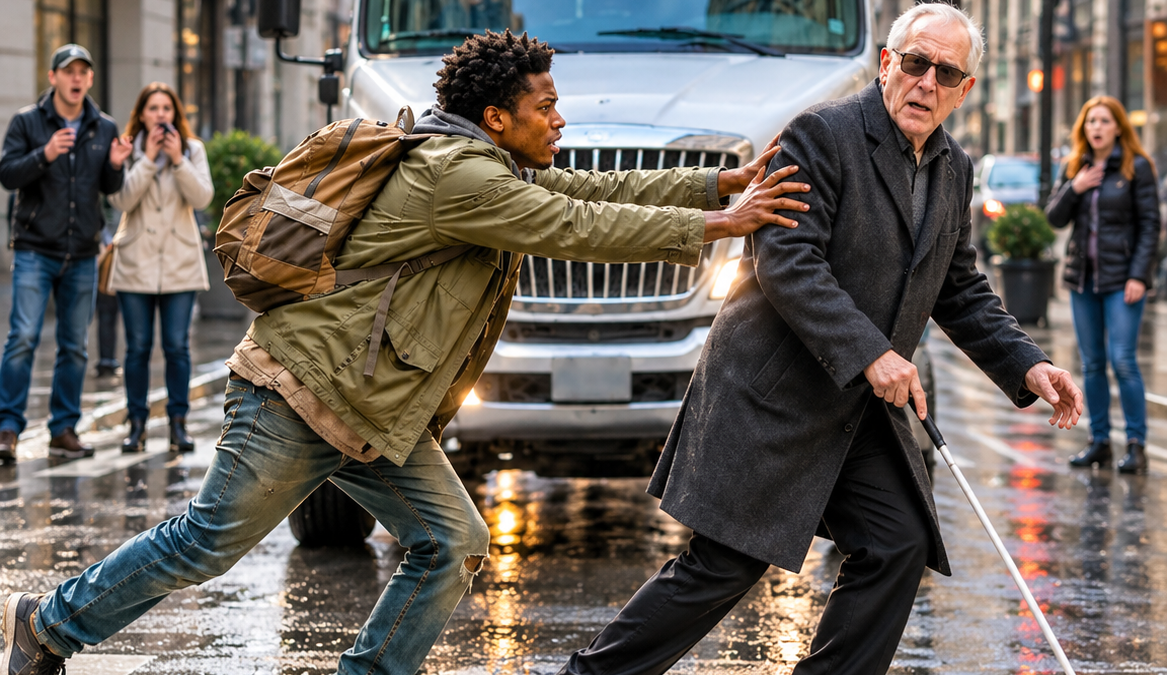
SIR, DON’T STEP! A skinny black boy screamed those words and threw himself into the street. A delivery truck was barreling through a red light. A blind man with a white cane had just stepped off the curb, right into its path. The boy grabbed him, yanked him backward. They hit the sidewalk hard.
The truck roared past inches from their bodies. Six seconds. That’s all it took. The boy was 14, homeless, hadn’t eaten since yesterday, had nothing but a torn jacket and a backpack full of everything he owned in this world.
He didn’t know the man he’d just saved, and he had absolutely no idea that those six seconds would change his life forever. But before that moment at the crosswalk, before the truck, before the scream, Bryson Adams had already been fighting a war most adults couldn’t survive.
And he’d been fighting it alone. 5:45 in the morning, Philadelphia. Under the Chestnut Street overpass, a 14-year-old boy opened his eyes. No alarm clock, no bed, no ceiling, just concrete.
Cold, damp concrete. And the sound of early traffic rumbling overhead like distant thunder. Bryson sat up slowly. His bed was a flattened cardboard produce box.
His pillow was a balled-up T-shirt. His entire life fit inside one backpack, a change of clothes, a water bottle, a worn Bible his grandmother gave him, a Ziploc bag of saltine crackers, and a small tube of lavender hand cream,
almost empty, but he kept it. Every morning, he’d unzip the backpack, find that tube, and open the cap. Just for a second. Just to breathe it in. Lavender.
That was his grandmother’s smell. The smell of safety. The smell of home. Back when he had one. He capped it, put it away. Then he did what he did every single morning.
He folded the cardboard neatly. Stacked it against the concrete pillar. Swept the area around his spot. With his hands brushing away pebbles and trash. His corner was always clean. Always.
Because that’s what Grandma Dolores taught him. Every single day of his life, she said the same thing. “You keep your corner clean, Bryson. That’s how God knows you’re ready for a bigger room.” >> [clears throat] >> He whispered it to himself now.
Alone. Under a bridge. At 5:45 in the morning. And then he started walking. Now, you’re probably wondering how does a 14-year-old end up sleeping under a bridge in one of the biggest cities in America?
His mother passed when he was 3. Complications after surgery. He barely remembered her face. Just a feeling. Warmth. A voice humming something soft. His father?
Never showed up. Not once. Not even a phone call. So, his grandmother, Dolores Adams, raised him. Alone. Dolores worked as a hotel housekeeper for 22 years.
Scrubbed floors. Changed sheets. Smiled at guests who never learned her name. She did it all. Rent, groceries, school supplies, church shoes on Easter. On $8.60 an hour.
Then, her body started giving out. Arthritis first. Her fingers curled. Her knees swelled. Then came the diagnosis that changed everything. Kidney failure.
Early stage, but progressing fast. She lost the job. Couldn’t work anymore. 4 months later, they lost the apartment. Dolores was admitted to the charity ward at Philadelphia General Hospital.
Bryson told her he was staying with a friend from church. He wasn’t. He was under a bridge. Alone. At 14. But he couldn’t tell her that. He couldn’t add one more worry to a woman whose body was already shutting down.
So, he lied. And every other day he walked 45 minutes each way to sit by her bed, hold her hand, and pretend everything was fine. That’s who Bryson Adams was.
A boy who carried everyone else’s weight. And never let them see him stumble. But even a boy like that has to survive somehow. During the day, Bryson had a routine. He’d walk to the public library as soon as it opened.
Free Wi-Fi. Warmth. Clean restrooms. He’d find a corner table and read everything. History, science, business magazines, old newspapers. The librarian, a quiet older woman, noticed him.
She never asked questions. But she let him stay past closing sometimes. And she’d leave a granola bar on the table near his chair. Casual. Like she’d just forgotten it there. She hadn’t forgotten.
Bryson always whispered, “Thank you.” when she wasn’t looking. After the library, he’d walk to the Whole Foods on Broad Street. Not to buy anything. He couldn’t afford a single item inside. He’d stand near the entrance and offer to carry grocery bags for elderly shoppers.
Some said yes. Most said no. A few gave him a dollar or two. It was honest work. Small, invisible, but it was his. Not everyone saw it that way.
Craig Dunlap owned a convenience store near the overpass. A thick man with a loud voice and a short temper. Every time Bryson walked past his storefront, Craig would step outside and shout, “Hey, keep moving. I don’t need you hanging around here scaring off customers.”
Bryson never argued. Never talked back. Just turned and walked away. One afternoon, another homeless man near the bridge asked him about it. “Why don’t you say something to that guy? He treats you like trash.”
Bryson shrugged. “He doesn’t know me. Can’t be mad at somebody for not knowing you.” The man stared at him. Didn’t say a word. Bryson picked up his backpack and kept walking past the old buildings, past the parked cars, past the construction site where a new
office tower was going up. A massive banner hung from the scaffolding. Giant letters, silver on navy blue. Harrington. Bryson glanced at it. Just a building, just a name.
He didn’t slow down, didn’t think twice. But that name was going to find him again, much sooner than he could ever imagine. And when it did, nothing about his life would ever be the same.
Bryson had no plans to be a hero that afternoon. He just wanted to get to the hospital before visiting hours ended. But the universe had a different schedule. It was a Thursday late afternoon. The sky had been gray all day. Now it was turning black.
The drizzle from the morning thickened into a steady cold rain, temperature dropping fast. Bryson was walking quickly, hands in his pockets, head down, counting the blocks to Philadelphia General. 16 more blocks.
30 minutes if he kept this pace. Then his phone buzzed. It was a prepaid phone donated, cracked screen barely holding a charge, but it worked. And the name on the screen made his stomach tighten.
Pastor Gerald Davis from the shelter. Pastor Davis never called unless something was wrong. Bryson answered. Bryson, it’s your grandmother. Four words. That’s all it took for his world to tilt sideways.
Dolores had collapsed that morning. Her kidneys were failing faster than the doctors expected. They were talking about emergency dialysis, maybe a transplant. But her insurance, the little she had, didn’t cover any of it.
The pastor’s voice was careful, measured, the way people talk when they’re trying not to scare you. But Bryson heard what he wasn’t saying. She’s running out of time. >> [clears throat] >> He hung up, stood still for a moment on the sidewalk, rain hitting his face, people rushing past him on both sides
like water around a rock. His mind started doing math. The terrible math of poverty. No money, no insurance, no family, no options. Dialysis costs thousands.
A transplant, hundreds of thousands. He was a 14-year-old boy with $11 in his pocket and a backpack held together with tape. His eyes burned. He blinked hard, swallowed the knot in his throat.
He would not cry. Not here. Not now. He started walking again, faster this time, almost running. Because the only thing he could do, the only thing he had any control over,
was getting to that hospital and sitting next to his grandmother. Everything else was out of his hands. Or so he thought. The rain was heavier now.
Rush hour traffic clogged every lane. Horns, sirens, the squeal of brakes on wet roads. Downtown Philadelphia at its loudest and most chaotic.
Bryson reached the intersection of Broad and Walnut and stopped at the curb, waiting for the light. That’s when he noticed him. >> [clears throat] >> An older white man standing at the edge of the crosswalk. Expensive wool overcoat, dark gray tailored, dark sunglasses,
and in his right hand, a white cane. The man was blind, and he was clearly lost. His head turned side to side, slowly, deliberately, listening to the traffic, trying to map the intersection with sound alone.
But the rain and the horns and the chaos made it impossible. There was something about the way he stood though. Even confused, even disoriented his shoulders were square.
His chin was up. He carried himself with a kind of stillness that most people never have. Like a man who was used to rooms going quiet when he entered. Bryson didn’t notice that.
Not consciously. He was too focused on the hospital. On his grandmother. On the clock ticking down. But what happened next he noticed. People walked past the blind man one after another.
A woman bumped his elbow and kept going. Didn’t even look back. A cyclist swerved around him close enough to clip his coat. A man in a suit glanced at him then looked at his phone and crossed the street.
Nobody stopped. Nobody said a word. Then the signal changed. The blind man heard the click of the crossing signal. He stepped forward. One step.
Two steps. Off the curb into the street. But it was the wrong moment. The pedestrian light was still red. The click he heard was for the parallel traffic, not for him. >> [clears throat] >> And from the left accelerating through the intersection running a red light a
delivery truck. Full speed. No sign of slowing down. The man was two steps into the lane. The truck was three seconds away. Nobody moved.
Nobody screamed. People on the sidewalk froze the way humans do when something terrible is about to happen right in front of them and their brains can’t process it fast enough. Nobody moved.
Except Bryson. He didn’t think. His body decided before his brain caught up. He dropped his backpack. He sprinted straight off the curb into the street, into the path of a moving truck.
And he screamed three words. “Sir, don’t step.” His hand closed around the blind man’s arm. He pulled with everything he had. Everything in his skinny, starving, 14-year-old body.
What happened next took 6 seconds. But for Bryson Adams, those 6 seconds would last a lifetime. And the man he just saved? He had no idea. Not yet.
But that man was about to turn Bryson’s entire world upside down. The truck was gone. The sound faded into the rain. And for a long, strange moment, everything was silent.
Not real silence. The city was still loud. Horns, rain, traffic. But Bryson couldn’t hear any of it. Just a ringing in his ears. Just his own heartbeat slamming against his ribs.
They were on the sidewalk, both of them, flat on the wet concrete. Bryson’s back had hit first. He’d pulled the man backward with everything he had and his own body took the fall. His spine slammed into the curb. His elbows scraped the pavement.
His palms torn open, raw, bleeding, stinging in the rain. He didn’t feel any of it. Not yet. The blind man was half on top of him, shaking.
His white cane had rolled into the gutter. His dark sunglasses were cracked, hanging off one ear. Bryson pushed himself up, gently moved the man to the side, got on his knees.
“Sir, sir, are you okay? Are you hurt anywhere?” The man’s hands were trembling, his chest rising and falling, fast, too fast. Then slowly his voice came, quiet, barely steady.
>> “You pulled me back.” >> Not a question, a statement, like he was still trying to understand what just happened. “Yes, sir. The truck, it ran the red light. You were in the street and I Bryson couldn’t finish.
His own voice cracked. The adrenaline was fading and his hands were starting to shake, too. A crowd had gathered, 10, maybe 15 people, phones out, recording.
Every single one of them had watched a blind man walk into traffic. Not one of them moved. But now, now that it was over, they were filming. Someone said it out loud.
“That kid just saved that man’s life.” The words hung in the wet air. Nobody stepped forward to help. Bryson didn’t look at them. He was looking at the old man, still on the ground, still shaking, rain dripping down his face.
He could leave. He was already late for the hospital. His grandmother was getting worse by the hour. His back was throbbing. His hands were bleeding. Every reason in the world said, “Go.”
But he looked at this man, blind, shaken, alone on a wet sidewalk in a city full of people who couldn’t be bothered to stop. Bryson couldn’t leave him. It wasn’t in him.
He walked to the gutter, picked up the white cane, wiped it clean with his sleeve, placed it gently into the man’s hand, guiding his fingers around the grip. Here you go, sir. I got your cane.
Then he picked up the cracked sunglasses, folded them carefully, slid them into the breast pocket of the man’s overcoat. Your glasses are in your coat pocket, sir. Left side. The man’s hand found the pocket, touched the glasses.
His jaw tightened. Thank you. He whispered. And the way he said it, it wasn’t casual. It was heavy. Like those two words were carrying something much bigger underneath.
Bryson knelt beside him. Sir, is someone coming for you? Do you have a phone? The man exhaled slowly. I walked away from my assistant. I wanted to walk a few blocks on my own.
Try to feel independent. He paused. My phone is in the car, with her. Bryson didn’t judge. Didn’t ask why a blind man would walk alone in the rain during rush hour.
Okay. Then I’ll stay with you until they find you. Do you know her number? The man recited 10 digits from memory. No hesitation. Bryson dialed on his cracked prepaid phone.
12% battery, spider web screen. Hello, my name is Bryson. I’m with a gentleman at Broad and Walnut. He needs a ride. Yes, ma’am. He’s okay.
We’re under the awning at the corner. Yes, ma’am. We’ll wait right here. He hung up. Took the man’s arm gently, the way you’d guide your own grandfather, and walked him to a bench under a storefront awning, out of the rain.
They sat. Two strangers on a bench. One blind, one broke. Both soaking wet. The man was still shivering. His wool overcoat was soaked through, heavy, dripping, useless against the cold.
Bryson looked at him, then looked down at himself. His jacket, thin, worn, faded olive green, zipper half broken, a tear at the left elbow. Found it in a donation bin 3 months ago.
It was the only jacket he owned in this world. He didn’t think about it. Didn’t weigh the pros and cons. He unzipped it, pulled it off, and draped it over the old man’s shoulders. The man flinched.
Reached up and touched the fabric. What are you doing? It’s my jacket, sir. You’re cold. No, I can’t take your jacket. You’ll freeze. I’m fine, sir. You need it more than I do right now.
He was lying. He was already shivering in nothing but a thin soaked t-shirt. The wind cut straight through it. But he sat up straight, kept his jaw tight, kept his arms still so the man wouldn’t hear him trembling.
They waited. The rain softened to a drizzle. The man asked questions, quiet ones. “What’s your name?” “Bryson Adams.” “How old are you?”
“14.” “Where do you live?” A long pause. “I’m staying around, between places right now.” The man didn’t press, but something shifted in his face.
A muscle in his jaw, a crease between his brows. He asked where Bryson was headed before all this. Bryson told him, >> [clears throat] >> the hospital. His grandmother.
Kidneys failing. Not for sympathy, just answering the question. The way people in hardship talk about hardship when they’ve stopped expecting anyone to fix it. The man listened, really listened.
Not the polite kind, the kind where the silence afterward is heavier than words. His hand found Bryson’s forearm, squeezed once, firm, warm, held it for a long moment.
Then a black SUV with tinted windows pulled up to the curb. The back door flew open. A woman in a tailored charcoal suit stepped out. Mid-40s, sharp eyes, heels clicking on wet pavement.
Her face white with panic. She saw the man on the bench and her whole body sagged. Mr. Harrington, oh thank god. Are you hurt? What happened?
Mr. Harrington. She said it with a weight that went beyond employer and employee. A respect, almost a reverence in the way she rushed to him. The way her eyes scanned him for injury before she even glanced at Bryson.
Bryson heard the name, Harrington. Something flickered. A banner on scaffolding, silver letters on navy blue, but it didn’t connect. He was too cold, too tired, too worried about his grandmother.
But that name was about to find him again. And when it did, Bryson Adams would realize that the man sitting on this bench, shivering under his jacket, holding his arm, was someone he never could have imagined.
Not even close. Caroline Whitfield moved fast. She checked Theo’s arms, his hands, his face, running her fingers along his coat like she was inspecting a piece of priceless art for cracks.
Her voice was steady, but her hands weren’t. What happened? Who did this? Are you hurt anywhere? Theo shook his head slowly. I’m fine, Caroline. Because of him.
He tilted his head toward Bryson. Caroline turned, looked at the boy for the first time, really looked. A skinny black kid in a soaked t-shirt, no jacket, scraped palms smeared with blood, shivering so hard his teeth were
clicking. Standing in the rain like he didn’t even notice it anymore. She blinked. He? You saved him? Bryson shifted on his feet, uncomfortable with the attention.
The truck ran the red light, ma’am. He was in the street. I just pulled him back. You just pulled him back, Caroline repeated. She stared at him. Then she reached into her bag and pulled out her wallet, opened it, held out a fold of bills.
Bryson could see hundreds, several of them. Please, take this. It’s the least we can do. Bryson looked at the money. And this is the part that gets me. Because you have to understand, this boy needed that money more than most people could comprehend.
His grandmother was dying. He hadn’t eaten a real meal in days. He was sleeping under a bridge. That money could have meant food for a week, a warm bed, a bus ride to the hospital instead of a 45-minute walk in the cold.
Every fiber of survival instinct should have told him to take it. He shook his head. I didn’t do it for money, ma’am. He was about to get hit. That’s it? Caroline pushed the bills closer.
Please, you’re freezing. At least let me From inside the SUV, Theo’s voice, calm, firm. Caroline, let the boy be. She stopped, lowered the money, looked at Bryson with an expression he
couldn’t quite read, somewhere between admiration and heartbreak. Theo called out again. Bryson, come here. Bryson stepped closer to the open car door.
The interior was warm leather seats, soft lighting, the kind of warmth he hadn’t felt in months. He could feel it radiating out into the cold air. Theo reached out his hand.
Bryson took it. They shook, but Theo didn’t let go right away. You could have died out there, son. >> [clears throat] >> That truck would have killed us both. And you didn’t hesitate. Not for one second.
His grip tightened. Bryson Adams, I will not forget that name. The way he said it, it wasn’t a pleasantry. It wasn’t something people say to be polite and then forget by dinner.
It was a declaration. A man who is used to making things happen, deciding something in real time. Bryson didn’t know that yet. He just nodded. I’m glad you’re okay, sir.
Caroline stepped forward. She pressed something into Bryson’s hand. Not money this time. Something small, stiff, textured. A business card. Thick card stock, embossed lettering.
The kind of card that costs more to print than most people spend on lunch. Theodore R. Harrington. Harrington Capital Group. Bryson glanced at it. The name again.
Harrington. The banner on the scaffolding. The tower going up near his bridge. A flicker of recognition, but it still didn’t click. He slipped the card into his jeans pocket.
Caroline’s voice was firm, almost pleading. “If you ever need anything, anything at all, you call that number. You saved his life today, Bryson. Please, don’t forget that.”
The SUV door closed. The engine hummed. The black car pulled away from the curb and disappeared into the rain. Bryson stood there, alone again, >> [clears throat] >> soaked t-shirt clinging to his ribs,
blood drying on his palms, wind cutting through him. He looked down at his hands, scraped, trembling. Then he remembered.
Grandma. He turned, started walking. 45 minutes in the cold rain, no jacket, back throbbing with every step, the tube of lavender hand cream pressing against his spine through the thin backpack fabric.
He made it to the hospital with 3 minutes to spare before visiting hours ended. Dolores saw his torn hands, his soaked clothes, his pale face. “Baby, what happened to you?”
He smiled. “Just tripped on the sidewalk, Grandma. I’m clumsy like that.” He sat beside her bed, took her hand, held it until she fell asleep.
Then he walked 45 minutes back to his bridge in the dark, in the cold, without a jacket. And in his pocket, a business card he didn’t yet understand was about to change everything.
Bryson didn’t think about the business card again that night. He had bigger things on his mind, like whether his grandmother would still be alive in the morning. But someone else was thinking about Bryson Adams.
In the back of the black SUV, Theodore Harrington sat in silence. Caroline drove. She kept glancing at the rearview mirror. She’d worked for this man for 11 years.
She knew every version of him, commanding in boardrooms, patient in negotiations, vulnerable after his diagnosis. But this version, she’d never seen this one.
He was holding Bryson’s jacket, the thin, faded olive green jacket, still damp. He ran his fingers over the fabric, the way a blind man read something. The worn seams, the tear at the elbow, the broken zipper.
Then he spoke, almost to himself. 14 years old, sleeping outside, and he threw himself in front of a truck for me, then gave me his only jacket and walked away in the rain like it was nothing.
A long pause. I want to know everything about this boy. Caroline nodded. Full report by morning, sir. Theo leaned back. His hand was still gripping the jacket.
He didn’t let go of it for the entire ride home. The next morning, Bryson’s prepaid phone buzzed. A number he didn’t recognize. He almost didn’t answer. Unknown numbers usually meant nothing good, but something made him pick up.
Bryson, this is Caroline Whitfield. We met yesterday at the intersection. His stomach tightened. Yes, ma’am. I remember. Mr. Harrington would like to meet with you tomorrow afternoon.
She gave him an address. He borrowed a pen from the librarian and wrote it on the back of his hand. That afternoon, he looked it up at the library computer, typed it into Google Maps. His breath caught. Harrington Capital Group headquarters, the tower,
the one with the banner on the scaffolding, the building he walked past every day without a second thought. His fingers moved to the search bar. He typed Theodore Harrington. Forbes profiles, Bloomberg interviews, net worth $4.2 billion.
Bryson’s hand started shaking. The blind man on the sidewalk, the man he pulled from the street, the man was wearing his jacket. A billionaire. He whispered to the empty library.
That was him. He sat there for a long time, heart pounding, trying to make two images fit, the trembling old man on the wet bench and the face on the Forbes list. But here’s what Bryson didn’t know.
That meeting wasn’t about a thank you. It wasn’t about a handshake and a gift card. What Theodore Harrington had planned was something this boy couldn’t have dreamed, not in a thousand lifetimes.
Bryson walked into the Harrington Capital Group headquarters at exactly 2:00 the next afternoon. He’d never been inside a building like this. Marble floors so polished he could see his own reflection.
Glass walls. A waterfall running down an entire stone panel. Security guards in black suits near the elevators. Men and women in tailored clothes moving fast in every direction.
And then there was Bryson. Same jeans, same sneakers still damp. A t-shirt washed in a gas station sink that morning. Scraped hands still pink and raw across both palms.
Every pair of eyes in the lobby landed on him. A security guard stepped forward, hand already up. Can I help you? The tone said something different than the words. The tone said, “You don’t belong here.”
Before Bryson could answer, a voice cut across the lobby. “He’s with me.” Caroline Whitfield. She smiled at Bryson and placed a hand on his shoulder. “Right this way.”
The guard stepped back. The people looked away. But Bryson felt the weight being watched, measured, judged by everything on the outside. He kept his eyes forward, chin up, shoulders straight.
Because that’s what Grandma Dolores taught him. “You walk into any room like you belong there, baby. Because you do.” They rode the elevator to the top floor. Caroline opened the double doors at the end of a quiet hallway.
The office was massive. Floor-to-ceiling windows on three sides. The entire city of Philadelphia stretched out below. Theodore Harrington stood the moment he heard footsteps, walked around the desk, no cane,
just memory and spatial awareness in his own space, and extended his hand. Bryson, thank you for coming. They shook. The same hand that had gripped Bryson’s forearm on the bench yesterday, but different now.
Yesterday, that hand trembled. Today, it was steady, firm, in control. They sat. Theo didn’t waste time. Bryson, I asked Caroline to look into your background.
Not to invade your privacy, but because I needed to understand the full picture. He paused. Your mother passed when you were three. Your father was never present. Your grandmother raised you alone.
She worked as a hotel housekeeper until her health gave out. Kidney failure. You lost your apartment 4 months ago. She’s in the charity ward at Philadelphia General. Another pause.
Longer. And you’ve been sleeping under the Chestnut Street overpass, alone, for 4 months, with a 3.8 GPA before you had to stop attending school.
Bryson didn’t speak. His eyes were burning. His throat locked shut. Nobody had ever said all of that out loud before. He’d spent every day making sure nobody could see the full picture.
And now a stranger was reading his entire life back to him. Theo leaned forward. I need to tell you something, and I need you to hear it. The room went silent.
I grew up in Scranton, Pennsylvania. >> [clears throat] >> Foster care. Six different homes before I turned 15. I ate from trash cans. I slept in a bus station for 3 weeks one winter because the last family gave me back like a defective appliance.
Bryson looked up. Stared at the billionaire across the desk. The man in the corner office with the view of the entire city. When I heard your story, 14 alone, no home, I saw myself.
I saw exactly where that road goes if nobody steps in. And I will not let that happen to you. He let those words breathe. Then his voice shifted. Harder.
More direct. But let me be very clear. I’m not doing this because I feel sorry for you. I’m doing this because you jumped in front of a truck for me. He leaned closer.
You could have died, Bryson. A 14-year-old boy, hungry, freezing, with nothing, threw his body in front of a moving vehicle to save a complete stranger.
Do you understand how rare that is? I’ve spent my career surrounded by wealthy, powerful people. Not one of them would have done what you did. Silence. Then Theo laid it out, piece by piece.
No drama. Just facts. Dolores Adams would be transferred to the University of Pennsylvania Kidney Center, one of the best in the country. Treatment, dialysis, transplant if needed, fully covered.
Every cent. Bryson would not sleep under a bridge tonight or any night after. Temporary housing was already arranged. A trust fund for his care and education through age 25 was being established.
Bryson sat motionless, scraped hands flat on his knees. He opened his mouth, closed it, opened it again. Nothing came out. Theo reached across the desk, found Bryson’s hand, held it.
“You threw yourself in front of a truck for me, son. Don’t you dare thank me.” Bryson’s shoulders started shaking. A sound came out. Not a word, not a cry. Something deeper.
Something locked inside a 14-year-old chest for 4 months of cold nights and empty stomachs and lonely walks to the hospital. “I just I couldn’t let him get hit. I couldn’t just stand there.”
Still calling Theo him. Third person. Like he couldn’t reconcile the man on the bench with the man behind this desk. Theo stood, walked around the desk, placed something in Bryson’s hands.
His jacket. The faded olive green jacket. Washed, folded, smelling like clean laundry for the first time in its life. “I believe this belongs to you.”
Bryson pressed it against his chest, closed his eyes. But Theo wasn’t finished. Not even close. Because what he was about to propose next wouldn’t just change Bryson’s life, it would change an entire city.
Bryson was still holding the jacket against his chest when Theo sat back down. The room was quiet. The city hummed far below. Sunlight cut through the floor-to-ceiling windows and landed on the oak desk between them.
Theo folded his hands. There’s more. Bryson looked up, eyes still red, cheeks are still wet. More? Theo’s voice was measured. The voice of a man who had rehearsed what he was about to say, not because it was scripted, but because it mattered
too much to get wrong. >> [clears throat] >> I’m establishing a foundation. It will be called the Bryson Adams Kindness Foundation. Bryson blinked. I’m sorry, what?
Your name on a foundation seated with $10 million from Harrington Capital Group. $10 million? Bryson’s brain couldn’t process the number. $10 million?
He’d spent the last 4 months counting nickels and dimes, calculating whether he could afford a dollar menu sandwich, or if he should save that dollar for the bus on a rainy day. $10 million?
The foundation will identify and support homeless youth across Philadelphia who demonstrate exceptional character. Kids like you, Bryson. Kids who are invisible, not because they’re not extraordinary, but because nobody’s looking.
Theo continued. The fund would provide housing assistance for displaced families, medical coverage for kids with no insurance, educational scholarships from middle school through college, and mentorship every single recipient paired with a Harrington Capital employee who would meet with them
weekly. Not charity. Structure. A system designed to catch kids before they fell through every crack the way Bryson almost did. Bryson shook his head.
Not in refusal. In disbelief. Sir, I just I pulled you out of the street. That’s not worth Theo cut him off. Not harsh, but firm.
You risked your life. At 14. With nothing to gain and everything to lose. That’s not just anything, Bryson. He paused. And the fact that you think it is that you genuinely believe saving a man’s life and giving him the coat off
your back is somehow ordinary. That’s exactly why this foundation carries your name. Bryson pressed his lips together. Looked down at his scraped hands. The hands that grabbed a blind man’s arm and pulled him out of the path of a truck.
The hands that picked up a white cane from a gutter and wiped it clean. Theo wasn’t finished. You’ll be the first recipient. Full scholarship to Westfield Preparatory. One of the best schools in Pennsylvania.
From there, any university in the country. Tuition, books, housing. All of it. Covered. Bryson’s mouth opened. No sound came out. He sat there in a billionaire’s office in a t-shirt from a gas station sink.
And tried to understand that his life had just changed in the span of 15 minutes. Then Theo said one more thing. And I’d like to mentor you. Personally. Bryson looked up.
Every Saturday. You and me. Not charity. Bryson, investment. I’m going to teach you everything I know. Finance, business, how to read people, how to walk into a room full of people who think you don’t belong, and make them wrong.
He leaned forward. I can’t see your face, but I heard everything I needed to know in 6 seconds on that street. You didn’t hesitate. You didn’t calculate. You ran toward danger when every other person froze.
People who move like that are rare, and I invest in rare. For the first time since walking into this building, Bryson allowed himself to feel something he hadn’t felt in a very long time.
Hope. Not the desperate, fragile kind that breaks the moment you lean on it. Real hope. The kind that has a foundation underneath it. The kind with a name and a number, and a man who means what he says.
He nodded. Slowly. Couldn’t speak, but he nodded. That evening, Bryson took a car, Theo insisted, to the hospital. But it wasn’t Philadelphia General anymore.
Dolores Adams had already been transferred. The University of Pennsylvania Kidney Center. A private room on the fourth floor. Fresh flowers on the nightstand. A specialist reviewing her chart.
Monitors beeping softly. Clean sheets. Warm light. Bryson stood in the doorway. Looked at the room. Looked at his grandmother. Small, frail, propped up on pillows, but surrounded by more care than she’d
seen in years. Dolores saw him. Her eyes moved from his face to the room, back to his face. Baby, what on earth did you do?
He sat on the edge of her bed, took her hands, those arthritic fingers, that familiar smell of lavender, and told her everything. The blind man, the truck, the scream, 6 seconds on a wet street,
the jacket, the business card, the tower, the office, the foundation. Dolores listened, didn’t interrupt. Her eyes filled slowly, not with sadness this time, with something else.
Something she hadn’t allowed herself to feel in 4 months of hospital beds and failing kidneys, and worrying about her grandson sleeping God knows where. She cupped his face with both hands, trembling, warm.
I told you, baby, keep your corner clean. They held each other. The lavender smell, the beeping monitors, the warmth of a room that finally felt safe.
Then Bryson reached into his backpack, pulled out the tube of lavender hand cream, almost empty. He squeezed the last bit onto his fingers and rubbed it into her hands, gently, slowly, the way she used to do for him when he was small and scared of thunderstorms.
Dolores laughed through her tears. Boy, you kept that old thing? Every day, Grandma. Every single day. They sat together until the sun went down.
Quiet. Holding hands. Breathing. But this was only the beginning. Because what happened over the next 12 months would prove that one act of courage doesn’t just save one life.
It can ignite an entire city. If this story ended right here with Bryson sitting beside his grandmother in a warm hospital room, it would already be extraordinary. But it didn’t end there. Not even close.
Because what happened over the next 12 months turned Bryson Adams from an invisible boy under a bridge into a name that an entire city would know. It started with a school uniform.
Bryson enrolled at Westfield Preparatory on a Monday morning in September. New uniform, navy blazer, pressed khakis, polished shoes. New backpack, new notebooks. Everything new.
But some habits don’t change. Every morning before leaving his room, a real room now with a real bed and a real door, he made his bed with military precision. Folded his clothes, straightened his desk, swept the floor.
His corner was always clean. His teachers noticed him within the first week. Not because of the scholarship. Not because of the story. Because this kid showed up every single day like he was afraid someone would take it all away if he slacked off for even one second.
He caught up on four months of missed coursework in six weeks. Made honor roll by the end of his first semester, joined the debate team, and the first time he stood up to argue a case in front of the class, his teacher sat down and just listened.
All those hours in the public library, all those business magazines and history books and old newspapers, they hadn’t been wasted. Not one minute. Bryson visited Delores every day after school.
Her treatment was working. The specialists at Penn had stabilized her kidneys. She was on the transplant waiting list, and for the first time in months, the doctors were optimistic. She was getting stronger, laughing again, fussing at the nurses about the food,
telling Bryson to sit up straight and stop growing so fast. Every Saturday, Bryson met with Theo. They sat in Theo’s office or walked together through Rittenhouse Square, Bryson guiding Theo, talking.
They discussed everything, business, ethics, history, failure, how to read a balance sheet, how to shake someone’s hand, how to listen to what people aren’t saying.
It wasn’t a father-son relationship, not exactly. It was something rarer, a mutual respect between two people who understood what it felt like to start from nothing.
Then, the media found the story. Rebecca Moore, a reporter for the local news station, ran a 5-minute feature on the Bryson Adams Kindness Foundation. She interviewed Theo. She interviewed Bryson.
She showed footage from that rainy intersection, bystander video, shaky and blurred, but clear enough to see a skinny lunge into the street and pull a blind man backward as a truck roared past.
The segment aired on a Thursday evening. By Friday morning, it had 2 million views online. The foundation exploded. Donations poured in from across Philadelphia and then from across the country.
Theo’s initial 10 million grew. Corporate sponsors joined. Local businesses contributed. The fund became a movement. The first cohort was selected. 12 homeless youth ages 13 to 18.
Each one identified by shelters and community workers for their character, their resilience, their refusal to give up. Each one paired with a mentor, enrolled in school, given stable housing.
One of them was a 15-year-old girl named Sarah, who’d been sleeping in a car with her mother for 8 months. Bryson met her on her first day at the foundation’s intake center. She was terrified. Wouldn’t make eye contact. Kept pulling at her sleeves.
Bryson sat down next to her. Didn’t say much. Just told her one thing. Keep your corner clean. The rest will come. She looked at him and for the first time in months, she almost smiled.
Then there was Craig Dunlap, the convenience store owner who used to chase Bryson away from his storefront, who called him trouble, who looked at a homeless black kid and saw a threat instead of a child.
Craig saw the news segment, recognized the face, realized that the boy he’d been shouting at for months was the same boy the entire city was now calling a hero. He found Bryson outside the store one afternoon.
Stood there, hands in his pockets, jaw working. “I didn’t know.” Bryson looked at him. >> [clears throat] >> Calm. No anger. No resentment. “You didn’t need to know, Mr. Dunlap.
You just needed to see me.” Craig didn’t say anything for a long time. >> [clears throat] >> Then he nodded. Turned around. Went back inside. A week later he donated to the foundation.
Not a large amount. But he donated. And he never chased another person away from his store again. >> [clears throat] >> One act of courage. One moment on a rainy street. And look what it built.
A ripple that kept expanding. Touching lives that Bryson Adams would never even know about. But the story still had one more chapter. And it started exactly where it all began. >> [clears throat] >> One year later. A Thursday afternoon.
Rain. Bryson Adams stood at the intersection of Broad and Walnut. The exact same corner where everything changed. He was taller now. Broader in the shoulders. Wearing a new jacket. Dark navy. Fitted.
Warm. But underneath it, pressed against his chest, he wore something else. The faded olive green jacket. Washed so many times the color had softened to something almost gray.
Zipper still broken. Tear at the elbow still there. He never got rid of it. He never would. He was waiting for someone. A black SUV pulled up to the curb. The back door opened.
Theodore Harrington stepped out, white cane in his right hand, left hand reaching forward. Bryson took it. Right on time, sir. I’m always on time, Bryson. You [clears throat] know that.
They walked together. Bryson guiding, Theo holding his arm, the same arm that had grabbed him on the street 1 year ago and pulled him out of the path of a truck. Two blocks north, past the overpass where Bryson used to sleep, the cardboard was gone now, cleared away
months ago. Past Craig Dunlap’s store, the door was open. A community partner sticker in the window. They stopped in front of a building, brand new, bright windows, a sign above the entrance.
Bryson Adams Kindness Foundation Youth Center. Inside the building was alive. Kids everywhere. Bookshelves lining the walls, computers on long desks, a kitchen in the back with the smell of something warm cooking.
Upstairs bedrooms, real bedrooms with real beds and real doors. On the wall near the entrance, a framed quote, simple black text on white paper. Keep your corner clean. That’s how God knows you’re ready for a bigger room.
Dolores was there. In a wheelchair, but healthier, stronger. Her transplant surgery was scheduled for next month. She saw the quote on the wall and pressed her hand to her heart. Didn’t say a word.
Didn’t need to. Bryson stood beside her. Theo stood beside him. Three people who had no business knowing each other connected by 6 seconds on a rainy street.
After the ceremony, as people filed out into the afternoon drizzle, Bryson noticed something. A boy, maybe 10 years old, dirty clothes, no jacket, standing alone on the sidewalk, watching the celebration from outside, hands in his pockets, eyes wide.
Bryson walked over, knelt down so they were eye to eye. “You hungry?” The boy nodded. Bryson unzipped his new jacket, the navy one, and draped it over the boy’s shoulders.
The boy looked up at him, confused, grateful, silent. Theo stood a few feet away. He couldn’t see what happened, but he heard the zipper, heard the rustle of fabric, heard the quiet, and he smiled.
The cycle continues. Bryson Adams was 14, homeless, hungry, invisible. He had every reason to keep walking that afternoon.
Every reason to look the other way. His grandmother was dying. >> [clears throat] >> His hands were empty. His future was a question mark with no answer in sight. But he didn’t walk away.
He ran into the street. He grabbed a stranger’s arm. He risked his life, all of it, every last thing he had for someone he’d never met.
And that single moment, those 6 seconds in the rain, changed everything. Not just for him. Not just for Theo. But for an entire city full of kids who had been invisible just like him.
One act of courage. That’s all it took. If this story moved you even a little, hit that like button. Share it with someone who needs to hear it today. And if you’re not subscribed yet, join this family.
We tell stories that remind us who we can be. I’ll see you in the next one.