The Slave Woman Entered The Forbidden Room And Was Shocked By What She Found Inside
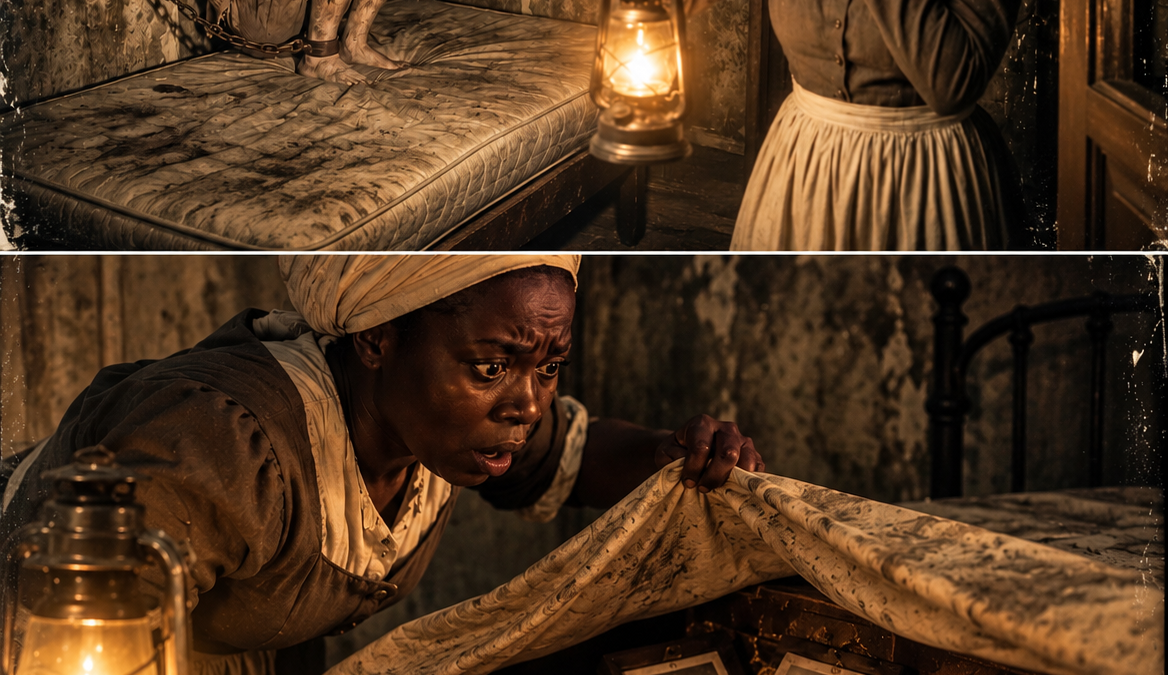
From the outside, the Ouro Verde farm was dazzling: the most expensive coffee, furniture brought from Europe, and the gleam of the silverware that blinded anyone entering the main hall. But look, behind that facade of perfection, the wood of the walls seemed to groan. It wasn’t the wind, no.
It was the weight of a secret that the family had kept for decades. Something so monstrous that the very ground seemed to want to open up and swallow that house. A ghost of flesh and blood locked in darkness so that the family charade could continue. Welcome to the Beyond Slavery channel. I am Bruno Henrique. Today I’m going to tell you a story about our people and our past.
But before we continue, subscribe to the channel, leave a like, and tell me in the comments where you’re from. I love knowing where each of you lives. Get ready, because the excitement begins now. This is the story of the woman who unearthed the dead son of her masters and used the truth to bring down an empire of lies.
The Ouro Verde or Guadalupe farm, as Colonel Horácio liked to boast in official documents, was the epitome of power. The colonel was a man of iron, you understand? of those who believe that the family name is sacred and that any stain must be erased, no matter the cost. And so Clementina, well, she was his mirror image, a woman who lived for appearances, obsessed with the purity of her lineage.
For her, beauty was a blessing, and imperfection was a punishment from God that needed to be hidden from the world. They had everything, land as far as the eye could see . The respect, or rather, the fear of the entire village. And an heir, Caio, who was the pride of the house, a strong, handsome young man , the future owner of everything.
But Mariana, Mariana knew that peace was a lie. She worked in the main house, cleaning up after others , and she had this habit of noticing details. She watched Clementina enter that room at the end of the corridor with a look of terror mixed with guilt. She could hear the whispers of Father Eusébio, who lived locked in his office with the colonel, talking about the burden that providence had sent.
What would that burden be? The people in the slave quarters spoke of hauntings, of tormented souls that cried at night. But Mariana didn’t believe in ghosts that ate, and she occasionally saw trays of food disappearing into that room. The farm’s routine was a well-rehearsed play. The colonel would order her to pretend to be a saint, and the priest would bless the lie.
It was a perfect machine. Driven by the sweat and blood of people like Mariana. But the truth is, you know how it is? The truth is like a plant that grows in the dark. She keeps forcing the stones until she finds a sliver of light. And Mariana was that crack. She was intelligent, she kept every word she overheard behind closed doors, every averted glance.
She knew that the colonel’s power was built on a graveyard of secrets. That afternoon, the silence in the house was absolute. The colonel had gone out to negotiate the sale of cattle. Aá was in the garden and the house, the house seemed to be holding its breath. Mariana had the bucket and the cloth, but her feet took her to a place where no one could go.
The hallway in the east wing was cold, even in the midday heat. The walls felt like they were squeezing us in, you know? And there, in the far end, was the dark oak door , the door that never opened. But on that day, due to human error, the maid’s tiredness as she carried the food, or perhaps a twist of fate, the key was there. Mariana stopped.
Her heart was beating so fast that she thought the gentlemen would hear it from the garden. She thought about going back. She knew that if she were caught, the punishment would be the worst of all. The colonel did not forgive anyone who rummaged through his drawers.
Imagine who was snooping around in your secrets. But curiosity, or rather, that sense of justice she carried in her heart, prevailed. She held out her hand. My hand was shaking, you know? Cold sweat trickled down his forehead. She turned the key. The sound of the creaking metal sounded like a cry for help when the door opened just a crack.
A smell, a smell of mold, of lack of sun, of a caged animal, came from inside. Mariana covered her mouth to avoid screaming. The room was dimly lit, but the light coming from the hallway illuminated a corner. And there, sitting on an old mattress, tied by a thin but sturdy chain, was a being that Mariana had never seen before.
He wasn’t a monster, as the legends said; he was a man, a young man. Her skin was pale, almost transparent, from being in the dark for so long. His eyes were large and frightened, and he tried to hide when he saw the light. Mariana took a step inside. The fear had vanished, giving way to a pain she had never felt before.
She looked at the boy’s face and for a second the world stopped. His features, his nose, the shape of his forehead were identical to the colonel’s, but the boy had something different, a facial deformity, a fragility in his body that made him unacceptable by the standards of those cruel people. At that moment, it dawned on Mariana.
That was no stranger; that was the firstborn son, who said he had died in childbirth. The rightful heir was buried alive inside his own house so as not to tarnish the family name. Mariana felt a lump in her throat. His terror, his terror was something that can’t even be explained. He didn’t speak, he only made soft sounds, as if he had forgotten how to be human.
And it was there, in that dirty room, looking at the son whom the masters had discarded as if he were trash, that Mariana understood that her life would never be the same again. She was no longer just a slave. She was the guardian of the truth that would destroy the green gold. When Mariana closed the door to that room, the sound of the latch seemed like a cannon shot in the silence of the east wing.
She leaned her back against the cold wood, her chest rising and falling, gasping for air. You know when the world seems to spin too slowly and you can’t process what you just saw? So it is. What was inside wasn’t a ghost, it wasn’t the evil thing that the older maids said inhabited the dark corners of Ouro Verde.
He was a young man, who must have been the same age as Caius, the perfect heir of the lords. But that boy, my God, he was the very image of pain. Mariana stood there motionless, her hands trembling so much that the cleaning bucket almost fell to the floor. She thought, or rather, she tried not to think about the seriousness of the situation.
If Clementina had dreamt that she had set foot there, if Colonel Horácio had imagined that the dirtiest secret of his lineage had been exposed to a domestic slave, her life wouldn’t have been worth a dried coffee bean . But what she saw wouldn’t leave her mind. That boy had the colonel’s eyes , the same tilt of his forehead, the same way of frowning.
But his face, his face was marked by a deformity that, in the sick minds of that elite, was a curse, a shame that needed to be erased. And that’s when Mariana remembered. She pulled from the depths of her memory the stories she heard in the slave quarters when she was a girl. They were talking about a difficult childbirth Sinhá had 20 years ago.
They said that the first child had been stillborn, that Father Eusébio had held a hasty burial in the middle of the night, without letting anyone see the little body. The coffin was closed. They always said it was to spare the mother suffering, but now the truth was screaming in the silence of that musty room. The dead man was alive.
The rightful heir was rotting away in a luxury cell, while his younger brother , Caio, paraded around like the prince of the valley. Can you feel the weight of this injustice? A human being, flesh and blood of that family, condemned to never see the sun, to never feel the wind on her face, just so that she could maintain the pose of the perfect woman.
It’s so cruel it makes your blood boil, doesn’t it? If you were also outraged by this cowardly act, leave your comment below. What would you do in Mariana’s place? Would she stay silent to save her own skin, or would she risk everything for this boy? Mariana went back to the kitchen, but her body was acting on autopilot.
She was washing the dishes, but she could see Oracinho’s pale face . She served coffee to the colonel and felt such profound disgust that her hands began to tingle. Colonel Horácio, with that posture of an upright man, a pillar of society, a man who allowed his own son to be treated worse than a beast of burden.
And so, ah, so, Clementina. She walked past Mariana wearing that expensive perfume, talking about morality and good manners, while carrying the key to that prison hanging from her waist, hidden beneath the folds of her silk dress. Mariana had a choice. She could have pretended that nothing happened.
He could have gone on with his life, lowered his head, and waited for time to pass. But Mariana had something that those gentlemen would never have. Humanity. That same night, as the big house plunged into the heavy silence of the early morning, she did not sleep. She took a piece of bread, a mug of fresh milk, and a piece of clean cloth. Her heart was like a drum beating in her chest.
Each plank that creaked beneath his feet sounded like a cry of betrayal. She went back to the room. The key was still there. Thus, in his arrogance, he thought that no one would dare to defy his orders. When Mariana entered, the boy shrank into the corner. He didn’t know what affection was, you understand? In his opinion, anyone who entered there brought either cold food or indifference.
But Mariana approached slowly. She didn’t say anything, she just held out the mug of milk. His eyes, oh, his eyes shone with such confusion that Mariana had to bite her lip to keep from crying right there. “Drink, my son,” she whispered, her voice faltering. “No one will hurt you today.” While he was drinking, his hands trembling, Mariana noticed a detail.
On his arm, near his elbow, he had a birthmark, a dark, crescent-shaped mark. It was the same mark that Clementina hid with her lace gloves and long sleeves. I no longer had any doubts. The proof was right there on his skin. That was their blood. The secret was real, and it was physical. From that day on, Mariana began to live a double life.
By day, she was the obedient slave, the shadow that cleaned the floor. At night, she was that boy’s only link to the world of the living. She brought him better food, she wiped his face, she talked about the trees, about the river, about how beautiful the sky looked when it was going to rain.
She was returning to him, drop by drop, the dignity that the colonel and his wife had stolen from him. But you know how it is? Keeping a secret of this magnitude inside a house full of eyes and ears is like trying to hold hot coals with your bare hand. Eventually , the smoke appears. Mariana began to notice that Mrs. Clementina was becoming suspicious.
She looked at Mariana in a different way, with a sharp gaze, as if she were trying to read what was hidden behind those downcast eyes. Father Eusébio also began to appear more frequently at the farm. He and the colonel would spend hours locked inside, talking in hushed tones, discussing solutions and the end of their suffering.
Mariana felt a chill down her spine. She knew what that meant. They were planning something. Perhaps he was becoming too ill, or perhaps his presence was becoming too great a risk. Now that Caio was about to take over the business. Mariana knew that their solution was anything but Christian. Her fear, her terror, was something that consumed her strength. She needed to act.
But how? A slave against a colonel, a woman, and a priest. The whole system was set up for her to lose. But Mariana had an advantage that they underestimated. She was not alone. In the slave quarters, the whispers began to take shape. She started talking to the older people, to people who remembered that night of the empty funeral.
She was piecing together a puzzle of pain and resilience. She knew that if she was to bring down that empire of lies, she would need more than courage. I would need the right moment, and that moment was approaching. Caio’s engagement to the Baron’s daughter was set.
It was going to be the biggest party the valley had ever seen. All the elite, all the powerful people would be there. The perfect stage for either a triumph or complete ruin. Mariana looked at Horacinho, who was now able to smile a little when he saw her arrive, and silently promised: “They won’t erase you. The world will know who you are.” That’s right, my friend.
Tensions at Ouro Verde were reaching a breaking point. It was like a rope stretched too tight, about to snap and whip anyone nearby. And Mariana, she was holding the end of that rope. Time, time is a funny beast, isn’t it? For those who are out in the sun, living life, it flies. But for those in the dark, forgotten by their own blood, each minute is an eternity that drags the chains across their soul. 20 years.
The little oracle spent 20 years in that room. Can you imagine what that is? Two decades without knowing what the sun’s warmth on their skin felt like, without seeing the green of the woods that gave the farm its name. Meanwhile, outside that oak door, life in Ouro Verde went on as if nothing had happened, as if the lie were the most solid truth in the world.
The contrast, oh, the contrast was heartbreaking . On one side of the house, Caio, the perfect heir. He grew up surrounded by pampering, learning to read with the best tutors, riding the most expensive horses. Being groomed to be the new king of coffee. Colonel Horácio looked at him with a pride that was almost disgusting.
Do you know why that pride was fueled by the sacrifice of the son he chose to erase? And so, Clementina paraded through the ballrooms in her silk dresses, hosting dinners, laughing with the other ladies of society, as if there wasn’t a piece of herself rotting away just a few feet away. It was a life of crystal, beautiful to behold, but one that any touch of truth could shatter.
And Mariana, Mariana was there in the middle of this silent hurricane. She now lived in two worlds. During the day, she served coffee to Caio, cleaned the colonel’s boots, and listened to Sha’s curt orders . But her thoughts were elsewhere in the east wing. She saw the hypocrisy in every gesture.
She saw Father Eusebio arriving for dinner, blessing the table, speaking of charity and love for one’s neighbor, while his eyes wandered down the forbidden corridor. Mariana felt a burning anger inside her. How can people who claim to be of God sleep soundly with such a crime under the same roof? Months went by and Mariana’s secret was becoming too heavy a burden.
She continued her nightly visits, bringing not only food, but humanity to Horacinho. She began to notice that he, despite everything, was intelligent. He understood what she was saying. He would cry when she told him about the world outside. And Mariana, she began to see the similarities becoming more and more striking.
The way he tilted his head when he was confused was exactly like the colonel’s. The birthmark on his arm, that crescent moon he had so fervently hidden, was still there, vividly visible on the boy’s pale skin. But the tension, the tension was reaching a point where the air seemed electrified. And then came that day, that day when almost everything went down the drain.
You know that chill that runs down your spine when you know death is near? Mariana was in Horacinho’s room. She had brought some leftover pumpkin jam from the kitchen, trying to bring a little joy to the boy. She was there, distracted, wiping his face with a damp cloth when she heard the sound. Tap, tap, tap.
The sound of high heels clicking on the hallway wood. It wasn’t the colonel’s heavy step, nor the hurried pace of the other maids. It was Siná Clementina’s firm, elegant, and deadly step . Mariana stopped, her heart stopped. Oracinho noticed the fear in her eyes and cowered, terror etched on that scarred face. The footsteps were getting closer.
The doorknob began to turn. Mariana had nowhere to run. The room was small, full of shadows, but with no hiding place. She squeezed herself behind an old, heavy curtain that covered a window boarded up . She held her breath. The silence was so absolute that she swore she could hear the sound of her blood rushing through her veins. The door opened.
The hallway light cut through the dimness of the room like a knife. That’s how she entered. Mariana could see her boss’s face through a small gap in the curtain. There was no love there, no longing, only disgust . Clementina looked at her son as if she were looking at an accounting error, at a plague in the plantation.
She left a tray with thin, cold soup on a rickety table. “Why don’t you just die already?” Like this! She whispered; her voice was like distilled poison. Why do you insist on being such a burden in my life? Mariana felt an urge to jump on that woman’s neck. The cruelty, the soullessness, it seemed inhuman.
So he took another look around. Suspicious. She sniffed the air. The smell of the pumpkin candy was still there. She frowned, took a step towards the curtain where Mariana was hiding. Time stood still. The mistress’s hand was outstretched, ready to pull the fabric, but then a scream came from below. It was the colonel calling for his wife.
Clementina stopped, huffed in irritation, and without looking back, left the room, locking the door again. Mariana collapsed to the ground. Sweat was running down his entire body. She looked at Horacinho and saw a tear running down his face. At that moment, Mariana understood that she couldn’t wait any longer .
The near-miss was the final warning. The young man’s health was failing, Shahá’s hatred was growing, and the family’s charade was about to be sealed with Caio’s marriage . The farm was in an uproar. The wedding to the Baron’s daughter was to take place in a few weeks. The colonel was spending a fortune. Father Eusebius was preparing the most beautiful sermon in history.
And so Assinha was at the height of her glory. But Mariana, Mariana was weaving a different web. She started talking to Sebastião, an old slave who looked after the stables and who was on the farm the night of the funeral. She needed allies. She needed people who had witnessed the lie being born to help the truth come to light. They killed the boy on paper, Mariana.
Old Sebastião said, his voice hoarse from years of silence. But the blood, the blood cries out from the earth, or rather, from the walls of that house. The urgency, the need to act, was like a fire that wouldn’t go out. Mariana knew that the trigger was coming. The wedding was n’t just going to be a party; it was going to be the final judgment of Ouro Verde.
And she, the silent visionary, was going to be the judge. Can you feel the pressure? Imagine living with that ticking time bomb in your hands, knowing that one wrong move means your death and the death of that innocent boy. If you’re rooting for Mariana, if you want to see this mask fall, don’t forget to subscribe to the channel.
Justice is slow in coming, but when it does, oh, it comes with the force of a storm. Caio’s wedding day. Look, I’ve seen a lot of beautiful parties in my life, but nothing compared to what Colonel Horácio put on at Ouro Verde. It was as if he wanted to use the gleam of those silver objects and the fragrance of those flowers to suffocate any trace of decay that might still linger in the air.
The elite of the valley were all there. Barons, commanders, madams with jewels worth more than the lives of 100 men. Everyone was laughing, drinking the finest wine, celebrating the union of the two most powerful families in the region. The sun was shining brightly, but to Mariana, that sun seemed like an executioner waiting for the right moment to strike.
The farm was a hive of activity, slaves running to and fro with trays, musicians tuning their instruments, Father Eusébio in his newest cassock, distributing smiles and blessings, as if his soul were pure. But behind all that joy , Mariana felt the weight of the key in her pocket. She had obtained the ultimate key. It was no longer a slip-up on Siná’s part; it was destiny delivering the tool of justice.
She looked at Siná Clementina, who was stunning in a blue silk dress, the very embodiment of purity and elegance, and felt a knot in her stomach. How can someone smile like that knowing that just a few meters away their own child was wasting away in the darkness? Mariana’s plan was dangerous; it was suicide, if you stop to think about it.
But she wasn’t thinking about her anymore. She looked at Horacinho, whom she had visited in the dead of night the previous night, and saw in him the image of all the oppressed, of all the secrets that the powerful try to bury. She knew that if Caio got married and claimed the inheritance, Horacinho’s fate would be death.
The colonel and his wife weren’t going to let that stain remain for much longer. It was now or never. The ceremony was about to begin in the great hall of the house. The altar was set up, the candles lit, and the scent of lilies was so strong it was almost dizzying. Caio was standing there proudly, waiting for his bride.
Colonel Horácio, standing beside him , looked like a king. But Mariana, Mariana wasn’t in the kitchen, she wasn’t serving wine. She was in the hallway of the east wing. She opened the door to the forbidden room. Oracinho cowered, startled by the brightness that streamed in, even though it was only the light from the torches in the hallway. Come, my son.
She said, her voice firmer than ever. Today you will meet your family. Today the world will know who you are. He was weak, you know? My legs were trembling. He could barely stand. Mariana practically had to carry him. It was a slow, painful journey. With each step they took down the hallway, it seemed as if the whole house trembled.
The music in the hall was getting louder. The sound of laughter, the clinking of crystal glasses. Mariana guided the pale young man, whose clothes she herself had tried to clean, but which still carried the smell of neglect. When they reached the side door of the main hall, Mariana paused for a second. She saw the glitz, she saw the hypocrisy in every face present there.
She saw Father Eusebio opening the Bible to begin the ceremony. Silence fell over the guests. It was a solemn moment. And it was in this silence that Mariana acted. She pushed open the double doors with all the strength she had. The crash of the doors slamming against the wall echoed like thunder. All heads turned at the same time.
At first, nobody understood. They only saw Mariana, a domestic slave, standing in the middle of the entrance. But then everyone’s eyes fell to the figure she was holding by the arm. The shock was immediate. It was as if the air had been sucked out of the room. Oracinho, blinking his eyes, dizzy from so much light and so many people, looked like an apparition.
His skin was a sickly white, his hair long and disheveled, his body too thin, but his face, ah, his face left no doubt. The silence that followed was the heaviest I’ve ever heard in the history of this country. Nobody was breathing. Colonel Horácio turned pale, the color draining from his face, as if he had witnessed his own death.
So Clementina let out a muffled cry, her hand going straight to her neck, where the birthmark was hidden under the lace. “What is that?”, someone in the back asked. The trembling voice. Mariana stepped forward, guiding the little prayer to the center of the hall, right in front of the altar, right in front of all the elite of the valley.
“This one,” Mariana said, and her voice was no longer the voice of a submissive slave, it was the voice of justice itself. This is Horácio Filho, the firstborn, the true heir to this house, whom you said was stillborn, but whom you kept locked up like an animal for 20 years. The murmur began quietly, like a swarm of bees.
Thus, Clementina tried to move forward. “Get that monster out of here!” she screamed in a hysterical voice, losing all pretense of being a lady. Mariana, you’ve gone mad. This is a setup. That being is nothing to me. But Mariana didn’t back down. She tugged at the boy’s sleeve, revealing his pale arm.
And there it was, the birthmark, the dark crescent moon, identical to Siná’s. “Look closely!” Mariana shouted, pointing to his arm and then to Siná. Look at the mark, look into his eyes. He has the colonel’s blood and the mark of Siná. They buried an empty coffin to hide what they called a curse, just to maintain the image of a perfect family.
Colonel Horácio tried to speak, but no sound came out. He looked at his son, the son he had condemned to oblivion. And what he saw was not a monster, he saw himself. He saw the crime he had committed against his own blood. He slumped into his chair, his eyes vacant, their authority vanished along with the spilled wine.
Caio, the younger brother, was in shock. He looked at Horacinho, then at his parents. And the truth began to burn in his mind. His entire life, all his wealth, his entire future. Everything was built upon the suffering of that young man who was now trembling in the middle of the hall. And Father Eusébio, oh, the priest, he tried to hide behind the altar, but Mariana pointed her finger at him too.
And the Father, the Lord who blessed the lie, the Lord who heard Sá’s confessions and said that the suffering of this innocent person was the will of God. The Lord is just as guilty as they are. The catharsis was total. The ladies began to walk away. The men whispered, glancing at each other with disdainful looks.
The mask of Ouro Verde hadn’t just fallen off, it had been crushed in front of everyone. So Clementina started laughing. A nervous laugh that gradually turned into uncontrollable crying. A delusion of someone who realizes they’ve lost everything. The image of perfection that she had spent 20 years building had vanished in 5 minutes.
Oracinho, amidst all of that, looked at Mariana. For the first time, he saw the sky through the large windows of the hall. He saw the green of the trees and, even though he was frightened, he smiled. A weak smile, but one that was worth more than all the colonel’s gold. Justice had been served not by the hand of the law, which at that time was blind to the crimes of the powerful, but by the hand of truth.
Mariana, the unnoticed slave, had brought down an empire of lies with a single act of courage. The silence of Ouro Verde had ended, and what came next, well, what came next would change the history of that valley forever. You know, after the dust settles and the shouting dies down, what remains is the weight of reality.
The party at Ouro Verde didn’t end with fireworks or toasts. It ended with the sound of carriages speeding away , with the clatter of jewels against the chests of ladies fleeing the house as if it were on fire. And in a way, it was. The flame of truth had been lit by Mariana. And he wasn’t going to stop until he had consumed every single beam of wood from that cursed farm.
What happened next? Wow, it’s spine- chilling. Thus Clementina, that woman who lived to be the center of attention, who couldn’t tolerate a single stain on her dress, couldn’t bear the weight of her own shattered mask. They say that in the days that followed, she could no longer look at herself in a mirror.
She saw in them not the beauty she had so carefully cultivated, but the face of the son she had tried to erase. She was losing her mind, you know? She began to wander through the corridors of the east wing, talking to herself, begging forgiveness from empty walls. Colonel Horácio. Well, he tried to use the money to quell the scandal, but his honor had gone up in smoke.
Business dwindled, friends disappeared, and he ended his days as a shadow, locked in his office, drinking to forget that, in the end , he was the jailer of his own blood. His arrogance and power were of no use in the face of the judgmental gaze of the entire village. And Father Eusébio, well, the cassock wasn’t enough to hide his complicity.
His church was empty. The people, even the simplest among them, understood that this man of God had used faith to seal the door of a prison. He was deposed, expelled from the community, and carried to the end the burden of knowing that he had chosen the side of the executioners instead of the side of the innocent.
But what about Mariana? And the little prayer. Ah, this is the part that makes us believe there is a higher justice. Oracinho was recognized. It wasn’t easy, of course. His body was battered. His mind needed time to understand what it meant to be free. But he never went back into the darkness again.
He came to live in the light, cared for by someone who truly had a soul. And what about Mariana? Mariana was no longer just a slave who saw too much. She became the guardian of that redemption. She gained her freedom, but she didn’t leave. She stayed to transform the gold into green. The farm, which was once a symbol of oppression and dirty secrets, began to change.
Mariana used her strength, her voice, and her wisdom to welcome others, to ensure that no other forbidden room existed in those lands. Can you imagine the strength of this woman? The weight of this secret, the courage to confront an empire of lies with only the truth in hand? Mariana teaches us that silence can be a weapon, but the voice, the voice is what liberates souls.
This story hurts, but it heals. She shows that evil may build castles, but the truth is the earthquake that brings them all down. The justice of fate may be slow, it may take 20 years, but it never gets the address wrong. Oracinho, who was born to be a secret, ended up being the light that exposed the darkness of his parents.
And Mariana, well, Mariana became a legend. Her name is still whispered in the valleys, like the woman who had the vision to see what no one wanted to see and the courage to say what no one dared to say. If this story of courage and redemption touched your heart, if you felt the indignation and relief of justice being served, I ask you to leave a like.
It’s a simple gesture, but one that helps honor the memory of so many women from Mariana who fought silently against cruelty. Comment below with the word “justice”. If you believe that, no matter how deep a secret is buried, the light always finds a way through. We’ll see each other in the next story, where the truth, however harsh it may be, will always be told.
Because as long as there is someone to listen, no secret will be safe. You know, there are things you can sense in the air long before you see them with your own eyes. It’s as if the environment is warning that something is wrong, that there’s a piece out of place in that machine of appearances. The Ouro Verde farm was like this. From the outside, it’s stunning.
The most expensive coffee, the furniture brought from Europe, the gleam of the silverware that blinded anyone who entered the main hall. But look, behind that facade of perfection, the wood of the walls seemed to groan. It wasn’t the wind, no. It was the weight of a secret that the family had kept for decades.
Something so monstrous that the very ground seemed to want to open up and swallow that house. And everything started to fall apart because of one detail, one oversight. Mariana, Mariana was the type of woman you wouldn’t think much of if you glanced at her quickly; quiet, head down, always with a dish towel on her shoulder.
But her eyes, oh my friend, those eyes missed nothing. She was the silent visionary of the slave quarters. Meanwhile, Clementina flaunted her arrogance through the hallways, while Mariana read the clues. She could tell when the plate of food left the kitchen and didn’t go to the masters’ table.
She noticed the trace of fear on the faces of the older maids as they passed near the east wing. And it was at the end of an afternoon, as the sun was setting and turning everything that blood-red color, that the unthinkable happened. Mariana entered the forbidden corridor. She shouldn’t have been there, you know? One more key.