Why Did the British Leave India in 1947? – The Real Story of Independence Day
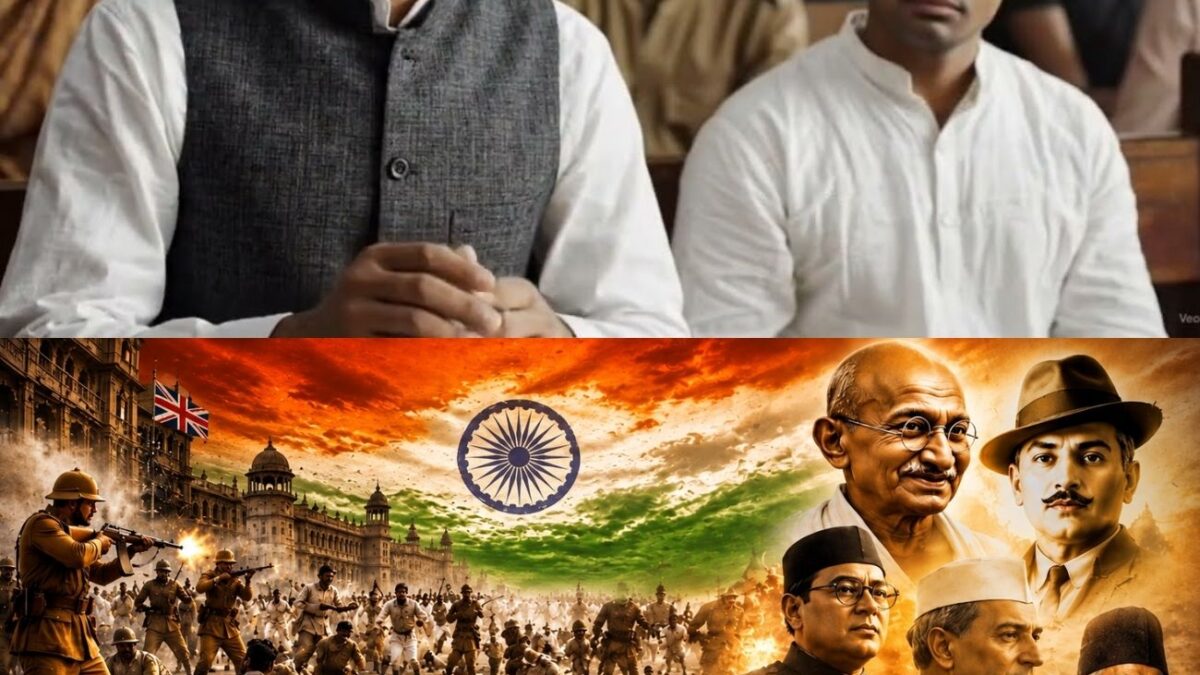
August 15, 1947, was a day India had been waiting for for decades. But one question remains just as significant today. Why did the British actually leave India? Why was the empire that had such a strong grip on India suddenly ready to retreat so quickly?
Was the only reason the pressure of the freedom movements? Or had something changed after the Second World War that altered the entire game? Because even in 1942, India was not independent. But just a few years later, Britain first spoke of transferring power by 1948 and
then decided to leave India in 1947 itself. Why such a hurry? And meanwhile , the situation in India was also changing. Movements were growing. Political confrontation was rising, and in 1946, the mutiny of the Indian Navy personnel also emerged. But was this
the only reason, or was there a chain of events spanning many years behind it that gradually weakened the British Raj’s grip? And then, when the British started to leave, was India just about to be independent or also about to be broken? After all, what happened
between 1857 and 1947 that brought India to that turning point? This is the true story of India’s independence. Think about it. A company that came to India to trade. That same company became so powerful after a few decades
that it had its own army, its own revenue, and control over a large part of India. But the question is, how did a private trading company become such a major political power? This story began in 1600 when the English East India Company received the right to trade
from England. Its goal in India was clear. Buy goods, sell them, and earn a profit. India was one of the world’s major trade hubs at that time. Textiles , spices, and other goods were exported far and wide. The company established its trading centers in different parts
of India. But by the 18th century, the political situation in India began to change rapidly. The central power of the Mughal Empire was weakening. Different regional powers were getting stronger, and European powers were also competing with each other for influence in India. In this changing environment,
the company realized one thing. If you have political power, your business can be much more secure, and that is where the company’s path began to change. Now , its goal was not just trade. It started increasing its influence in Indian politics as well. Then came the 1757 Battle of Plassey. The Nawab of
Bengal, Siraj-ud-Daulah, and the East India Company’s forces were face to face. After the Company’s victory, its influence on Bengal’s politics grew significantly. But the real change was yet to come. The Battle of Buxar took place in 1764. This time, the Company faced the combined forces of Nawab Mir
Qasim of Bengal, Nawab Shuja-ud-Daula of Awadh, and Mughal Emperor Shah Alam II. The Company won again. And the very next year, in 1765, Mughal Emperor Shah Alam granted the East India Company the Diwani of Bengal. This meant the right to collect revenue in Bengal, Bihar,
and Odisha. Now imagine, a company that once brought money from abroad to buy goods from India could now finance its expenses, army, and expansion with India’s own revenue. From here, the relationship between trade and power changed completely. First, the Company
had come to India to trade. Then, it built political influence. Then, revenue came into its hands, and with revenue, its military and political power grew rapidly. But as the Company became more powerful, the resistance against it also grew. The power of Indian rulers was being stripped away.
In many regions, discontent with the Company’s policies was rising, and resentment was also brewing within its own army. Until now, the Company felt that no one could challenge its power. But then 1857 came, and a large section of the very army that helped the Company maintain control over India
took up arms against it. This was not just a military mutiny. It raised a major question before the entire British rule. If the army of the company ruling India turns against it, can its rule over India remain the same ? 1857 did not provide an immediate
answer to this question, but it certainly shook the foundations of British rule. Before 1857, the East India Company was continuously increasing its strength. But its greatest strength was its army, and that army had a large number of Indian soldiers. The problem was that various
types of resentment were slowly growing among these soldiers. There was concern regarding new military policies and rules. Many soldiers feared that there could be interference with their religion and social practices. On the other hand, many Indian rulers and their supporters were also troubled by the Company’s expansion. There was
discontent regarding land and revenue policies in many areas. In other words, before 1857, the anger was not just in one place. Many different reasons were gradually accumulating. Then came the new cartridge for the Enfield rifle.
Soldiers had to bite off the tip of the cartridge before using it, and word spread that cow and pig fat had been used on them. This was a highly sensitive issue for Hindu and Muslim soldiers. The cartridge controversy became a major trigger for the resentment that already existed. And
then, on May 10, 1857, Indian soldiers in Meerut rebelled against their British officers. Jails were broken open. Their comrades were freed, and then the rebel soldiers marched toward Delhi. They reached Delhi the next day.
An elderly Mughal emperor was still present there. Bahadur Shah Zafar. He did not have the same political power as before, but his name held great weight. The rebels accepted him as their leader, and suddenly, a military revolt began turning into a major political challenge. The rebellion
spread beyond Delhi. In Kanpur, Nana Saheb came to the forefront. In Lucknow , the resistance grew strong. In Jhansi , Rani Lakshmibai fought the battle. In Bihar, leaders like Kunwar Singh emerged. But it is very important to understand one thing. All of India did not rise up against British rule at
once. In some regions, the rebellion was very strong. In other places, its impact was minimal, and many Indian rulers and groups even sided with the British. Yet, the threat to the Company was immense. Because a large part of the Indian Army, on which it relied to maintain its rule, was now standing
against it. British forces launched a counter-attack. Delhi was recaptured. In Kanpur, Lucknow, and other areas, British forces gradually regained control, and by 1858, the rebellion was suppressed. But the story did not end there. 1857 had made one thing very
clear to the British government. Continuing to govern India through the East India Company was no longer as secure as before. In 1858, the Company’s rule was ended. Now, the direct governance of India came into the hands of the British Crown. The Company was gone, but one question
remained. If such a massive rebellion had been suppressed, why didn’t the idea of freedom from the British die out in India? Rather, in the coming years, that same question was to return in a new form. The 1857 rebellion had been crushed. But there was one thing the British could not destroy. The
growing political awareness in India. The question was no longer just about which British policies were wrong. Gradually, a much bigger question began to emerge. Why can’t Indians make the decisions for India themselves? After 1857, a new educated Indian middle class was rapidly emerging. People were
reading newspapers. Public meetings were being held. Political ideas were gaining traction, and for the first time, people from different regions began to see each other’s problems as a larger national issue. Then came 1885, when the Indian National Congress was founded. However, the Congress’s
initial demand was not immediate independence. At that time, its early leaders wanted Indians to have more representation in government and administration. In other words, it started with a small question. But over time, the question grew bigger. If Indians can run their own country, why shouldn’t they have the full right to
make decisions for their own nation? And during this time, dissatisfaction with British policies was also growing. Then came 1905, when the British government partitioned Bengal. The government called it an administrative decision. But many Indian leaders and
citizens opposed it. They felt it could pave the way to divide the people and weaken political opposition. The protest intensified, and from this opposition, a new movement emerged. The Swadeshi movement. People were asked to boycott foreign goods and embrace Indian goods. Foreign clothes were
boycotted. Attempts were made to support Indian industries and local products. And most importantly, political protest was no longer limited to meetings of leaders. Students joined , merchants joined, women joined, and common people from various places began to be part of this movement. But not
everyone believed that petitions, meetings, and boycotts would end British rule. Some youths chose a revolutionary path. Secret organizations began to form. Some revolutionaries targeted British officials and government institutions.
They believed that the British Empire could not be removed just by making requests. In this way, different paths gradually began to appear within the freedom struggle. One path was political reforms and constitutional pressure, the second was Swadeshi and boycott, and the third was revolutionary action. But meanwhile,
another major change was taking place. The demand for independence in India was no longer meant to be limited to a few educated people. The fight had to reach those millions who worked in fields and factories. Those living in small towns and villages, who were still considered far removed from the
world of politics. Then in 1915, a person returned to India who was going to change the entire approach of this struggle. He believed that if common people stood together. If they stopped cooperating with the British system, even a massive empire could be
challenged. That person’s name was Mohandas Karamchand Gandhi, and now the Indian freedom struggle was no longer just going to be a battle for political leaders. It was slowly set to become the struggle of common Indians. When Gandhi returned to India in 1915, voices against the British were already
rising. The Congress existed and the Swadeshi movement had taken place. Revolutionaries were also active. But the biggest challenge of the freedom struggle remained the same. A vast majority of India’s population was not fully connected to this fight. Gandhi began his work from this very point. He did not launch a nationwide movement
immediately. First, he understood India . What were the farmers enduring? What were the workers ‘problems and how weak was the common man’s voice against the British system? Then came Champaran in 1917. Here, indigo farmers complained about being forced to grow indigo on
parts of their land and the issues linked to it. Gandhi reached out to the farmers. He listened to them, investigated, and when ordered to leave the region, he refused to go. It was a small step, but the message was huge.
By standing with a common man, the British authority could be openly challenged. In 1918, the farmers’ issue in Kheda came to light. Crops had failed and farmers wanted relief in revenue. Meanwhile, a labor dispute in Ahmedabad also surfaced. Gandhi’s
politics was now slowly reaching farmers and workers. But in 1919, the situation changed abruptly. The British government passed the Rowlatt Act. This gave the government powers like detention of political suspects without a normal trial. Gandhi gave a call for
a nationwide Satyagraha against it. But amidst the protests, the situation in Punjab worsened rapidly, and then came April 13, 1919, Amritsar’s Jallianwala Bagh. A large gathering had assembled there. British troops arrived there and opened fire on the people. Hundreds of
people were killed and injured. This incident shook the entire nation. Now the anger against British rule was no longer just political. A deep emotional anger had also been added to it. Gandhi realized that to challenge British rule , the movement could not be limited to just leaders. With this thought came
the 1920 Non-Cooperation Movement. The idea was simple. If the British government maintains its power with the cooperation of Indian society, then Indians could withdraw that cooperation . Boycotting government schools and institutions, boycotting foreign goods, returning British titles, and embracing
Swadeshi. Now, large numbers of common people began joining the freedom struggle. But this mass movement was also a major challenge. Keeping millions of people on the path of non-violence was not easy. Then in 1922 , violence broke out between protesters and police in Chauri Chaura. The police
station was set on fire and 22 policemen were killed. Gandhi withdrew the movement. Many were disappointed by this decision, but for Gandhi, the principle was clear. If the foundation of the movement is non-violence, then victory achieved by abandoning that principle was not the right path for him. A few years later, a freedom
struggle issue emerged once again that every Indian could understand. Salt. In 1930, Gandhi started the Salt March from Sabarmati Ashram to Dandi. Salt was a necessity for every person, and the British government had imposed laws and taxes on it. Therefore, challenging
the salt law was a step that every common Indian, from village to city, could understand. Reaching Dandi on April 6, 1930, Gandhi broke the salt law. After this, the Civil Disobedience Movement began to spread. People challenged British laws in different places, and the freedom struggle had
now reached a completely different stage. It was no longer just the political demand of a few leaders. Common Indians had themselves become a part of this fight. But at the same time, another line of thought was also strengthening. Some youths felt that it would not be possible to defeat the British Empire only through non-violence and peaceful protests, and
from this thinking, a completely different path was about to emerge in the freedom struggle with greater force . Gandhi’s movements had led millions of Indians to stand against British rule. But not every youth believed that the British would leave India solely through non-violence and peaceful protests. For some youths, the question
was: if you are facing an empire that has an army, police, and the entire government machinery, can it be challenged by protests alone? From this mindset, the revolutionary movement started gaining new strength. In the 1920s, several revolutionary groups were active. Among them, the Hindustan
Republican Association was also an important organization. Later it was named the Hindustan Socialist Republican Association, or HSRA, and in this revolutionary movement, one name was rising rapidly: Bhagat Singh. But to view Bhagat Singh only as a revolutionary who took up arms would be
to greatly diminish his entire story. He used to read books. He understood political ideas. He wrote and thought about socialism and revolution. For him , revolution did not just mean attacking British officers. He also spoke about a major transformation in society and the system. Then in 1928,
the Simon Commission came to India. There was no Indian member in this commission. There were protests against it all over the country. During a protest in Lahore, there was police action against Lala Lajpat Rai. Some time later, he passed away. This incident had a deep impact on the young revolutionaries. They planned to target
the British officer James Scott. But due to a case of mistaken identity, police officer J.P. Saunders was killed . Now, the British government intensified its crackdown on the revolutionary network. But the revolutionaries were not going to back down either. They decided to take a step whose purpose was not just to
attack, but to make their voices heard across the country. On April 8, 1929, at the Central Legislative Assembly, Bhagat Singh and Batukeshwar Dutt threw bombs inside the assembly. But after this, the two did not flee. They let themselves be arrested. Why? Because
now the court had become a new platform for them. They wanted to convey their ideas to the public. Then, another struggle began inside the jail. The revolutionaries went on a hunger strike against the treatment of prisoners. Their demand was that political prisoners should be treated better and with dignity. This hunger strike drew
the country’s attention to the struggle inside the jail, and then Jatin Das died during the hunger strike. His death created a deep emotional reaction in the country. Now, Bhagat Singh’s identity was no longer just that of an accused revolutionary. He had become a symbol of resistance and sacrifice for
thousands of youths. Then came the Lahore Conspiracy Case. Bhagat Singh, Sukhdev, and Rajguru were sentenced to death in the Saunders murder case, and all three were hanged on March 23, 1931 . They were very young. But their story
did not end with their deaths. Their names, their pictures, and their ideas spread even more among the youth of the country. It would not be correct to say that the revolutionaries alone ended British rule. India’s independence was the result of a very long and complex struggle. But the revolutionaries
certainly created a different kind of energy in the freedom movement. They posed a question to the youth. If the country is enslaved, is waiting the only way forward? And this very question gave a new direction to the freedom struggle. But now the story was not going to be limited only to India’s
politics. The world was heading toward a war that was going to change the very power of the British Empire. And this time, a new face of India’s freedom struggle was about to emerge. 1939 The Second World War began in Europe. But the impact of this war was also going
to fall on India. The British government dragged India into the war as well. But there was a big question: how could India be involved in the war without asking the Indian people? The Congress opposed this. Political tension began to rise. But at the same time, something else was happening.
Millions of Indian soldiers became part of the British war effort. They went to fight on different fronts, from Europe to Africa and Asia. India did not just provide soldiers. Resources and money were also used for the war. But as the war dragged on, the economic and
military pressure on Britain grew, and the demand for independence in India became stronger than ever. Then came 1942. Japan was advancing rapidly in Southeast Asia. The situation had become extremely critical for the British Empire. At this time, the
British government sent the Cripps Mission to gain political support in India. But the talks were not successful. And following this, a major movement began in India. The Quit India Movement. On August 8th, 1942, in Bombay, Congress passed the Quit India resolution against British rule. Gandhi
gave a clear message: Do or Die. The very next day, the British government arrested Gandhi and other top Congress leaders. But the movement did not stop. Protests and strikes took place in many places, underground networks were formed, and in some areas, government buildings and communication systems
were targeted. The British government suppressed the movement with force. But now, one thing had become clear. It was not easy to end the resistance against British rule in India just by arresting a few leaders. Yet, the British did not leave India in 1942. This is what makes
this entire story even more interesting . Because if Quit India was such a big movement, then why didn’t independence come in 1942? The answer was not just in India. The impact of World War II was now affecting Britain, and by the end of the war, Britain’s economic and
military situation would not be the same. The war ended in 1945. But the story of returning to India was about to become even bigger. Because after the war, the British government did not just have to face India’s political demands. It had to face a changed world
, and a new atmosphere had also been created in India. On one hand, the political conflict between the Congress and the Muslim League was growing. On the other hand, the story of Subhash Chandra Bose and the Indian National Army had impacted both the Indian public and the British government. And
then, news was about to come from one of British India’s most sensitive places, which made the question even more serious: if the British had to rely on Indian soldiers to save their rule, did those soldiers still have faith in the British Empire? When in India, Gandhi was challenging British
rule through the path of non-violence and mass movement. Then another leader believed that a completely different path was needed to remove British rule. His name was Subhash Chandra Bose. Bose was among the prominent leaders of the Congress. But differences between him
and other Congress leaders, including Gandhi, grew regarding the methods to achieve independence. After stepping down as Congress President in 1939, Bose formed the Forward Bloc. Then the Second World War began and Bose thought that if Britain was entangled in the war, this was perhaps the biggest
opportunity for India’s independence. He left India. He first reached Germany and then in 1943, arrived in Southeast Asia. There, he began working with the Indian National Army, or INA. The INA included a large number of Indian prisoners of war who had been captured
by Japan in Southeast Asia. Bose did not see this army merely as a military force. For him, it was a way to liberate India through an armed struggle. He established the Azad Hind Government. The INA, along with Japanese forces, participated in a
military advance towards British India. But this campaign was not successful. After the battles of Imphal and Kohima, the Japanese and INA forces had to retreat. Meaning, the INA could not defeat the British Empire militarily.
But the story did not end there. After the war ended in 1945, many INA soldiers were arrested by British authorities and then began the INA trials. These trials at Delhi’s Red Fort captured the attention of the entire country. The most interesting
thing was that the question was no longer just why these soldiers fought against the British Army. The question had also become, were these people traitors or soldiers fighting for India’s freedom? Despite the action against the INA, demonstrations and public campaigns in their support began
in many parts of India. The INA trials further ignited public sentiment and its effect was not limited to civilians only. The atmosphere inside the British Indian Armed Forces was also changing. In 1946, sailors of the Royal Indian Navy revolted against British
authorities in Bombay. This incident was separate. But the INA trials and the public anger generated around them were a part of the environment in which this revolt took place. Now, a very serious question stood before the British government. If they were to rule over millions of people in India,
the British government would have to rely on its armed forces. But if discontent was also growing among the Indian soldiers and sailors of those same forces, how long could British rule last? It was from here that the story began to reach a decisive turning point. Because by 1945, the demand for India’s independence was no longer
limited to just political meetings and protests. The war had weakened Britain. Quit India had demonstrated mass resistance against British rule. The INA had presented a different path of armed struggle. And now, discontent was becoming visible within the Indian Armed Forces as well. But did all this
mean that Britain could no longer continue its rule over India? The answer to this question began to emerge rapidly in the India of 1946. The Second World War had ended in 1945.
Britain had won the war. But it was no longer as strong as it once was. The war had placed a massive strain on its economy. Debt had risen, and now Britain also had to manage its own country’s economy. On the other hand, the demand for independence in India had become stronger than ever before.
The Quit India Movement had demonstrated mass resistance. The INA trials had generated a new political energy among the people. And in 1946, the revolt by the sailors of the Royal Indian Navy also erupted. This revolt did not last very long. But for the British government, its implications
were serious. To maintain its rule over India, the British government relied heavily on the Indian Armed Forces. If discontent began to grow within those very forces, maintaining control over such a large country could become even more difficult. But this was not the only problem. India’s politics were
also changing rapidly. Differences between the Congress and the Muslim League were growing. The question was no longer just when India would get independence. The question was also what would be India’s political future after independence. In 1946, the British government sent the Cabinet
Mission to India. Its goal was to find a way between the Congress, Muslim League, and other political forces to transfer power to Indians and reach an agreement on India’s constitutional future. A lot of negotiations took place. A plan was also put forward. But
the differences between the Congress and the Muslim League could not be resolved, and with this, India’s political crisis deepened further. Communal tensions were also rising. Violence occurred in many places. Now the British government was facing a difficult situation. If the transfer of power was delayed, conflict within
India could increase further. But if the transfer of power was done quickly, would India be able to stay together? Then came February 20, 1947. British Prime Minister Clement Attlee announced that it was the British government’s
intention to complete the transfer of power in India by June 1948. Meaning, for the first time, a clear deadline was now in place. But at that time, no one knew that even this deadline would prove to be too far off. A few days later, it was decided to send Lord
Mountbatten as the new Viceroy of India . He was given a very difficult task. Ending British rule and transferring power. But the biggest question before him was, could power be handed over to a united India? Or was the growing conflict between the Congress and the
Muslim League leading India toward a partition? After Mountbatten’s arrival, the situation began to change rapidly, and the transfer that was to happen by June 1948 was suddenly going to take place more than a year earlier. But why such a rush? Was it just the wish of
the British government, or had the political and communal situation within India forced them to make a quick decision? Because now, India’s independence was not just close. Its date was about to be set. On February 20, 1947, the British government had said that the transfer of power in
India would be completed by June 1948. But within a few months, this date was to change, and behind it was not just London’s decision. The political situation inside India was deteriorating rapidly. An agreement could not be reached between the Congress and the Muslim League. The
demand for partition had become strong, and communal violence in many places had made the situation even more difficult. Then came June 3, 1947. The British government presented the plan for the partition of India and the transfer of power. Now the path for the creation of India and Pakistan was
clear. And most importantly, instead of delaying the transfer of power until June 1948, it was brought forward to August 1947. That is, the independence deadline that was just stated as 1948 was going to arrive in just a few months. But one more big question was
looming. If India was to be divided so quickly, where would the new boundary be? Which city would go to India? Which would go to Pakistan, whose house would remain on which side, and how would millions of people know which country their home had suddenly become a part of? The responsibility of deciding this
boundary was given to Sir Cyril Radcliffe. He had very little prior knowledge about India, and he had to determine the new boundaries of Punjab and Bengal in a very short time. But this was not just a job of drawing a line on a map. On one side of that line was a home, on the other was a new
country, and this decision was going to impact the lives of millions. Then, August 15, 1947, arrived. Preparations for independence were underway in Delhi . But in many areas of Punjab and Bengal, people didn’t even know yet where the final boundary would be. And
when that boundary was revealed, a new history began. India had become independent. But with that very independence came a partition that forced millions of people to leave their homes. August 15, 1947. India had become independent. But that morning,
the story was not the same for every Indian. Many people were celebrating independence. Tricolors were waving, and a new India was being born in Delhi . But in many parts of Punjab and Bengal, people faced a completely different reality. Because the final
boundary of the country that was being partitioned had not yet been officially revealed. The Boundary Commission was tasked with dividing Punjab and Bengal. And this boundary was announced on August 17, 1947. That is, two days after India and Pakistan became independent. This meant people were
celebrating independence. But many did not even know which country their home would fall into. Then the boundary was revealed, and millions had to leave their homes. Hindus and Sikhs started moving from Pakistan towards India.
Muslims started moving from India towards Pakistan. Many people could only carry as much as they could hold in their hands. Some left their homes. Some left their shops, some their land, and some their entire former lives. But
this migration was not always peaceful. Terrifying communal violence spread in many areas. People were leaving their homes out of fear. Refugees, trains, and long convoys began to appear. Millions were trying to reach a new country. This was not just a story of
changing borders. It was an event that changed the lives of millions, and amidst all this, India saw its first morning as a new nation. Around the midnight of August 14 and 15, the historic moment of the transfer of power came in the Constituent Assembly.
Jawaharlal Nehru delivered his famous speech for independent India. And just a few hours later, India stepped into a new era with its new identity. Nearly 200 years of British rule had come to an end. But with independence came a price that future generations would
remember for a long time. So, was India’s independence just the story of the end of the British Empire? No. It was the story of that long struggle in which different people, from farmers to workers, political leaders to revolutionaries, and soldiers to common
citizens, all played their part. 1857 provided the first major challenge to British rule. Nationalism gave people a political identity. Gandhi connected millions to the struggle through mass movements. Revolutionaries sparked a different kind of resistance among the
youth. The Second World War weakened Britain. The INA and the 1946 military unrest created new concerns for British authorities. And finally, Britain withdrew its power from India. But at the final stage of independence, India was divided into two nations. On one
side was the birth of a new independent India, and on the other, the separation and exodus of millions, a tragedy whose memory is still part of history today. Therefore, viewing August 15, 1947, as just a date would be to oversimplify this entire story. Because on that day,
India became free. And at the same time , history changed India forever. So now , let’s return to the same question. Why did the British leave India after all? Was it just because of Gandhi? Was it just because of 1857? Was it just
because of Bhagat Singh and the revolutionaries? Or was it just because of the Second World War? The truth is that India did not become independent due to any one of these reasons. It was a long chain of events unfolding over many decades. 1857 had shown that a
major resistance against British rule could arise. Following this, nationalism gradually strengthened. The Congress and other political movements advanced the demand for self-government . Gandhi’s movements brought millions of common Indians against British rule.
The revolutionaries instilled a different sense of resistance among the youth. Then the Second World War put immense pressure on Britain’s economic and military strength, and the post-war political situation in India was no longer the same. The INA trials
influenced public opinion. In 1946, the Royal Indian Navy revolt created further concern for British authorities . Now, the question before Britain was not just how to control India. The question was also whether maintaining
control over India was even practical or sustainable anymore. At the same time, the political deadlock between the Congress and the Muslim League was growing. Communal tensions and violence made the situation even more difficult.
The British government finally decided to transfer power. But no path could be found to hand over power to a united India. And then in 1947, British rule ended. India became independent, but with partition. That is why calling
India’s independence the victory of any one person, any one movement, or any one event does not tell the whole story . It was a long process. It included resistance, political struggle, mass movements, revolutionary ideas, the impact of war, and finally, a British
Empire that was no longer in a position to maintain its former control over India. On August 15, 1947, the British flag was lowered, and independent India began its new journey. But perhaps the
biggest takeaway from this entire story is that freedom did not come suddenly in just one day. August 15 was simply the day when the biggest chapter of that long story, spanning several decades, came to an end and the story of a new India began.